On the hot afternoon of August 16, 1956, a couple of utility workers sat in their truck in Placerita Canyon, about an hour north of Los Angeles, California, and finished their lunches. It was a hot afternoon, and it was stuffy in the truck, so they decided to go sit in the shade of one of big oak trees there in the canyon.
No soon had they sat down, than their utility truck exploded in a ball of flame. Thank goodness neither man was hurt. They stared at the truck’s smoldering remains, completely baffled by what had blown it up.
Little did they know that, 30,000 feet above them, raged one of the strangest air battles fought in history, and the only one fought over American soil. The Battle of Palmdale.
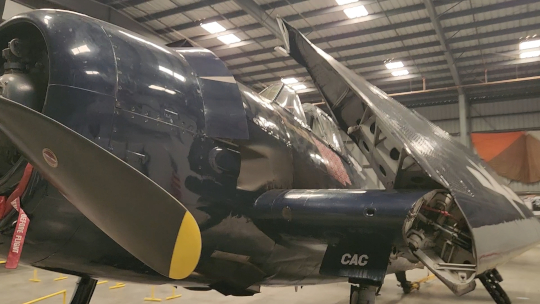
Earlier in the day, the Navy had launched an old Grumman F6F5 Hellcat, a propellor-driven remnant from WWII, from Naval Air Station Point Mugu. You can find a beautifully restored Hellcat at the Commemorative Air Force, SoCal Wing museum in Camarillo. The one launched by the Navy was painted bright orange to signify that she was a radio-controlled drone, with no pilot. Her mission was to get blown out of the sky as a target for the naval air station’s missile-practice.
But the old bird seemed to have a mind of her own. Not long after she crossed the coastline and headed out over the Pacific, her radio stopped communicating. With no instructions, she started a gentle left turn and headed southeast towards Los Angeles.
The Navy didn’t have any fighter resources available at Point Mugu at the moment, so they called for help to the Oxnard Air Force Base, just five miles up the road.
The Air Force, always eager to show up the Navy, dispatched two Northrop F-89D Scorpion jets to take out the errant Hellcat.
The Scorpions were state-of-the-art, front-line defenders at the time, armed with a brand-new weapon system – each brandished 104 Mighty Mouse 2.75 inch diameter missiles arrayed in 52-missile drums on the wingtips. Although the missiles were unguided, the jets featured an advanced, radar-driven targeting system.
The old Hellcat buzzed northeast of Los Angeles, out towards the desert communities of Castaic and Palmdale. It was over the rugged San Gabriel mountains that the battle began.
Because the Hellcat was now making a gentle right turn, the fighter pilots decided to take it out from the side rather than follow it around the circle – it was an easier shot for the radars. They let go a barrage of missiles. Or, attempted to. Neither of their radar-guided systems functioned correctly, and none of the combined 208 missiles was fired.
Frustrated, the pilots decided to take on the Hellcat old-school, using gunsights. But the gunsights had been removed from the F-89s because the radar system made them superfluous, so they couldn’t manually aim the missiles, either.
Finally, they did what any fighter pilot would do: point the jet at the Hellcat and let the missiles fly.
One, possibly two missiles bumped under the Hellcat’s fuselage, but didn’t explode. The other 202 missiles went wide and fell like explosive hailstones on the mountains below.
The resulting brushfires burned over 150 acres and took two days to put out. One missile blew shrapnel into a woman’s kitchen cupboard. One knocked out the right front tire of a car traveling on Highway 138. And one missile scored a direct hit on that utility truck in Placerita Canyon.
With no guns, no missiles, and no hits, the F-89s were forced to return to Oxnard, low on fuel.
The Hellcat, finally running out of gas, gently descended over Palmdale, clipped three power lines, and exploded on the desert floor just beyond Palmdale.
The two utility guys had to thumb a ride back to their shop, absolutely baffled by the destruction of their truck. You can just imagine how they explained it to their boss.
You can learn more about the Battle of Palmdale by visiting the Commemorative Air Force SoCal Wing in Camarillo.
 Marvelous Air Museums
Could not have said it better. Well done, young fella!
LikeLike