A Hot Day in the Desert

On the hot afternoon of August 16, 1956, a couple of utility workers sat in their truck in Placerita Canyon, about an hour north of Los Angeles, California, and finished their lunches. It was a hot afternoon, and it was stuffy in the truck, so they decided to go sit in the shade of one of big oak trees there in the canyon.

No soon had they sat down, than their utility truck exploded in a ball of flame. Thank goodness neither man was hurt. They stared at the truck’s smoldering remains, completely baffled by what had blown it up.

Little did they know that, 30,000 feet above them, raged one of the strangest air battles fought in history, and the only one fought over American soil. The Battle of Palmdale.

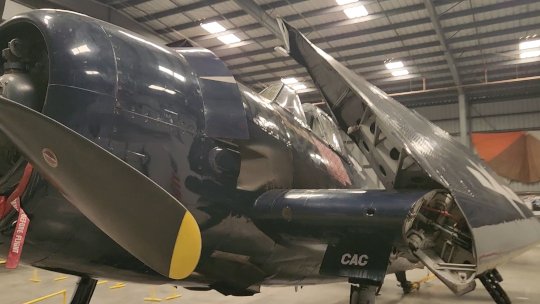
Earlier in the day, the Navy had launched an old Grumman F6F5 Hellcat, a propellor-driven remnant from WWII, from Naval Air Station Point Mugu. You can find a beautifully restored Hellcat at the Commemorative Air Force, SoCal Wing museum in Camarillo. The one launched by the Navy was painted bright orange to signify that she was a radio-controlled drone, with no pilot. Her mission was to get blown out of the sky as a target for the naval air station’s missile-practice.

But the old bird seemed to have a mind of her own. Not long after she crossed the coastline and headed out over the Pacific, her radio stopped communicating. With no instructions, she started a gentle left turn and headed southeast towards Los Angeles.

The Navy didn’t have any fighter resources available at Point Mugu at the moment, so they called for help to the Oxnard Air Force Base, just five miles up the road.

The Air Force, always eager to show up the Navy, dispatched two Northrop F-89D Scorpion jets to take out the errant Hellcat.

The Scorpions were state-of-the-art, front-line defenders at the time, armed with a brand-new weapon system – each brandished 104 Mighty Mouse 2.75 inch diameter missiles arrayed in 52-missile drums on the wingtips. Although the missiles were unguided, the jets featured an advanced, radar-driven targeting system.

The old Hellcat buzzed northeast of Los Angeles, out towards the desert communities of Castaic and Palmdale. It was over the rugged San Gabriel mountains that the battle began.

Because the Hellcat was now making a gentle right turn, the fighter pilots decided to take it out from the side rather than follow it around the circle – it was an easier shot for the radars. They let go a barrage of missiles. Or, attempted to. Neither of their radar-guided systems functioned correctly, and none of the combined 208 missiles was fired.

Frustrated, the pilots decided to take on the Hellcat old-school, using gunsights. But the gunsights had been removed from the F-89s because the radar system made them superfluous, so they couldn’t manually aim the missiles, either.

Finally, they did what any fighter pilot would do: point the jet at the Hellcat and let the missiles fly.

One, possibly two missiles bumped under the Hellcat’s fuselage, but didn’t explode. The other 202 missiles went wide and fell like explosive hailstones on the mountains below.

The resulting brushfires burned over 150 acres and took two days to put out. One missile blew shrapnel into a woman’s kitchen cupboard. One knocked out the right front tire of a car traveling on Highway 138. And one missile scored a direct hit on that utility truck in Placerita Canyon.

With no guns, no missiles, and no hits, the F-89s were forced to return to Oxnard, low on fuel.

The Hellcat, finally running out of gas, gently descended over Palmdale, clipped three power lines, and exploded on the desert floor just beyond Palmdale.

The two utility guys had to thumb a ride back to their shop, absolutely baffled by the destruction of their truck. You can just imagine how they explained it to their boss.

You can learn more about the Battle of Palmdale by visiting the Commemorative Air Force SoCal Wing in Camarillo.

Marvelous Air Museums is part of the John D Reinhart content family. Writer, illustrator, videographer, and accidental filmmaker — find the whole story at JohnDReinhart.com.

©2026 John D Reinhart/MarvelousAirMuseums.com – all rights reserved
Never Quote Me the Odds

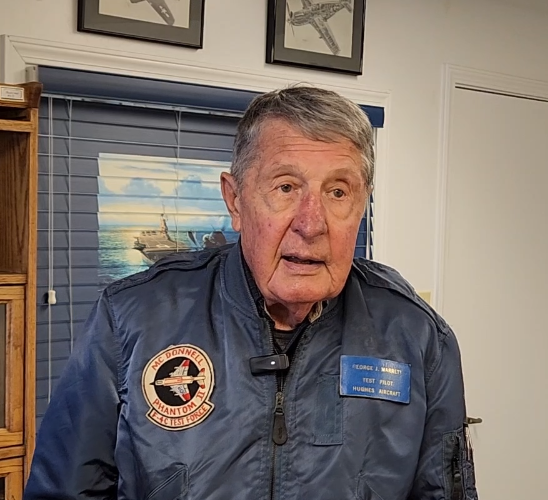
George J. Marrett is the historian at the Estrella Warbirds Museum in Paso Robles, CA. An amazing individual, he worked for Howard Hughes, has written at least half a dozen books, has test-flown nearly every jet the United States produced since World War II, flew death-defying rescue missions in Vietnam, is building homeless shelters in Paso Robles, and happens to be just about the nicest guy you’re ever going to meet.

My wife and I spent a nice trio of hours talking with him about the museum, about Howard Hughes, and about the many aircraft he’d test-flown. The man is remarkably sharp, and, at 88, still flies. He said he’d keep flying until nobody wanted to fly with him anymore.

So many of the stories he told stuck with me, but there was one in particular that I’m still pondering.

During the Vietnam war, he flew fourth position in a flight of four A-1E Skyraiders – big, propellor-driven fighter planes produced right after the end of World War II. They were slow compared to the jet fighters, but they were robust, and they carried lots of weapons.

His job, along with the other three Skyraiders, was to clear the jungle around a downed American pilot by firing at the Viet Cong soldiers intent on making a capture, so that the Huey helicopters could come in rescue him. The big fighter planes would lumber over the jungle, firing a spray of machine gun bullets at anything that moved towards the downed pilot.

The Viet Cong often fought back. In one flight, George watched the plane in front of him get hit, watched the pilot parachute away, and then actually watched the plane spiral down to crash among the trees.

“It was an amazing sight,” he grinned. He had inadvertently applied the air brakes in his own plane, called Sock It to ‘Em , and was flying too slow to be safe. But it gave him time to watch the crash.

When he returned to base, his crew chief, the guy who takes care of the plane when it’s on the ground, told him he’d been hit.

“You got a couple of bullet holes in the wheel well,” the chief said. “You wanna see ’em?”

George thought about it for a moment, and then said “No. Don’t even tell me that.”

Focus on the success, right? Let’s not recount how close we almost got to failure. His first book, the one about those rescue missions, is called Cheating Death.

That’s a profound way to look at high-risk tasks, isn’t it?

It reminds of the Star Wars line when C-3PO starts to tell Han Solo his chances of success…

“Never quote me the odds!”

Focus on where you’re going, not where you’ve been. I know George may have meant something far more profound that this, but we always apply the things we hear to ourselves, right?

So, when you’re taking a risk, and you hear that voice that starts to doubt the odds of your success, now you have an answer.

“Don’t tell me that. Never quote me the odds.”

You can learn more about the amazing George J. Marrett on Wikipedia and his many books on Amazon. And more about the impressive Estrella Warbirds Museum right here at California Air Museums.

Happy flying.

Marvelous Air Museums is part of the John D Reinhart content family. Writer, illustrator, videographer, and accidental filmmaker — find the whole story at JohnDReinhart.com.

©2026 John D Reinhart/MarvelousAirMuseums.com – all rights reserved
One Motor, Many Planes

The Southern California Wing of the Commemorative Air Force features a number of spectacular pieces of World War II flying history. 

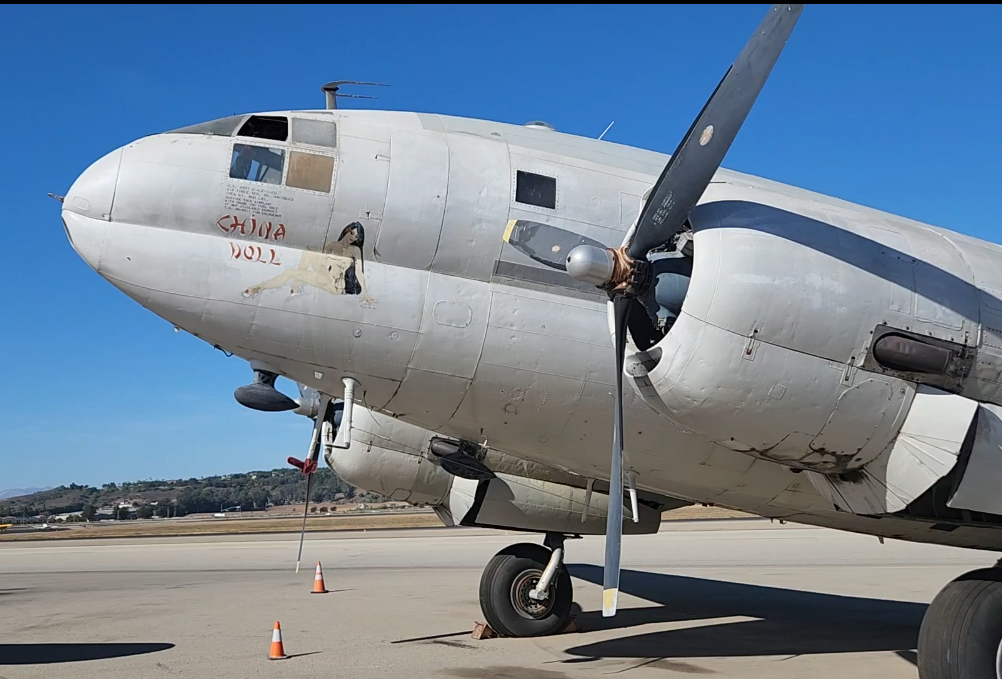
Their first acquisition was the massive Curtiss C-46 Commando, the largest twin-engine plane built by the allies during the war. 

The pride of their fleet is the North American PBJ maritime patrol bomber, the very last PBJ that still flies. 

And the museum is quite proud of its beautiful Grumman F6F Hellcat fighter, an immensely important carrier airplane from WWII. 

Although these three planes carried out vastly different missions, were built by completely different companies, and were operated by two different branches of the military, they all have one thing in common: the Wright R-2600 Twin Cyclone engine.

The R-2600 Twin-Cyclone is a 14-cylinder radial engine – where your car has 4, 6, or 8 cylinders arrayed in a line or a Vee, the radial’s 14 cylinders are arrayed in a circle around the engine’s crankshaft. It’s a big motor that weighs about a ton. 

One of the advantages to this rotary layout is the power it achieves. Where your Toyota Camry cranks out about 200 horsepower, and a new Dodge Charger pushes out less than 300, the R-2600 generates a whopping 1,800 horsepower.

Another advantage is that these engines are air-cooled, like in a VW bug. Standard engines have a radiator full of coolant.  A radial engine does away that, using passing air as coolant. They look different, with those big, finned cylinder heads, because they need a lot of air to stay cool. 

Our story gets interesting because the R-2600 engine was developed specifically for the Curtiss C-46 Commando. Wright, the engine manufacturer, was a division of Curtiss-Wright, the maker of the Commando.

The engine proved to be robust, and quickly became a huge success among aircraft manufacturers. 

In fact, North American Aviation put them into their new B-25 and PBJ bombers, the last of which is the pride of the CAF fleet. 

And Grumman Aircraft Engineering put them into their new F6F Hellcat fighters.

When installed in the PBJ bomber, the two R-2600s could move the 18,000 pound airplane at 245 mph on its bombing runs against Axis submarines and warships.

In the much heavier, 48,000 pound C-46 Commando, the engines pushed her along at 135 miles per hour over the Himalayas and into China to thwart the Japanese invasion there.

That same engine, when mounted in the much lighter, 8,100 pound Grumman F6F Hellcat, gave the pilot a brisk 376 miles per hour in dogfighting Japanese Zeroes to defend the American carrier fleet.

Three different airplanes. Three widely different roles. One engine.

Curtiss eventually opted to fit the C-46 Commando with the even more powerful Pratt & Whitney R-2800 Double-Wasp, 18-cylinder engines, which are what you’ll find on the China Doll. 

Interestingly, Grumman also moved up to the 2,000 horsepower Double Wasp for the Hellcat, and that’s what you’ll find on display in Camarillo. 

The PBJ still features the original Wright R-2600s.

In the annals of WWII aviation history, each of these three aircraft was a standout performer, contributing more than their share in defeating the global threat to democracy.

And all three of those airplanes, among literally dozens of others, got their start on the historic Wright R-2600 Twin Cyclone radial engine. 

Marvelous Air Museums is part of the John D Reinhart content family. Writer, illustrator, videographer, and accidental filmmaker — find the whole story at JohnDReinhart.com.

©2026 John D Reinhart/MarvelousAirMuseums.com – all rights reserved