Intrepid Museum

We braved the wind and the waves to visit the Intrepid Museum, an aviation and space museum housed within the aircraft carrier USS Intrepid, a massive World War II, Korean War, and Vietnam War veteran.

Commissioned in 1943, Intrepid was the fifth of the 24 Essex class carriers built during World War Two. Her squadrons fought in several critical campaigns, including the Mariannas, Truk, and Leyte Gulf. Her Curtiss SB2C Helldivers scored a hit on the mighty Yamato, the biggest battleship in the world, and were instrumental in sinking the Musashi, Yamato’s deadly sister ship. 

As remarkable as that is, the Fighting I also survived not one, not two, but four kamikaze attacks. This US Navy photograph depicts the frightening reality of a kamikaze strike, and the heroism and bravery of the sailors fighting to overcome the damage. 

Intrepid is all about heroism and bravery. Her long hanger deck features models and movies and memorabilia from her extensive and memorable career. 

The hanger deck is where you encounter the first piece of Intrepid’s aviation history, in the form of this beautifully maintained and restored Chance Vought FG1D Corsair, an F4-U built under license by Goodyear. She bears the markings of ensign Alfred Lerch, an Intrepid pilot who earned the Navy Cross for shooting down seven Imperial Japanese airplanes in one day, making him an instant ace.

Just astern of the Corsair you’ll find the huge Grumman TBM-3 Avenger flown by president George H.W. Bush during World War II. Although the wings are folded for on-deck storage, there’s no mistaking that huge seventeen-hundred horsepower Wright 14-cylinder radial engine. With a wingspan of 54 feet, these guys were the big heroes at the battle of Leyte Gulf.

Astern of the giant Avenger you’ll find a North American FJ-2 – a variant of the Korean-war era F-86 Saber Jet specialized for carrier duty. Land or sea, there’s no escaping the beautiful design of these potent jet fighters.

And neither can you forget the McDonnell/Douglas A-4B Skyhawk, the workhorse of the Vietnam War. This early example flew from the Intrepid between 1966 and 1969.

As the shuttle Enterprise exhibit was closed during our excursion, we made our way up to the gusty flight deck. Up here is where you’ll find the bulk of the Intrepid Museum’s excellent aircraft collection. 

There’s a beautifully restored NASA Northrup T-38 Talon trainer parked right next door to a Polish-built MIG-17. There’s a nice collection of helicopters, starting with a rare Sikorsky HH-52 Sea Guard and ending with an Army Bell UH-1 Iroquois. That’s a Bell AH-1J twin-engined Sea Cobra wedged in the middle . 

The collection of jets is truly impressive and includes the first production model of the Lockheed A-12, the attack version of the fabled SR-71 Blackbird.

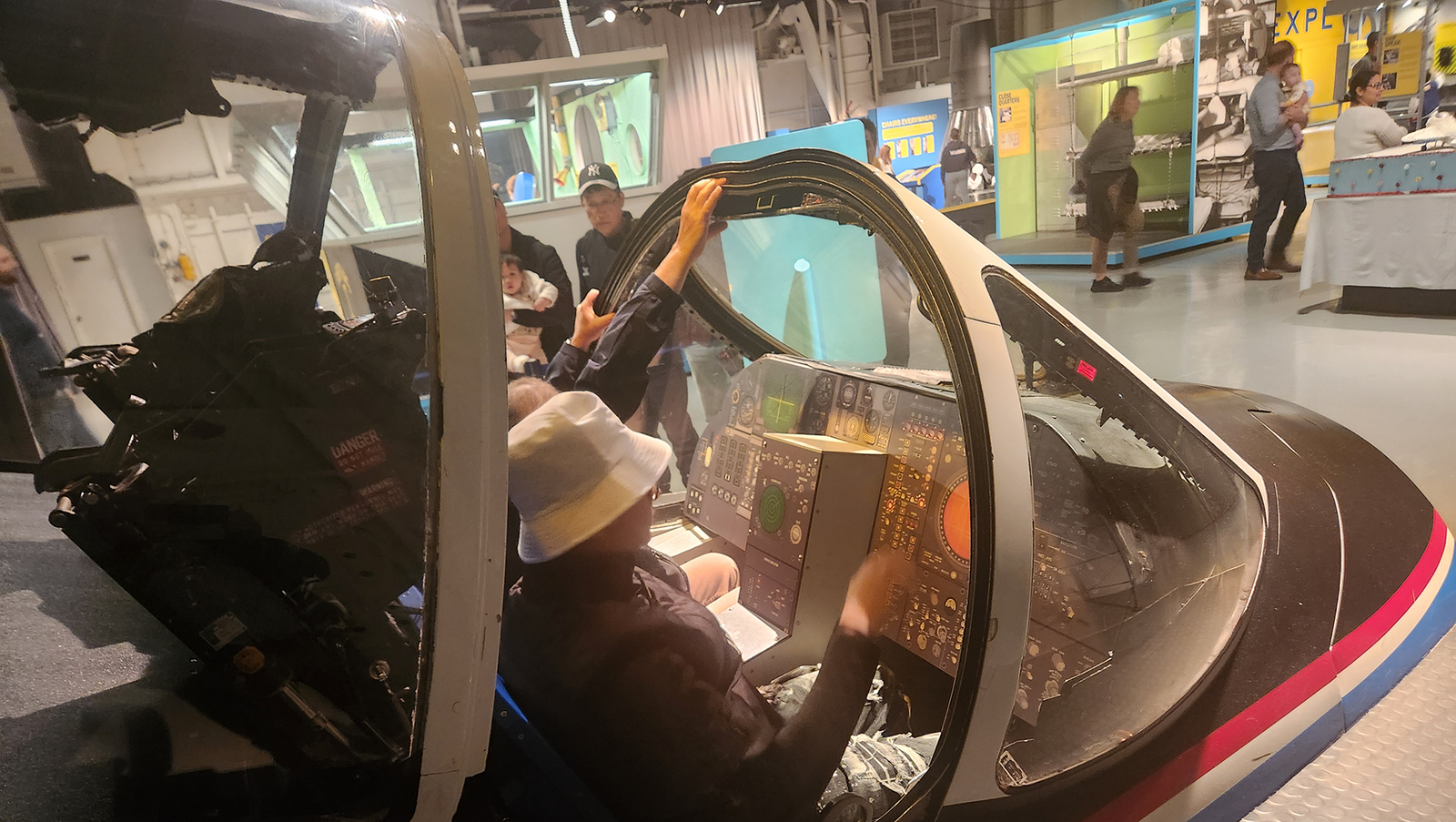
There’s a lot to see aboard Intrepid, from the spaceflight display to a ride-in A-6 cockpit mockup. 

Once you’ve seen all that, you’ll find two more surprises waiting right outside.

The first is the USS Growler, a World-War-II era diesel-electric submarine armed with Regulus cruise missiles. A nuclear deterrent vessel, the missiles were stored in those enormous tubes on the after deck.

The other big surprise is the BOAC Concorde sitting on the dock. Of the 20 built, this Concorde logged the most flight time. Compared to a 747, this lithe little ship is positively tiny!

I keep saying there’s a lot to see at the Intrepid Museum, but that’s a huge understatement. If you’re in the New York area, you owe it to yourself to check out this awesome and awe-inspiring seagoing museum.

You can watch the video of our adventure here.

Marvelous Air Museums is part of the John D Reinhart content family. Writer, illustrator, videographer, and accidental filmmaker — find the whole story at JohnDReinhart.com.

©2026 John D Reinhart/MarvelousAirMuseums.com – all rights reserved
Joe Davies Heritage Airpark

Today we hit the high desert to visit the Joe Davies Heritage Airpark in Palmdale. 

Although the open-air museum is free, it’s jam-packed with a priceless collection of beautiful and important airplanes.

The park is owned by the City of Palmdale. It’s named after Joe Davies, a local who commanded Building 42 in the mid-60’s, in the heart of the Skunkworks days, and also served as a city councilman.

To get in, you have to walk right down the maw of a huge jet-engine intake. It’s cool, because it’s actually two intake fairings mounted back-to-back.

Once inside, you’ll be amazed at the sheer number, and quality, of the planes on display.

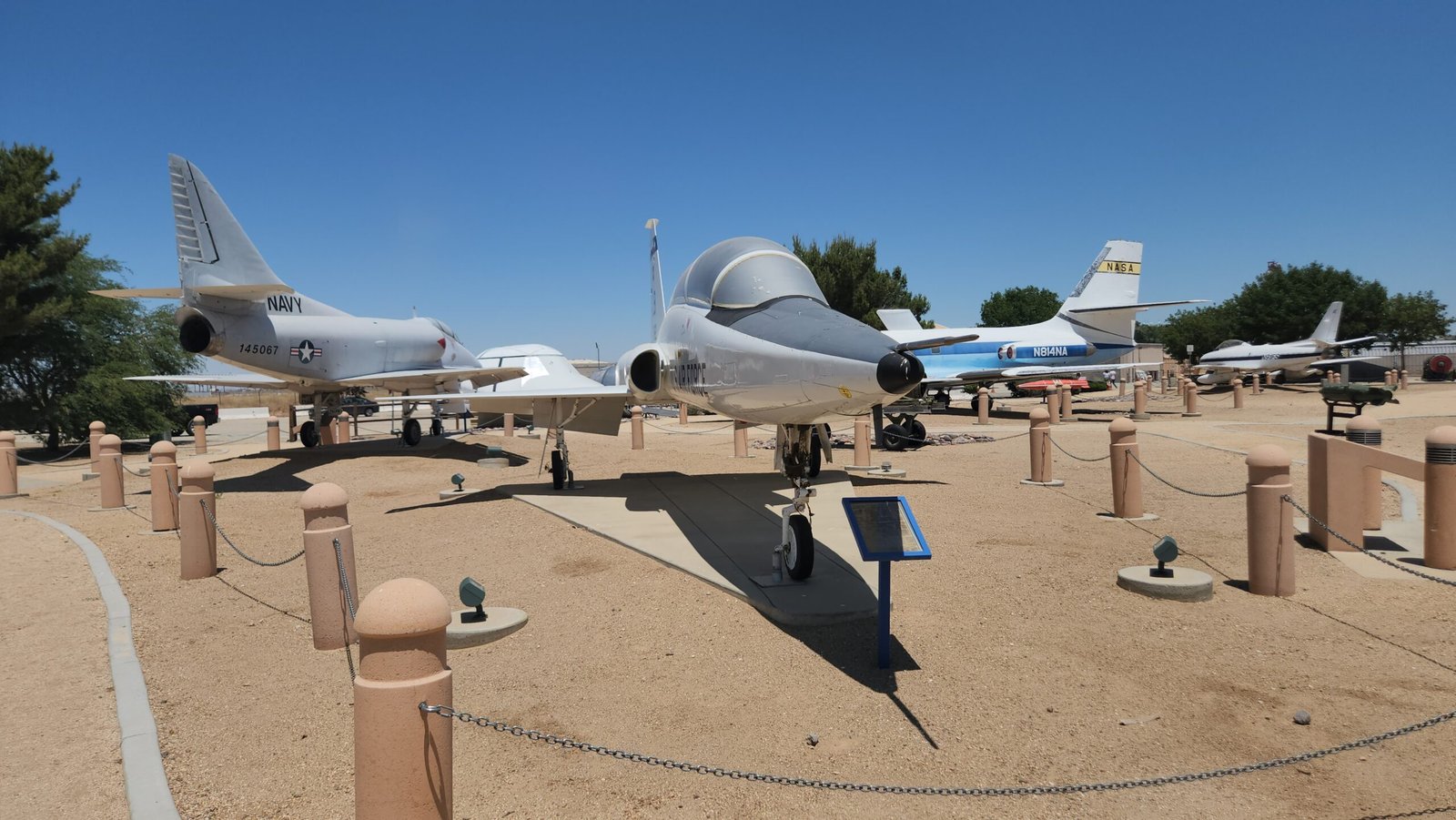
Right out of the box you’ll find a pair of NASA-owned aircraft – a Lockheed Jetstar, and a Canadair Sabre CL-15. 

There are over a dozen jets here, including this McDonnell Douglas F-101 Voodoo. In fact, the Century Series is pretty well represented, with this Republic F-100 Super Saber, the F-101, a Lockheed F-104 Starfighter, and a Republic F-105 Thunderchief. 

It was fun to compare the super-high stance of the F-105 with the crouched  approach of the F-104. 

That’s one of the best parts about the Joe Davies Memorial AIrpark – these are really spectacular pieces of aviation history.

I don’t know about you, but I’ve never stood inside the wheel well of a B-52 before. The bay itself is fenced off, but you can see right inside the lower fuselage of this huge jet bomber. She’s on stands, of course, and you can see the brakes are not quite set.

And here’s something you wouldn’t know unless you’re a fan of the BUFF: it doesn’t have a nose wheel! The massive weight of the whole ship sits on these eight, huge tires.

The BUFF’s age can be seen out here in the tail, where she still carries a quad set of 50 caliber machine guns. That’s a leftover from World War II, when air battles were fought with guns instead of missiles. 

These planes are not quite the original deal – they’re cobbled together from parts of other airframes. They look accurate, but a serial-number check won’t make it through the DMV. 

Because of that feature, Joe Davies offers another unique feature: Adopt-a-Plane. You can sponsor the restoration of these beautiful pieces of aviation history, either in part or in total. 

The star of the show for me is this positively ginormous Boeing 747 SCA, or Shuttle Carrier Aircraft. Like the B-52, I can’t quite put my finger on the last time I put my hands on a 747’s landing gear.

This SCA is one of two 747s specifically modified to ferry the space shuttle from its west-coast landing strip at Edwards to its East Coast Cape Canaveral launch facility. That it’s here is utterly amazing.

Another amazing site, and one that gave us the heebie-jeebies, was that Rockwell B-1B Lancer sitting out there on the tarmac. Although she looks ready to go, we were advised that she may very well be ready to go only into the Joe Davies collection.

There are lots of favorites to find here, from the mighty McDonnell Douglas F-4 Phantom II to the Northrop T-38, or the really nicely finished Grumman F-14 Tomcat.

Like most other open-air museums, Joe Davies doesn’t feature a gift store. It’s a tour-on-your own kind of place, and easily worth an hour or two to visit.

To find it, just take the Rancho Vista offramp from Highway 14 east until you see that huge 747.

You can take a tour of our tour by watching the YouTube video, here.

Marvelous Air Museums is part of the John D Reinhart content family. Writer, illustrator, videographer, and accidental filmmaker — find the whole story at JohnDReinhart.com.

©2026 John D Reinhart/MarvelousAirMuseums.com – all rights reserved
Blackbird Airpark

Here’s a fun opportunity: brave the winds and heat of the Antelope Valley to spend a few minutes at the Blackbird Airpark.

It only takes a few minutes because the museum is tiny – just four airplanes, a fire truck and a gift store.

Oh, but the airplanes there are so impressive.

You start with the U-2D, the 80-foot wingspan jet-powered glider built in 1959 but that served all the way out to 1980. This one has clearly done its time, and we were curious as to what shattered that starboard windscreen.

Looking at her, you can just picture her up there in the black, hovering on the very top of the atmosphere.

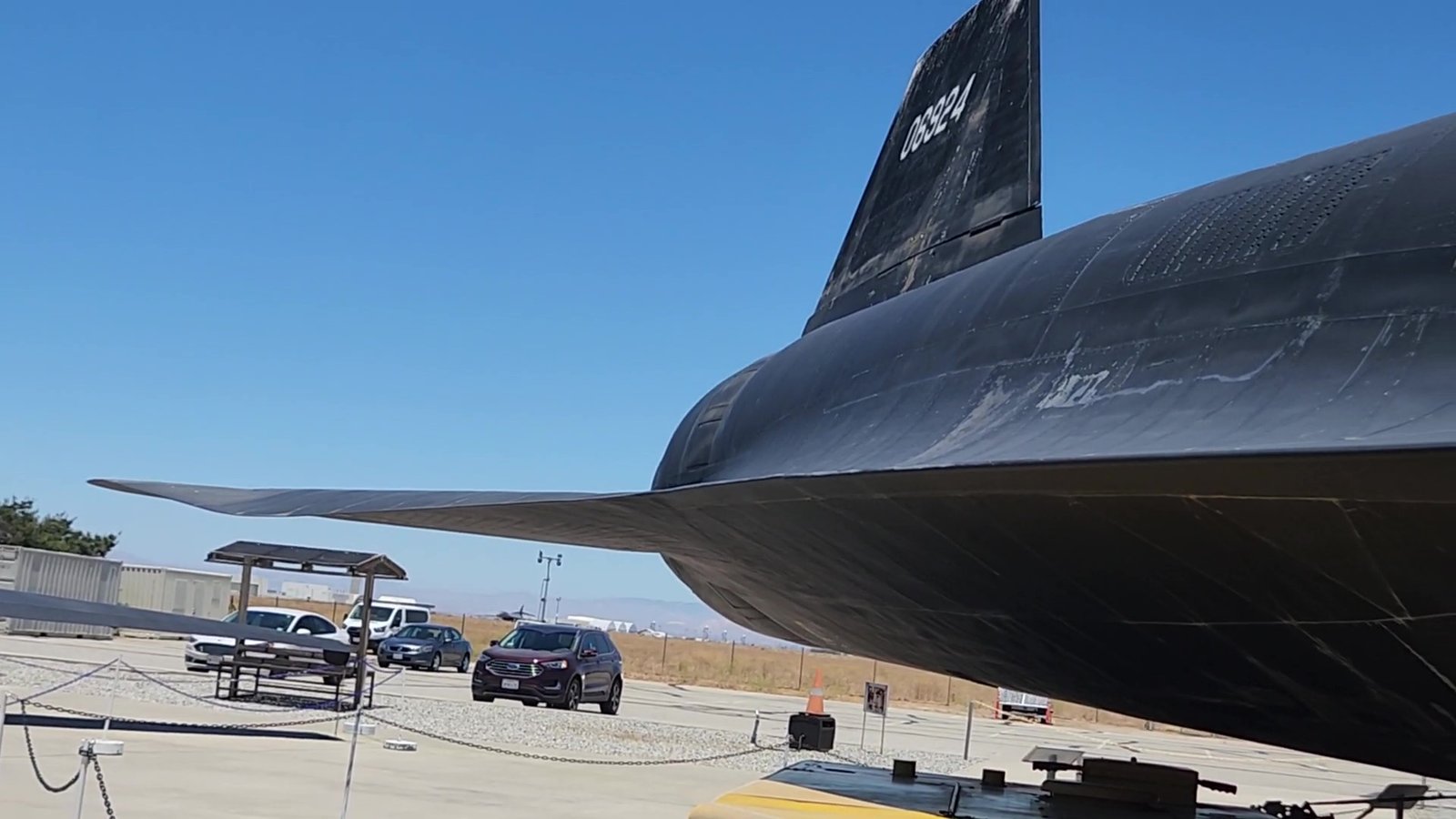
Right next door are these sinister-looking Blackbirds, an A-12 and an SR-71.

Like the U-2, these guys were assembled in the huge Building 42 – a place synonymous with top secret operations.

In fact, the A in A-12 here  doesn’t mean attack like it does for the A-6 or A-4. It stands for Archangel, the CIA codeword for the secret program for which she was developed.

The A-12 never flew a reconnaissance mission but performed as a test bed for the SR-71 program. This SR-71 in particular was pre-assembled in a secret hanger in Burbank and trucked up here at night for final assembly.

As we were looking at these astounding pieces of engineering, capable of traveling over 2,000 miles an hour at 80,000 feet, we were reminded that every inch of these incredible airframes was designed by guys with slide rules – calculators hadn’t even been invented yet.

Every square inch of the 101-foot-long fuselage has been sculpted to minimize friction and maximize lift.

The fourth airplane is a Lockheed D-21 drone. Built with little more than an SR-71 engine, these little guys zipped all the way up to 90,000 feet, where the sky is black, at 2200 miles per hour. They were built for reconnaissance, but the method of getting the film back proved to be just too difficult to manage.

The gift store has the usual tee shirts and memorabilia, but also features some really cool Blackbird-related technology, like the Goodyear tires made specifically for the Archangel program. The rubber’s mixed with powdered aluminum so they can handle the extreme heat environment of the SR-71.

The story of the Blackbird Airpark in intertwined with Edwards Flight-Test Museum. That museum is on the air force base, and only open during the week. But this Airpark is open Friday to Sunday, 11 to 4. The Flight Test Museum is seeking funding to build a new building that will someday include and protect these fine airplanes at the Airpark.

Until then, all you have to do to get here is take Exit 37, Rancho Vista Blvd, east from Highway 14.  You can’t miss it – the blackbirds are hiding just beyond the NASA 747.

Here’s the video we took during our tour: Blackbird Airpark.

Marvelous Air Museums is part of the John D Reinhart content family. Writer, illustrator, videographer, and accidental filmmaker — find the whole story at JohnDReinhart.com.

©2026 John D Reinhart/MarvelousAirMuseums.com – all rights reserved

Santa Maria Museum of Flight

The next time you find yourself on the Central Coast, make a little time to visit the Santa Maria Museum of Flight.

Sitting at the west end of the Santa Maria City Airport tarmac, the museum occupies a pair of hangers left over from the airport’s days in the US Army Air Force.

Back then, it was not uncommon to see Lockheed P-38 Lightnings roaring overhead. Inside, you find an amazing, and flyable, half-scale Lightning that was built to honor the brave guys and gals who flew the originals. Littered around the landing gear are the remains of some Lightnings that didn’t quite land as planned.

That’s actually one of the great things about the Santa Maria Museum of Flight – there’s a sense of history here, and also a sense of community, and a strong dose of folksy wisdom.

We met with docent Jerry Simas, who gave us a rainy tour of the museum ‘s wide-ranging collection. His laconic answer to my question about whether the half-scale Lightning could still fly was “Well, it was running when they shut it off.”

The museum was founded in 1984 to “preserve the past and present history of our aviation heritage, and inspiring future aviators in the Santa Maria Valley.”

There’s a memorial garden outside that is dedicated to the 99s – an international organization of woman aviators, mechanics, and innovators started in 1929 that is open to women who from over the world who love to fly. 

You’ll find that the museum is packed with surprises, from dioramas and models to some pieces of genuine Hollywood history, like the Hughes H-1 mockup built for the movie The Aviator. It doesn’t actually fly – doesn’t even have an engine, but it does have an electric motor that turns the propeller.  Some movie magic, there.

The 1991 Disney adventure film The Rocketeer was filmed right there, too. You’ll recognize the hanger, the runway outside, and of course, the Rocketeer’s iconic rocket-powered suit.

And up there is the Phoenix, a fictitious single-engine rescue plane built from the wreckage of a crashed Fairchild C-119 Flying Boxcar, made for the 2004 movie Flight of the Phoenix, with a miniature Dennis Quaid at the Controls. This is the model that was actually used in the film.

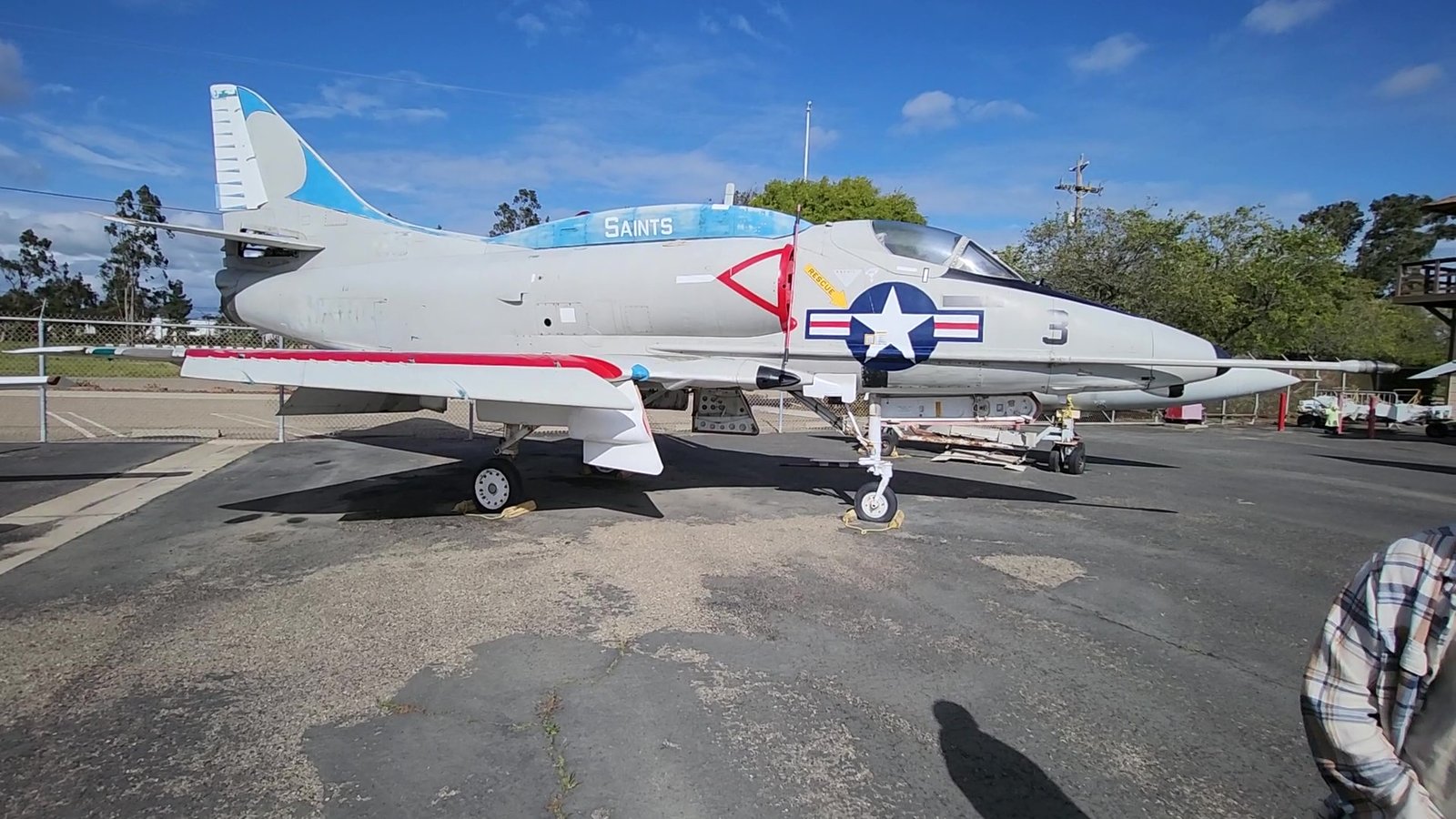
Outside, a huge F-4S Phantom II sits across from a A-4D Skyhawk, both made by McDonnell Douglas and both facing down the Czech Aero L-29 Delphin jet trainer. Inside the second hanger you’ll find a beautifully restored Folland/Hawker Siddeley Gnat – another gorgeous little trainer.

In fact, the more you look at the Santa Maria Museum of Flight, the more surprises you’ll find, like this Link Trainer. And like the flag that actually belonged to a World War II Japanese aviator. 

It’s a fun little museum, jam-packed with fascinating memorabilia that is sure to delight the entire family.

Here’s a video we made of our tour.

And it’s easy to find the museum itself, at 3015 Airpark Drive. Get to the Santa Maria Airport, and head just a block or so west on Airpark.

It’s the only building that has a Phantom jet sitting outside.

They’re open Fridays and Saturdays from 10 to 4, and Sundays from 12 to 3.

Visit their website at www.smmuseumofflight.com

Marvelous Air Museums is part of the John D Reinhart content family. Writer, illustrator, videographer, and accidental filmmaker — find the whole story at JohnDReinhart.com.

©2026 John D Reinhart/MarvelousAirMuseums.com – all rights reserved

Estrella Warbirds Museum

We journeyed out through the vineyards of Paso Robles wine country to visit The Estrella Warbirds Museum, an impressive collection of vintage aircraft adjacent to the Paso Robles Municipal Airport.

Estrella packs a huge number of surprises in a relatively small footprint. Their massive collection of mostly Vietnam-era fighter jets and helicopters is augmented by their huge cache of military transport vehicles, even a great M60A-1 Patton tank, undergoing refurbishment.

If that’s not enough, there’s the Red Ball Express, a second collection of transport vehicles from World War II. And make sure and check out the Woodland automotive museum, all on the same stretch of land.

We met with author, historian, and former combat and test pilot George J. Marrett, who guided our attention through the impressive array of airplanes that he actually helped develop.

For example, there’s a F-104 here in the museum that has George Marrett’s name on it as the test pilot.

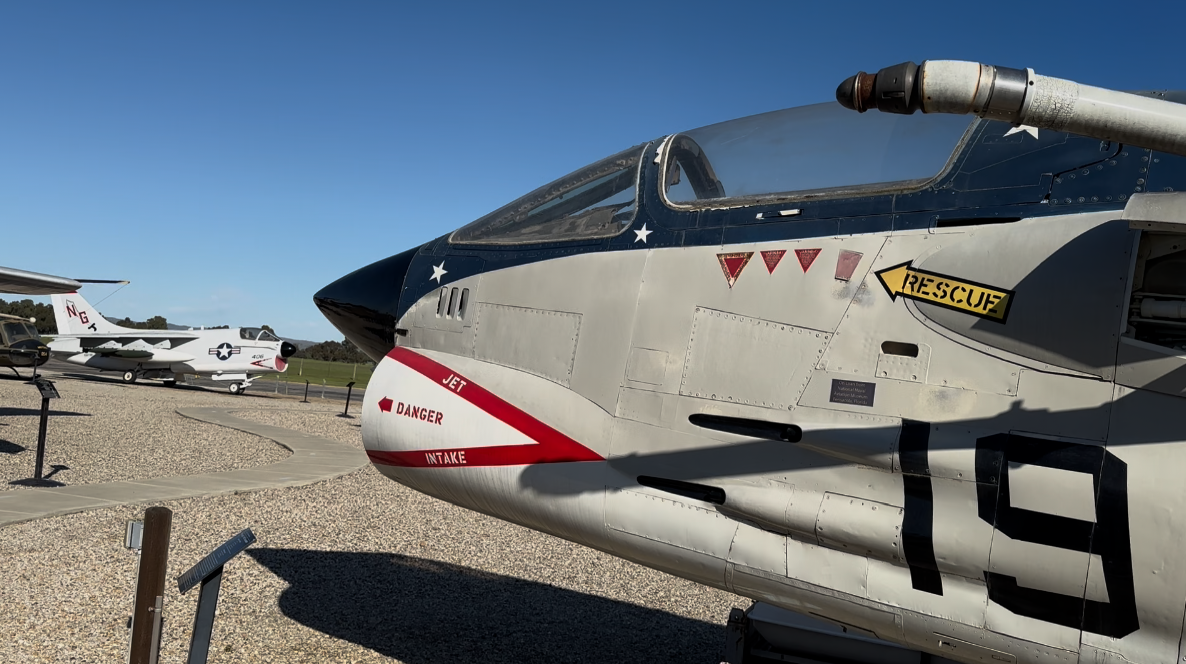
All the standards from the Vietnam War are here, from the venerable McDonnell-Douglas F-4S Phantom II to the McDonnell Douglas A4-D Skyhawk, and a Chance-Vought A7 Crusader, and a beautiful little bug-like OV-10A Bronco.

The 1980’s are represented by an F-14 Tomcat (George Marrett’s favorite), and an F-16 Falcon. There’s even an A-6 Intruder and US-2 Tracker.

You’ll also find this beautiful little Northrup F-5A Freedom Fighter.

Out on the tarmac, beyond the still-flying Douglas C-47 Gooney Bird painted in D-Day invasion stripes, sits the International Collection. Here you’ll find a Saab S-35 Draken, an Aermacchi MB326 Impala, and a sweet little Fouga CM.170 Magister.

While most of these aircraft are restored, they’re generally for ground display only. But what a grand display it is, and how wonderful to be able to touch all these iconic aircraft, side-by-side.

It’s hard to imagine it from looking at it, but the Lockheed P-2V Neptune was actually equipped to drop a nuclear bomb. These red doors covered the intakes for the jet engines. Yes, the Neptune was a JATO – jet-assisted-take-off. They closed once the plane reached a safe altitude to save gas.

Estrella is absolutely packed up with treasures, not least of all is Captain Marrett and the depth he brings to the museum.

You can read about his years as a test pilot in Contrails Over the Mojave, published by the Naval Institute Press, and in Testing Death, published by Praeger Security International, and his wild combat-rescue adventures in Cheating Death, published by Smithsonian Books.

The next time you’re in the Central Coast Wine Country, do yourself a massive favor and head over to the Paso Robles Municipal Airport, and the Estrella Warbirds Museum.  

Take Highway 46 east, get off at Airport Road, make a right on Dry Creek Road, and you’re sure to find them.

Just turn in at the A-4 Skyhawk…

Spend some time with us on our Video Tour and see just how great the Estrella Warbirds Museum is!

Marvelous Air Museums is part of the John D Reinhart content family. Writer, illustrator, videographer, and accidental filmmaker — find the whole story at JohnDReinhart.com.

©2026 John D Reinhart/MarvelousAirMuseums.com – all rights reserved
One Motor, Many Planes

The Southern California Wing of the Commemorative Air Force features a number of spectacular pieces of World War II flying history. 

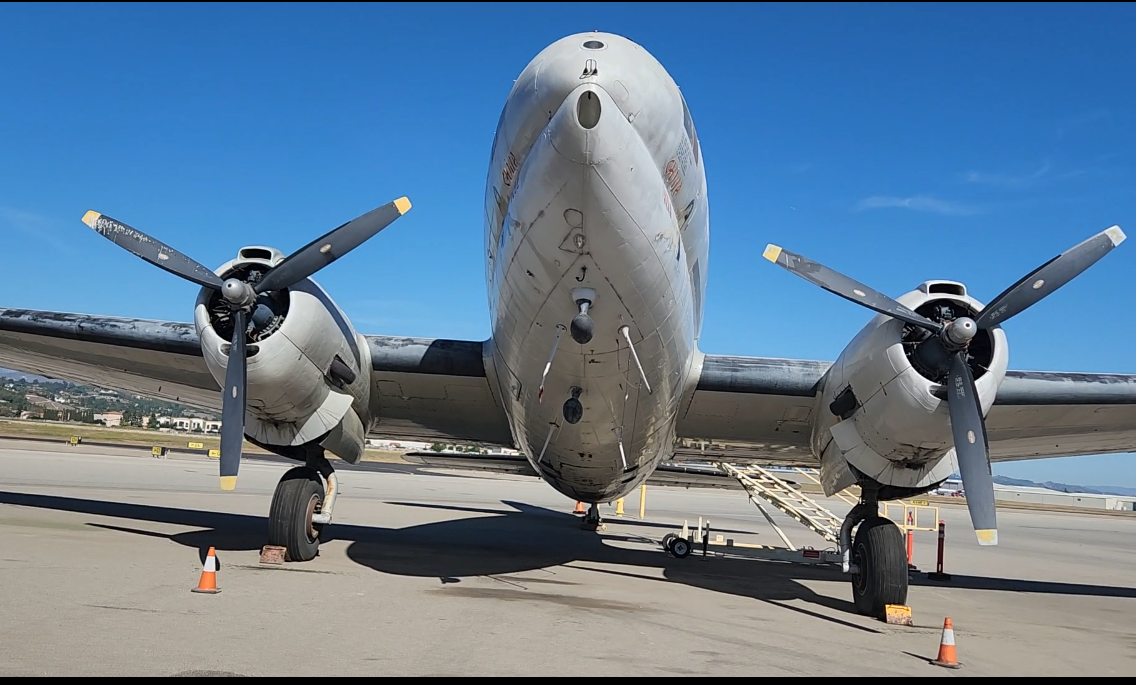
Their first acquisition was the massive Curtiss C-46 Commando, the largest twin-engine plane built by the allies during the war. 

The pride of their fleet is the North American PBJ maritime patrol bomber, the very last PBJ that still flies. 

And the museum is quite proud of its beautiful Grumman F6F Hellcat fighter, an immensely important carrier airplane from WWII. 

Although these three planes carried out vastly different missions, were built by completely different companies, and were operated by two different branches of the military, they all have one thing in common: the Wright R-2600 Twin Cyclone engine.

The R-2600 Twin-Cyclone is a 14-cylinder radial engine – where your car has 4, 6, or 8 cylinders arrayed in a line or a Vee, the radial’s 14 cylinders are arrayed in a circle around the engine’s crankshaft. It’s a big motor that weighs about a ton. 

One of the advantages to this rotary layout is the power it achieves. Where your Toyota Camry cranks out about 200 horsepower, and a new Dodge Charger pushes out less than 300, the R-2600 generates a whopping 1,800 horsepower.

Another advantage is that these engines are air-cooled, like in a VW bug. Standard engines have a radiator full of coolant.  A radial engine does away that, using passing air as coolant. They look different, with those big, finned cylinder heads, because they need a lot of air to stay cool. 

Our story gets interesting because the R-2600 engine was developed specifically for the Curtiss C-46 Commando. Wright, the engine manufacturer, was a division of Curtiss-Wright, the maker of the Commando.

The engine proved to be robust, and quickly became a huge success among aircraft manufacturers. 

In fact, North American Aviation put them into their new B-25 and PBJ bombers, the last of which is the pride of the CAF fleet. 

And Grumman Aircraft Engineering put them into their new F6F Hellcat fighters.

When installed in the PBJ bomber, the two R-2600s could move the 18,000 pound airplane at 245 mph on its bombing runs against Axis submarines and warships.

In the much heavier, 48,000 pound C-46 Commando, the engines pushed her along at 135 miles per hour over the Himalayas and into China to thwart the Japanese invasion there.

That same engine, when mounted in the much lighter, 8,100 pound Grumman F6F Hellcat, gave the pilot a brisk 376 miles per hour in dogfighting Japanese Zeroes to defend the American carrier fleet.

Three different airplanes. Three widely different roles. One engine.

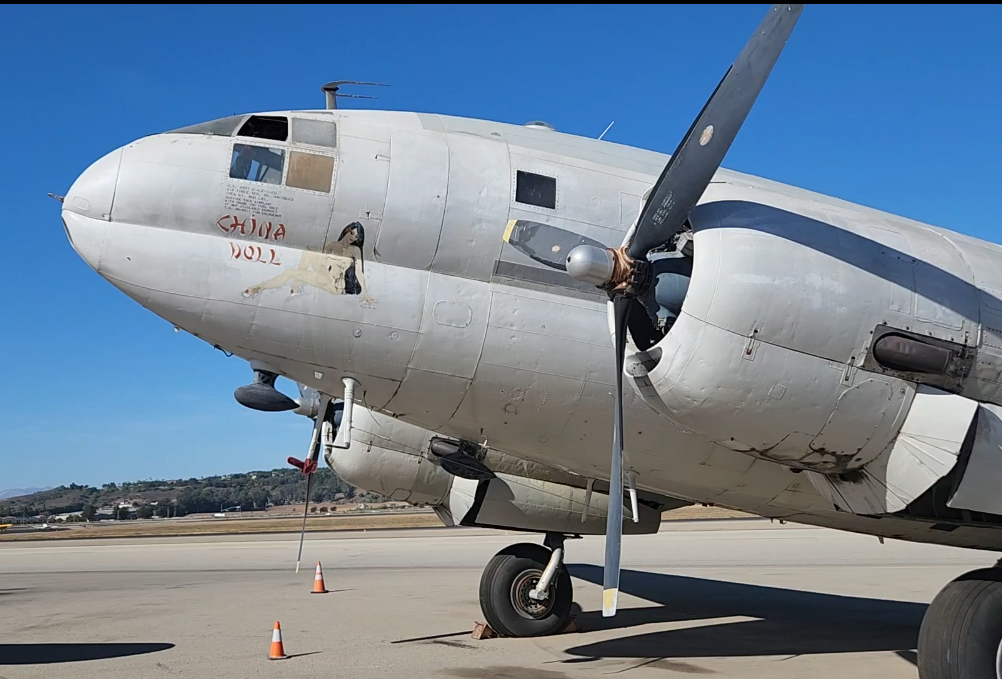
Curtiss eventually opted to fit the C-46 Commando with the even more powerful Pratt & Whitney R-2800 Double-Wasp, 18-cylinder engines, which are what you’ll find on the China Doll. 

Interestingly, Grumman also moved up to the 2,000 horsepower Double Wasp for the Hellcat, and that’s what you’ll find on display in Camarillo. 

The PBJ still features the original Wright R-2600s.

In the annals of WWII aviation history, each of these three aircraft was a standout performer, contributing more than their share in defeating the global threat to democracy.

And all three of those airplanes, among literally dozens of others, got their start on the historic Wright R-2600 Twin Cyclone radial engine. 

Marvelous Air Museums is part of the John D Reinhart content family. Writer, illustrator, videographer, and accidental filmmaker — find the whole story at JohnDReinhart.com.

©2026 John D Reinhart/MarvelousAirMuseums.com – all rights reserved

Curtiss C-46-Commando

The history of the C-46F “China Doll” is typical of post-WWII surplus transport aircraft.

“China Doll” was one of 234 C-46Fs built at the Curtiss plant in Buffalo NY. She rolled off the assembly line and was accepted in July 1945, with Curtiss Construction No 22486 and AAF serial No 44-78663. Records indicate that early assignments included Sedalia Army Air Base (now Whiteman AFB, home of the B-2 bomber), Greenville SC, Brookey AL, and other bases in the southeastern United States. Used as a transport and glider tow plane, she flew with the military until the early 50’s.

Surplused and sold to Meteor Air Transport of Teteboro NJ, she was given the new number N53594, a new civilian paint scheme, and was put to work hauling clothing to Detroit and auto parts back to New Jersey. She was even used as a Christmas holiday transport, hauling toys and Santa sleighs. A radio remote was broadcast from the plane on one Christmas eve over New York City, according to Ken Johnson, chief pilot at Meteor.

Meteor went out of business in 1958, after which the plane changed hands many times … Riddle, Zantop, Universal, and several companies owned by Ortner Air Service of Wakeman OH. The last civilian owner was Plymouth Leasing of Detroit, who leased the plane to Rosenbaum Aviation, who in turn cut holes in her sides, put spray booms on her wings, and used her as a pinecone beetle sprayer.

The CAF acquired the plane from Plymouth Leasing in Feb 1978, along with the C-46 N78774. Both of the old girls were tired and needed lots of “TLC”. N78774 got lucky early and went to the Oklahoma Wing to become “The Tinker Belle”. “Ol’ 594” had to wait. She was finally assigned to the East Texas Wing, located at Conroe TX, where she was given the name “Humpty Dumpty” in honor of the C-46s that flew over the Himalaya Mountains (i.e., “the Hump”) during the war. She also received a Chinese color scheme and clever nose art , showing a Chinese egg jumping over mountain peaks.

An engine failed in 1980. This posed a bigger problem than the East Texas folks wanted to handle, and the plane sat in non-flying condition until the summer of 1981. The newly formed So Calif Wing wanted a plane, and they were offered the C-46 if they could come up with two new engines and hang them on the plane. Who could refuse an offer like that?

It took the entire summer of 1981 to replace the engines. Then, on her first test flight, she skidded off the runway into axle-deep mud. With lots of coaxing, she finally left Conroe and flew to Airsho81 at Harlingen TX, where two main oil lines let go.

During Airsho81 the C-46 was officially assigned to the So Calif Wing. On Columbus Day 1981, she was flown to Van Nuys airport, in Los Angeles, and then to her permanent home at Camarillo Airport in the spring of 1982, where work began in earnest to make her a “star airshow airplane”. This wasn’t just a line fed to an ol’ country girl. The California Colonels really meant it. Over the course of several years they cleaned up corrosion, patched up lots of sheet metal, overhauled the propellers, replaced the passenger windows, and gave the plane a new coat of shiny aluminum paint and bright USAAF markings.

Still not satisfied, the So Calif Colonels gave her a new name and glamorous new nose art. In honor of the oriental flights of her sister ships, the name “China Doll” was chosen . Tony Starcer, the famed GI artist who painted the original “Memphis Belle” nose art plus hundreds of others, applied the new name and art. It was to be Starcer’s final nose art painting. When the plane was repainted in 1994, the nose art was re-done by artist Patricia Sica.

Source: https://www.cafsocal.com/our-aircrafts/our-aircraft-and-history/c-46-china-doll/

These images were taken at the Commemorative Air Force Southern California Wing museum in Camarillo, CA.

Marvelous Air Museums is part of the John D Reinhart content family. Writer, illustrator, videographer, and accidental filmmaker — find the whole story at JohnDReinhart.com.

©2026 John D Reinhart/MarvelousAirMuseums.com – all rights reserved