Marvelous Air Museums is part of the John D Reinhart content family. Writer, illustrator, videographer, and accidental filmmaker — find the whole story at JohnDReinhart.com.
©2026 John D Reinhart/MarvelousAirMuseums.com – all rights reserved
Explore the Best Aviation Museums in the U.S.
Marvelous Air Museums is part of the John D Reinhart content family. Writer, illustrator, videographer, and accidental filmmaker — find the whole story at JohnDReinhart.com.
©2026 John D Reinhart/MarvelousAirMuseums.com – all rights reserved
Marvelous Air Museums is part of the John D Reinhart content family. Writer, illustrator, videographer, and accidental filmmaker — find the whole story at JohnDReinhart.com.
©2026 John D Reinhart/MarvelousAirMuseums.com – all rights reserved
Marvelous Air Museums is part of the John D Reinhart content family. Writer, illustrator, videographer, and accidental filmmaker — find the whole story at JohnDReinhart.com.
©2026 John D Reinhart/MarvelousAirMuseums.com – all rights reserved
Marvelous Air Museums is part of the John D Reinhart content family. Writer, illustrator, videographer, and accidental filmmaker — find the whole story at JohnDReinhart.com.
©2026 John D Reinhart/MarvelousAirMuseums.com – all rights reserved
Marvelous Air Museums is part of the John D Reinhart content family. Writer, illustrator, videographer, and accidental filmmaker — find the whole story at JohnDReinhart.com.
©2026 John D Reinhart/MarvelousAirMuseums.com – all rights reserved
Marvelous Air Museums is part of the John D Reinhart content family. Writer, illustrator, videographer, and accidental filmmaker — find the whole story at JohnDReinhart.com.
©2026 John D Reinhart/MarvelousAirMuseums.com – all rights reserved
Marvelous Air Museums is part of the John D Reinhart content family. Writer, illustrator, videographer, and accidental filmmaker — find the whole story at JohnDReinhart.com.
©2026 John D Reinhart/MarvelousAirMuseums.com – all rights reserved
The Southern California Wing of the Commemorative Air Force features a number of spectacular pieces of World War II flying history.
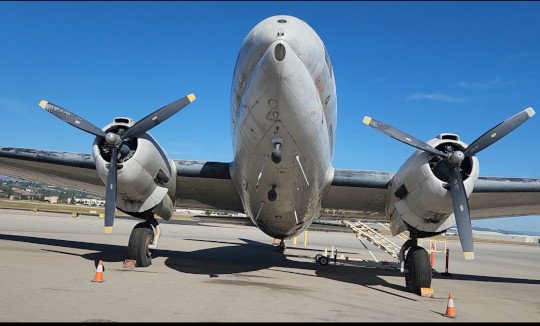
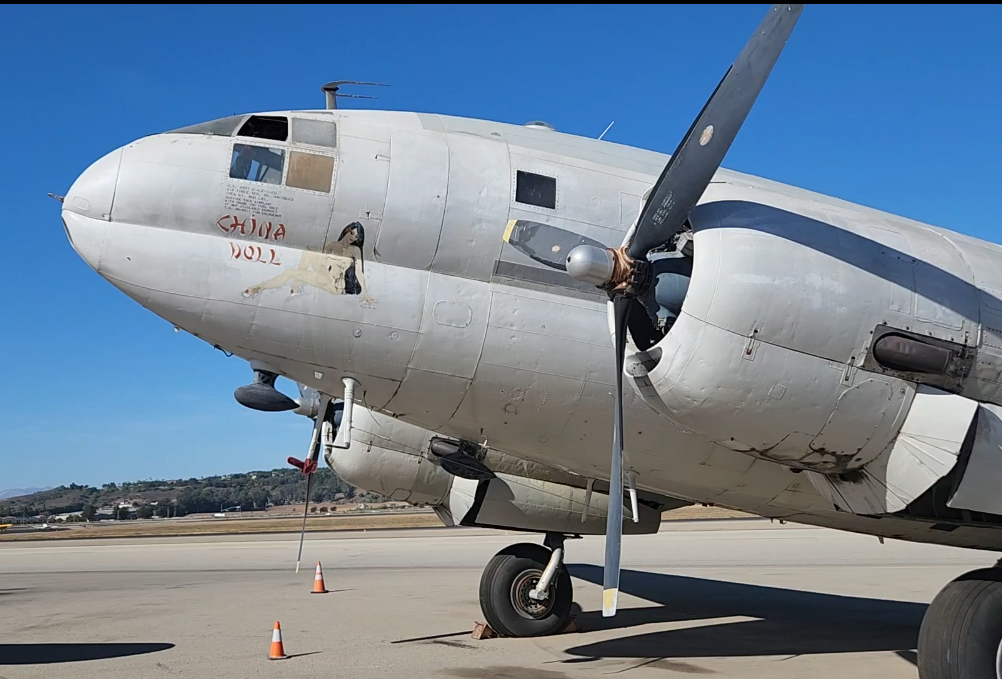
Their first acquisition was the massive Curtiss C-46 Commando, the largest twin-engine plane built by the allies during the war.

The pride of their fleet is the North American PBJ maritime patrol bomber, the very last PBJ that still flies.

And the museum is quite proud of its beautiful Grumman F6F Hellcat fighter, an immensely important carrier airplane from WWII.

Although these three planes carried out vastly different missions, were built by completely different companies, and were operated by two different branches of the military, they all have one thing in common: the Wright R-2600 Twin Cyclone engine.
The R-2600 Twin-Cyclone is a 14-cylinder radial engine – where your car has 4, 6, or 8 cylinders arrayed in a line or a Vee, the radial’s 14 cylinders are arrayed in a circle around the engine’s crankshaft. It’s a big motor that weighs about a ton.
One of the advantages to this rotary layout is the power it achieves. Where your Toyota Camry cranks out about 200 horsepower, and a new Dodge Charger pushes out less than 300, the R-2600 generates a whopping 1,800 horsepower.
Another advantage is that these engines are air-cooled, like in a VW bug. Standard engines have a radiator full of coolant. A radial engine does away that, using passing air as coolant. They look different, with those big, finned cylinder heads, because they need a lot of air to stay cool.
Our story gets interesting because the R-2600 engine was developed specifically for the Curtiss C-46 Commando. Wright, the engine manufacturer, was a division of Curtiss-Wright, the maker of the Commando.
The engine proved to be robust, and quickly became a huge success among aircraft manufacturers.
In fact, North American Aviation put them into their new B-25 and PBJ bombers, the last of which is the pride of the CAF fleet.
And Grumman Aircraft Engineering put them into their new F6F Hellcat fighters.
When installed in the PBJ bomber, the two R-2600s could move the 18,000 pound airplane at 245 mph on its bombing runs against Axis submarines and warships.
In the much heavier, 48,000 pound C-46 Commando, the engines pushed her along at 135 miles per hour over the Himalayas and into China to thwart the Japanese invasion there.
That same engine, when mounted in the much lighter, 8,100 pound Grumman F6F Hellcat, gave the pilot a brisk 376 miles per hour in dogfighting Japanese Zeroes to defend the American carrier fleet.
Three different airplanes. Three widely different roles. One engine.
Curtiss eventually opted to fit the C-46 Commando with the even more powerful Pratt & Whitney R-2800 Double-Wasp, 18-cylinder engines, which are what you’ll find on the China Doll.
Interestingly, Grumman also moved up to the 2,000 horsepower Double Wasp for the Hellcat, and that’s what you’ll find on display in Camarillo.
The PBJ still features the original Wright R-2600s.
In the annals of WWII aviation history, each of these three aircraft was a standout performer, contributing more than their share in defeating the global threat to democracy.
And all three of those airplanes, among literally dozens of others, got their start on the historic Wright R-2600 Twin Cyclone radial engine.
Marvelous Air Museums is part of the John D Reinhart content family. Writer, illustrator, videographer, and accidental filmmaker — find the whole story at JohnDReinhart.com.
©2026 John D Reinhart/MarvelousAirMuseums.com – all rights reserved
The Southern California Wing of the Commemorative Air Force is nestled against the south side of the Camarillo Airport, just west of the Santa Monica Mountains in Camarillo. It’s a sprawling complex of hangars jam-packed with World War II aircraft.
And they are beautiful examples of airplanes from both sides of the conflict. You’ll find a huge Curtiss C-46 Commando (the largest twin-engine plane ever flown by the US Army), a Grumman F-6F Hellcat, an F-8F Bearcat, and a Fairchild PT-19 trainer sitting alongside a North American SNJ-5 advanced trainer in its original, glorious yellow paint. There is a wonderful Messerschmitt BF-108 Taifun, and an in-process restoration of a Fiesler Storch. The Supermarine Spitfire MkXIV, with its menacing 5-bladed propellor is a must see, as is the Mitsubishi A6M3 Zero.

The star of the show, and the pride of the museum, is the North American PBJ Maritime Patrol Bomber. It took 23 years of loving restoration to clear the corrosion from this impressive, beautiful airplane which, at a first glance, looks like a B-25J Mitchell Bomber.
“It is the same airframe,” said Lucien Pillai, the museum’s public information officer, “except this one was built for the US Navy, not the Army. They called theirs B-25s, but the Navy called theirs P for patrol, B for bomber, and J because the plane was built by the North American Aircraft company. We traced out her tail numbers. This is the only surviving PBJ in the world.”
Like the PBJ, nearly all the other airplanes are either fully restored or in the process of getting back to their original, flying condition. The Bearcat and the Storch, for example, are currently missing their wings. The museum has the wings, but they’re being rebuilt.
Most importantly, you’ll find an oil-drip pan parked beneath each aircraft, because the CAF flies these beauties whenever they can.

Colonel Ron Fleishman, the museum’s historian, quipped that if an airplane doesn’t drip oil, there’s something wrong with it.
To prove the point, a meticulously restored T-34 Mentor in stunning Coast Guard graphics rumbled past us as we were crossing the tarmac, heading into a hangar towards a waiting drip pan.
And here’s something: you can book a ride one of these guys! Can you imagine, sitting in the front seat of the open-cockpit PT-19, rumbling through the Southern California skies? Or sitting in the all-Perspex nose of the PBJ as she thunders down the runway? Clear your calendar for the second Saturday of each month, and visit the museum’s website for ticket information.
One of the many fun things about the Southern California Wing of the Commemorative Air Force (based in Harlingen, Texas, but with museums, called “wings,” all over the world), is that everyone you meet is an officer, as in a military officer. We met with the Public Information Officer, Lucien Pillai. He introduced us to the SoCal wing’s historian, Colonel Ron Fleishman. Ron explained that, as the title “colonel” is an honorarium, everybody’s a colonel in the CAF!
The museum also houses an impressive collection of World War II artifacts, including a semi-melted engine from a P-38 Lightning that crashed into the Camarillo hillsides back when Camarillo Airport was the Oxnard Air Force Base. You’ll also find an actual ball turret, a fiberglass replica of the lower turret that was used in B-17 and B-24 bombers. And a huge number of model airplanes, from World War I right through to the present day.
And don’t miss the Link Trainer, a flight simulator so authentic that one student pilot actually bailed out of it!
There’s a lot to see at this easy-to-find, engaging museum.
We put together a video tour of the museum that you might like. But we strongly encourage you to go visit this great collection of vintage airplanes for yourself!
Get off the 101 Freeway at Las Posas Road, go south, make a right on Pleasant Valley, and a right on Eubanks, and you’re there. You can’t miss the huge Hamilton Standard propeller!
Visit them online at CAFSoCal.com, or call them at +1 805 482 0064. They’re open Fridays and Saturdays, 10-4, and Sundays 12-4.
Marvelous Air Museums is part of the John D Reinhart content family. Writer, illustrator, videographer, and accidental filmmaker — find the whole story at JohnDReinhart.com.
©2026 John D Reinhart/MarvelousAirMuseums.com – all rights reserved