The PBJ-1J “Mitchell” flew into Camarillo from Midland, Texas in April, 1993.
After inspection, the aircraft was put into our long restoration process, and at the conclusion this “Mitchell” is as brand-new as it was when it came off the assembly line.
The B-25 Mitchell is painted in the colors of a Marine Corps PBJ-1J, named “Semper Fi” with Globe and Anchor painted on the starboard nose.
The North American B-25 Mitchell is an American medium bomber that was introduced in 1941 and named in honor of Brigadier General William “Billy” Mitchell, a pioneer of U.S. military aviation.[2] Used by many Allied air forces, the B-25 served in every theater of World War II, and after the war ended, many remained in service, operating across four decades. Produced in numerous variants, nearly 10,000 B-25s were built,[1] It was the most-produced American medium bomber and the third most-produced American bomber overall. These included several limited models such as the F-10 reconnaissance aircraft, the AT-24 crew trainers, and the United States Marine Corps‘ PBJ-1 patrol bomber.
Marvelous Air Museums is part of the John D Reinhart content family. Writer, illustrator, videographer, and accidental filmmaker — find the whole story at JohnDReinhart.com.
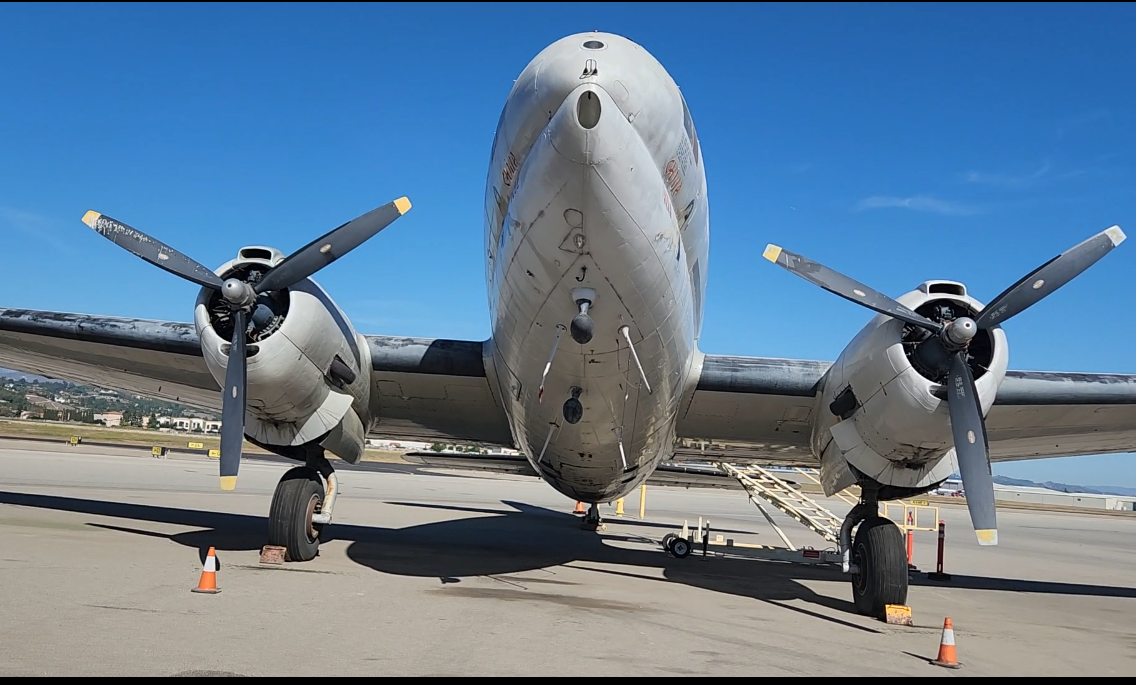
The history of the C-46F “China Doll” is typical of post-WWII surplus transport aircraft.
“China Doll” was one of 234 C-46Fs built at the Curtiss plant in Buffalo NY. She rolled off the assembly line and was accepted in July 1945, with Curtiss Construction No 22486 and AAF serial No 44-78663. Records indicate that early assignments included Sedalia Army Air Base (now Whiteman AFB, home of the B-2 bomber), Greenville SC, Brookey AL, and other bases in the southeastern United States. Used as a transport and glider tow plane, she flew with the military until the early 50’s.
Surplused and sold to Meteor Air Transport of Teteboro NJ, she was given the new number N53594, a new civilian paint scheme, and was put to work hauling clothing to Detroit and auto parts back to New Jersey. She was even used as a Christmas holiday transport, hauling toys and Santa sleighs. A radio remote was broadcast from the plane on one Christmas eve over New York City, according to Ken Johnson, chief pilot at Meteor.
Meteor went out of business in 1958, after which the plane changed hands many times … Riddle, Zantop, Universal, and several companies owned by Ortner Air Service of Wakeman OH. The last civilian owner was Plymouth Leasing of Detroit, who leased the plane to Rosenbaum Aviation, who in turn cut holes in her sides, put spray booms on her wings, and used her as a pinecone beetle sprayer.
The CAF acquired the plane from Plymouth Leasing in Feb 1978, along with the C-46 N78774. Both of the old girls were tired and needed lots of “TLC”. N78774 got lucky early and went to the Oklahoma Wing to become “The Tinker Belle”. “Ol’ 594” had to wait. She was finally assigned to the East Texas Wing, located at Conroe TX, where she was given the name “Humpty Dumpty” in honor of the C-46s that flew over the Himalaya Mountains (i.e., “the Hump”) during the war. She also received a Chinese color scheme and clever nose art , showing a Chinese egg jumping over mountain peaks.
An engine failed in 1980. This posed a bigger problem than the East Texas folks wanted to handle, and the plane sat in non-flying condition until the summer of 1981. The newly formed So Calif Wing wanted a plane, and they were offered the C-46 if they could come up with two new engines and hang them on the plane. Who could refuse an offer like that?
It took the entire summer of 1981 to replace the engines. Then, on her first test flight, she skidded off the runway into axle-deep mud. With lots of coaxing, she finally left Conroe and flew to Airsho81 at Harlingen TX, where two main oil lines let go.
During Airsho81 the C-46 was officially assigned to the So Calif Wing. On Columbus Day 1981, she was flown to Van Nuys airport, in Los Angeles, and then to her permanent home at Camarillo Airport in the spring of 1982, where work began in earnest to make her a “star airshow airplane”. This wasn’t just a line fed to an ol’ country girl. The California Colonels really meant it. Over the course of several years they cleaned up corrosion, patched up lots of sheet metal, overhauled the propellers, replaced the passenger windows, and gave the plane a new coat of shiny aluminum paint and bright USAAF markings.
Still not satisfied, the So Calif Colonels gave her a new name and glamorous new nose art. In honor of the oriental flights of her sister ships, the name “China Doll” was chosen . Tony Starcer, the famed GI artist who painted the original “Memphis Belle” nose art plus hundreds of others, applied the new name and art. It was to be Starcer’s final nose art painting. When the plane was repainted in 1994, the nose art was re-done by artist Patricia Sica.
Marvelous Air Museums is part of the John D Reinhart content family. Writer, illustrator, videographer, and accidental filmmaker — find the whole story at JohnDReinhart.com.
The Southern California Wing of the Commemorative Air Force is nestled against the south side of the Camarillo Airport, just west of the Santa Monica Mountains in Camarillo. It’s a sprawling complex of hangars jam-packed with World War II aircraft.
And they are beautiful examples of airplanes from both sides of the conflict. You’ll find a huge Curtiss C-46 Commando (the largest twin-engine plane ever flown by the US Army), a Grumman F-6F Hellcat, an F-8F Bearcat, and a Fairchild PT-19 trainer sitting alongside a North American SNJ-5 advanced trainer in its original, glorious yellow paint. There is a wonderful Messerschmitt BF-108 Taifun, and an in-process restoration of a Fiesler Storch. The Supermarine Spitfire MkXIV, with its menacing 5-bladed propellor is a must see, as is the Mitsubishi A6M3 Zero.
The star of the show, and the pride of the museum, is the North American PBJ Maritime Patrol Bomber. It took 23 years of loving restoration to clear the corrosion from this impressive, beautiful airplane which, at a first glance, looks like a B-25J Mitchell Bomber.
“It is the same airframe,” said Lucien Pillai, the museum’s public information officer, “except this one was built for the US Navy, not the Army. They called theirs B-25s, but the Navy called theirs P for patrol, B for bomber, and J because the plane was built by the North American Aircraft company. We traced out her tail numbers. This is the only surviving PBJ in the world.”
Like the PBJ, nearly all the other airplanes are either fully restored or in the process of getting back to their original, flying condition. The Bearcat and the Storch, for example, are currently missing their wings. The museum has the wings, but they’re being rebuilt.
Most importantly, you’ll find an oil-drip pan parked beneath each aircraft, because the CAF flies these beauties whenever they can.
Colonel Ron Fleishman, the museum’s historian, quipped that if an airplane doesn’t drip oil, there’s something wrong with it.
To prove the point, a meticulously restored T-34 Mentor in stunning Coast Guard graphics rumbled past us as we were crossing the tarmac, heading into a hangar towards a waiting drip pan.
And here’s something: you can book a ride one of these guys! Can you imagine, sitting in the front seat of the open-cockpit PT-19, rumbling through the Southern California skies? Or sitting in the all-Perspex nose of the PBJ as she thunders down the runway? Clear your calendar for the second Saturday of each month, and visit the museum’s website for ticket information.
One of the many fun things about the Southern California Wing of the Commemorative Air Force (based in Harlingen, Texas, but with museums, called “wings,” all over the world), is that everyone you meet is an officer, as in a military officer. We met with the Public Information Officer, Lucien Pillai. He introduced us to the SoCal wing’s historian, Colonel Ron Fleishman. Ron explained that, as the title “colonel” is an honorarium, everybody’s a colonel in the CAF!
The museum also houses an impressive collection of World War II artifacts, including a semi-melted engine from a P-38 Lightning that crashed into the Camarillo hillsides back when Camarillo Airport was the Oxnard Air Force Base. You’ll also find an actual ball turret, a fiberglass replica of the lower turret that was used in B-17 and B-24 bombers. And a huge number of model airplanes, from World War I right through to the present day.
And don’t miss the Link Trainer, a flight simulator so authentic that one student pilot actually bailed out of it!
There’s a lot to see at this easy-to-find, engaging museum.
We put together a video tour of the museum that you might like. But we strongly encourage you to go visit this great collection of vintage airplanes for yourself!
Get off the 101 Freeway at Las Posas Road, go south, make a right on Pleasant Valley, and a right on Eubanks, and you’re there. You can’t miss the huge Hamilton Standard propeller!
Visit them online at CAFSoCal.com, or call them at +1 805 482 0064. They’re open Fridays and Saturdays, 10-4, and Sundays 12-4.
Marvelous Air Museums is part of the John D Reinhart content family. Writer, illustrator, videographer, and accidental filmmaker — find the whole story at JohnDReinhart.com.