Convair CV990

The Convair 990 was a commercial airliner produced between 1961 and 1963. The narrow body could move up to 121 people across the country at Mach .84, around 585 miles per hour, which seems plenty fast. But it wasn’t quite the Mach .89 Convair, or its parent company General Dynamics, had promised American Airlines when they made the contract.

Sadly, only 37 of them were ever produced, although they flew for airlines all over the world. They operated from 1961 all the way through to 1994 – and that last flight was made by the CV990 that’s parked at the Mojave Spaceport.

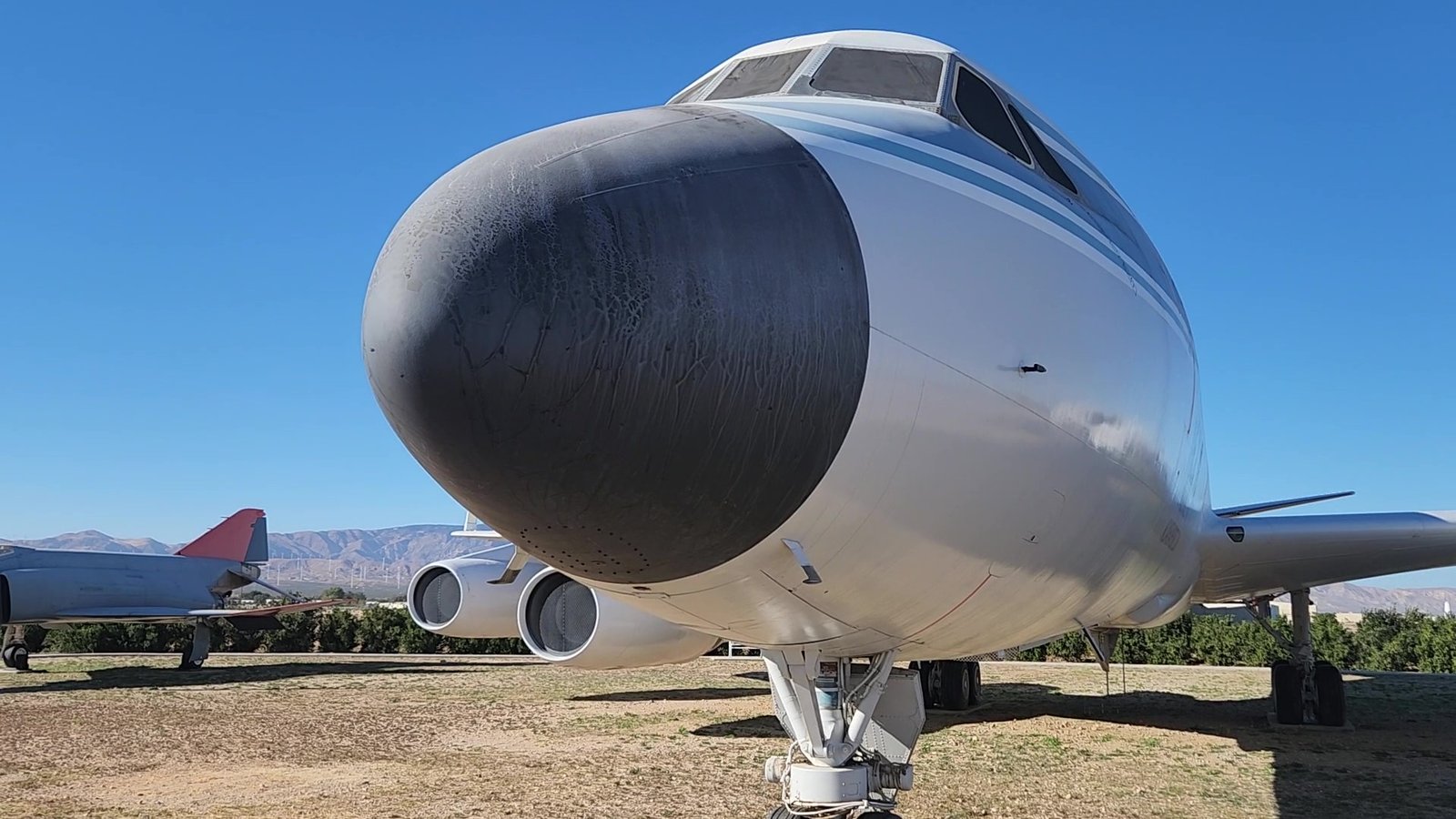
This Coronado, #810, had the right combination of flight dynamics, weight, and, frankly, availability, for NASA to use as a stand in for the still-building shuttle Enterprise in 1993.

NASA hacked an enormous bay carved out of her fuselage, right between the main landing gear. That bay, which looks kind of Frankensteined together, is where they wedged the Enterprise landing gear assembly. Her own main gear was still intact, but she actually took off and landed on the shuttle gear.

The engineers at NASA test the landing gear system’s crosswind braking and tire wear capabilities. As a result of 810’s performance, the Enterprise‘s approved to land in crosswinds up to 20 knots, an upgrade from the previous 15.

Oddly enough, while the McDonnell Douglas F-4J Phantom II and the Saab T-35 Draken are displayed with their engines removed, the Coronado still has rotating parts in those engine nacelles. We were surprised to hear the Mojave wind that pushed its way around the plywood intake cover on the number three engine, gently spinning the turbine fan with a lonesome tick-tick-tick.

These images of 810 were taken on a breezy afternoon at the Mojave Air Museum Legacy Park – an interesting and open-air museum that’s right outside the Spaceport.

Marvelous Air Museums is part of the John D Reinhart content family. Writer, illustrator, videographer, and accidental filmmaker — find the whole story at JohnDReinhart.com.

©2026 John D Reinhart/MarvelousAirMuseums.com – all rights reserved
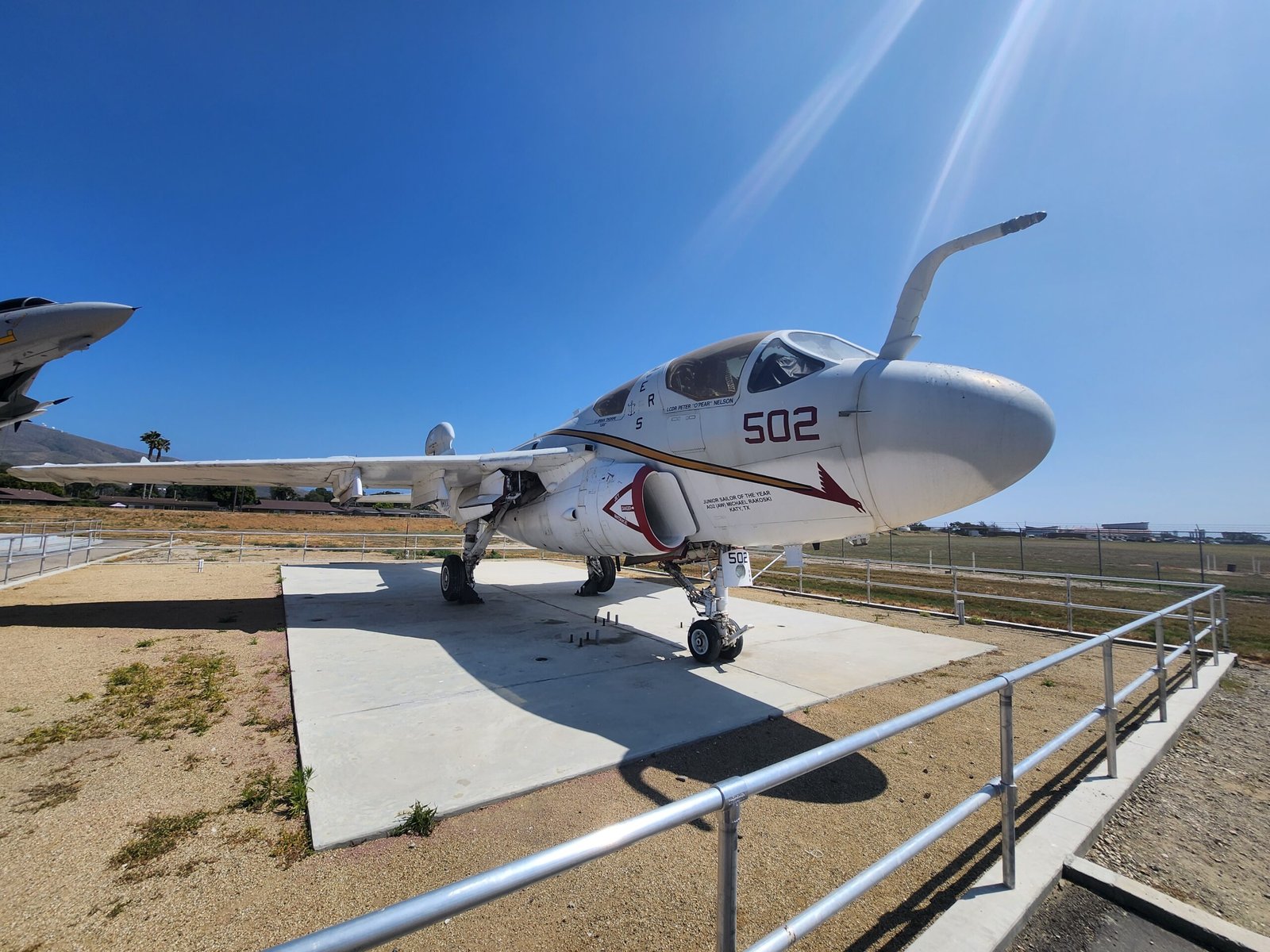
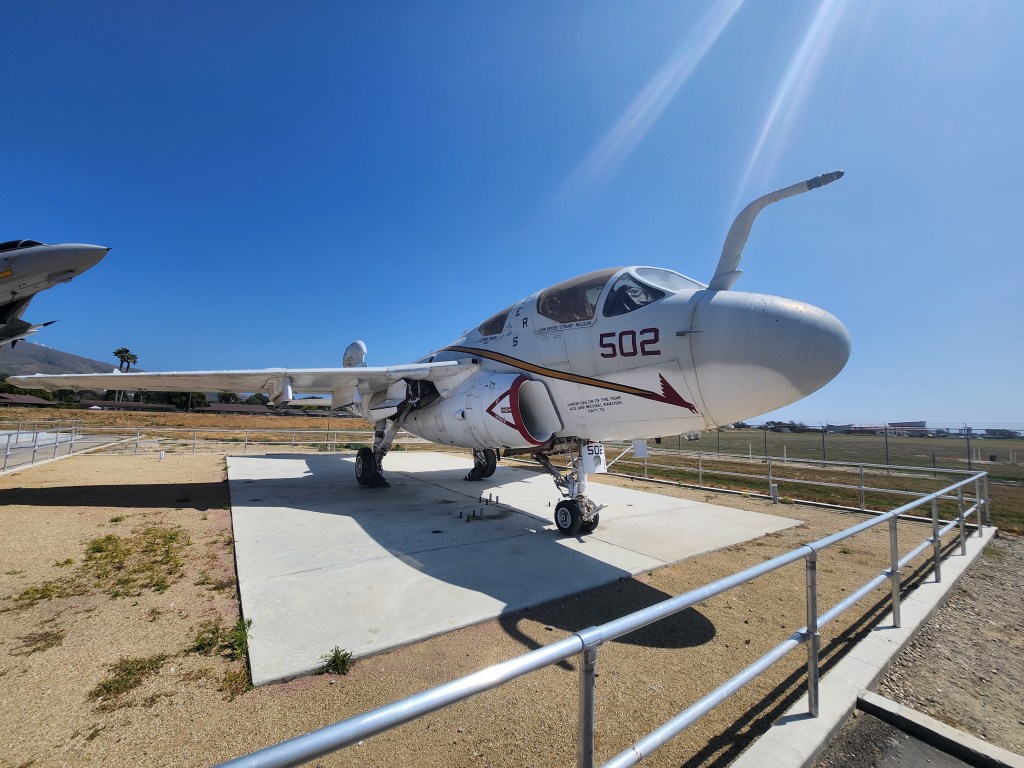
Grumman EA-6B Intruder

The Grumman EA-6B Prowler was a 4-seat electronic countermeasures attack aircraft developed during the Vietnam War. You can quickly differentiate an EA-6 from the A-6 Intruder upon which it was based by the longer airframe, the second cockpit canopies, and that distinctive bulb on the tail.

The A-6 Intruder was designed 1957 as a carrier-based strike and attack aircraft. That airframe was so successful that the last A-6 was retired in 1997. Along the way, Grumman produced several variants, including an airborne tanker, and the EA-6B Prowler.

The Prowler joined the Navy in 1971, serving in every theater of war from Vietnam through Afghanistan.

Her role was to identify, jam, and attack enemy air defense systems. She carried a pilot and three electronic countermeasures officers, referred to as ECMOs. The pilot brought the plane within range of the enemy’s defenses while the ECMOs located enemy radar installations.

The enemy’s defensive radar was to allowed to “sweep” the plane, which meant the Prowler was identified as a target. The Prowler’s defense was an aggressive and punishing attack on the installation, first by blinding the radar with radio waves and then destroying it with air-to-surface missiles.

It was hairy, dangerous work. Stunningly, not a single aircraft was ever lost in combat.

The Prowler’s mission and sophistication continued to evolve, such that by the time the plane served in Afghanistan and Iraq, the ECMOs could identify and disrupt specific cell phone communications.

Beginning in 2019, the Prowler’s role was beginning to move over to the two-seat Boeing EA-18 Growler, an adaptation of the wildly successful F/A-18 attack airframe.

In April of 2024, the Navy dedicated a plaque to the EA-6B at Point Mugu Missile Park in recognition of the service provided by these legendary aircraft.

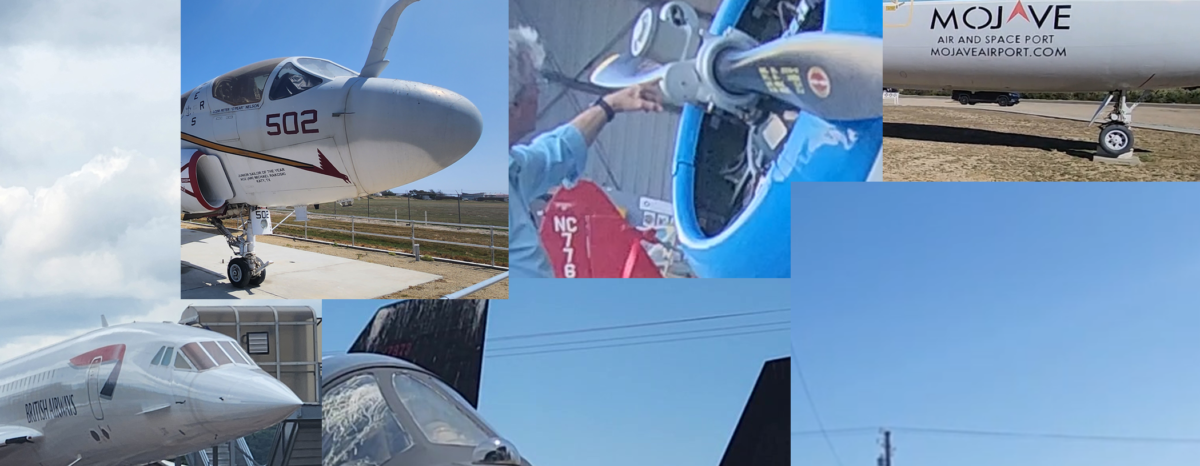
Included in the gallery at the top of this page is an A-6 undergoing restoration at the Estrella Warbirds Museum for comparison.

These images were taken at the Point Mugu Missile Park in Point Hueneme, and at the Estrella Warbirds Museum in Paso Robles.

Marvelous Air Museums is part of the John D Reinhart content family. Writer, illustrator, videographer, and accidental filmmaker — find the whole story at JohnDReinhart.com.

©2026 John D Reinhart/MarvelousAirMuseums.com – all rights reserved

Grumman F-14 Tomcat

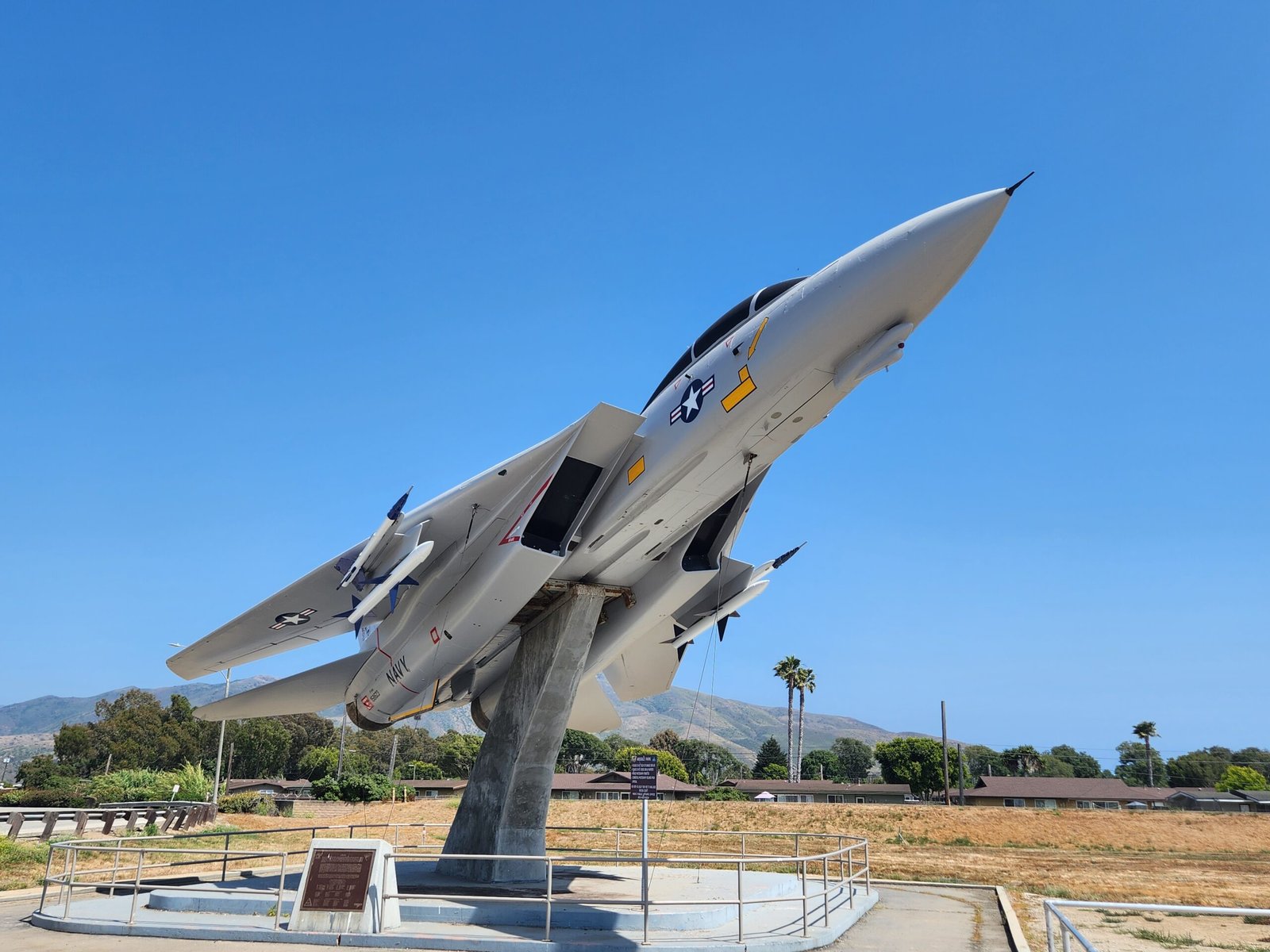
The variable-geometry F-14 Tomcat first left the ground in December of 1970, and served all the way through to September of 2006.

The big fighter took it’s first tour aboard the USS Enterprise in 1974, replacing the wing of aging F-4 Phantoms. The twin-engine, supersonic, two seat carrier fighter was a natural match for the Phantom’s role as air superiority, ground attack, and reconnaissance airframe.

The unique variable-geometry wing system, first developed for the General Dynamics F-111, sweeps the wings forward for more lift during take-off and landing, and then pulls them in close to the fuselage for supersonic flight.

According to test pilot George J. Marrett, the Tomcat was far and away his favorite airplane. He’s credited with the first-ever “supersonic missile kill,” having fired a missile from an F-14 while above Mach-1

The air-to-air missile sped away from the supersonic Tomcat, climbing as it went, to drop almost ballistically onto the target, a drone displaying the characteristics of the vaunted Mig-21. The drone never saw it coming. Both Marrett and the F-14 were credited for the kill. Neither aircraft were ever within visual range of one another.

The Tomcat provided the backbone for the US Navy through the Gulf, Afghanistan, and Iraq wars, to be replaced by the nimble A/F-18 in 2006.

These images were taken at the Point Mugu Missile Park in Port Hueneme, CA, and Estrella Warbirds Museum in Paso Robles.

Marvelous Air Museums is part of the John D Reinhart content family. Writer, illustrator, videographer, and accidental filmmaker — find the whole story at JohnDReinhart.com.

©2026 John D Reinhart/MarvelousAirMuseums.com – all rights reserved

Saab S-35 Draken

Imagine a dogfight where a Soviet MIG 17 pilot has the six of a Swedish Saab S35 Draken, his jet fighter directly behind the Swedish plane, looking right down the tailpipe, ready to launch a missile. There’s nothing the Draken pilot can do – no matter which way he turns, the MIG is right behind him.

Suddenly, the MIG pilot sees the Draken’s nose whip straight up, and to his amazement watches as the other airplane stalls, hanging in the air like a kite. The MIG whips past, its pilot wondering what had just happened.

Just as fast, the Draken’s nose comes back down, behind the MIG. And now the Draken pilot has the 6 position on the MIG, and is ready to fire the missile that will end the dogfight.

It sounds like something from Top Gun, but the Saab S 35 was the first airplane in history to be able to make that maneuver. The Draken’s double-delta wing arrangement gave it an insane degree of maneuverability, allowing it to invent and perform what’s been called the Cobra Manuever.

Modern fifth- and sixth-generation fighters, like the Lockheed F-35 Lightning II and the Sukhoi Su27 felon are among the few aircraft that can capably handle the maneuver today.

The little Draken was built between 1955 and 1974 in Sweden by the Svenska Aeroplan Aktiebolaget – we know them as Saab. The long, distinctive delta wing that starts at the air intakes and continues the whole length of the fuselage is augmented by a second set of deltas breaking away at a different angle about 2/3rds of the way back.

The Draken was the first aircraft to pioneer this double-delta innovation that led to increased stability in supersonic flight and yet offered the intense lift needed for the short runways from which the plane was expected to operate. In 1960, a Draken passed Mach 2 in level flight – another first for a Western European fighter jet.

Although it never fired a shot in anger, the versatile, efficient Draken was a mainstay in the Western European arsenal during the Cold War. They stayed in service right into the 1980’s, when they were phased out in favor of the JA 37 Viggen.

The example at the Mojave Air Museum Legacy Park is actually a T 35 Draken, a two-seat training version. You can see the periscope device mounted to the canopy bow over the front seat. This allowed the trainer sitting in the back to monitor the student’s performance.

A little dustier, and waiting for its time in the refurb shop, the S 35 at Estrella Warbirds is a good example of the Draken in its combat configuration.

Source: https://en.wikipedia.org/wiki/Saab_35_Draken

These images were taken at the Mojave Air Museum Legacy Park in Mojave, and at Estrella Warbirds Museum in Paso Robles.

Marvelous Air Museums is part of the John D Reinhart content family. Writer, illustrator, videographer, and accidental filmmaker — find the whole story at JohnDReinhart.com.

©2026 John D Reinhart/MarvelousAirMuseums.com – all rights reserved

North American PBJ Maritime Patrol Bomber

The PBJ-1J “Mitchell” flew into Camarillo from Midland, Texas in April, 1993.

After inspection, the aircraft was put into our long restoration process, and at the conclusion this “Mitchell” is as brand-new as it was when it came off the assembly line.

The B-25 Mitchell is painted in the colors of a Marine Corps PBJ-1J, named “Semper Fi” with Globe and Anchor painted on the starboard nose.

Source: https://www.cafsocal.com/our-aircrafts/our-aircraft-and-history/north-american-pbj/

The North American B-25 Mitchell is an American medium bomber that was introduced in 1941 and named in honor of Brigadier General William “Billy” Mitchell, a pioneer of U.S. military aviation.[2] Used by many Allied air forces, the B-25 served in every theater of World War II, and after the war ended, many remained in service, operating across four decades. Produced in numerous variants, nearly 10,000 B-25s were built,[1] It was the most-produced American medium bomber and the third most-produced American bomber overall. These included several limited models such as the F-10 reconnaissance aircraft, the AT-24 crew trainers, and the United States Marine Corps‘ PBJ-1 patrol bomber.

Source: https://en.wikipedia.org/wiki/North_American_B-25_Mitchell

These images were taken at the Commemorative Air Force Southern California Wing museum in Camarillo, CA.

Marvelous Air Museums is part of the John D Reinhart content family. Writer, illustrator, videographer, and accidental filmmaker — find the whole story at JohnDReinhart.com.

©2026 John D Reinhart/MarvelousAirMuseums.com – all rights reserved

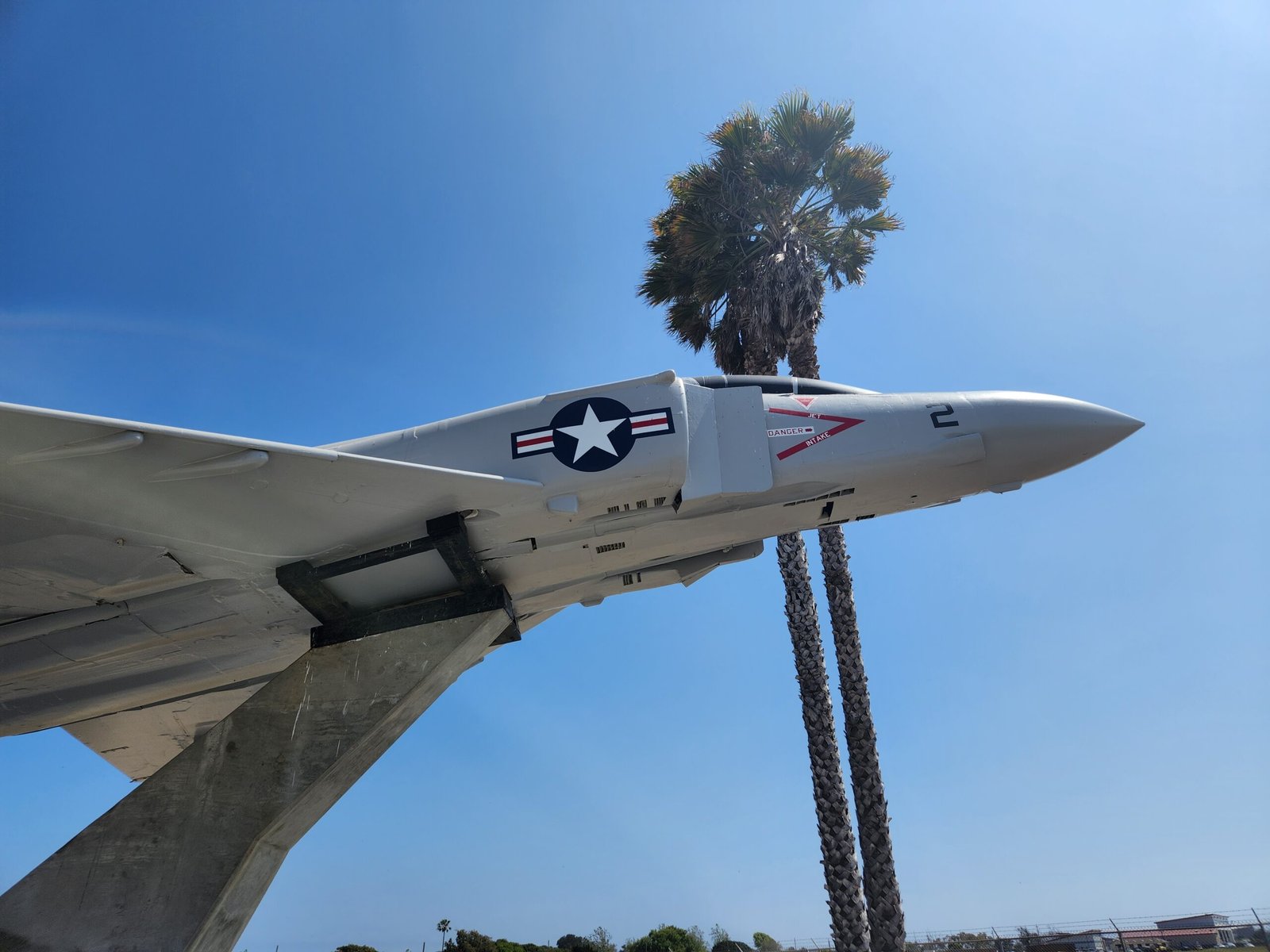
McDonnell Douglas F-4 Phantom II

The McDonnell Douglas F-4 Phantom II first took to the skies in 1959. Right off the runway, it set 15 world records, including absolute speed and absolute altitude.

The big, twin-engine fighter’s history is inextricably linked with the Vietnam War, in which it played a critical role for the United States Air Force, Marine Corps, and the Navy. It performed air superiority, ground attack, and even reconnaissance functions for all three services.

The 41-ton Phantom soldiered on after the Vietnam War, providing air superiority throughout the Cold War. In fact, the F-4 went on to provide suppression of enemy air defenses during the Gulf War.

The Mach-2 fighter was finally retired in 1996, being replaced by the more modern F-14 Tomcat, F-16 Eagle, and F-16 Fighting Falcon.

The importance and ubiquity of the F-4 cannot be overstated, perhaps best illustrated that you’ll find one is almost every air museum in California.

These images were taken at the Point Mugu Missile Park in Port Hueneme, CA, Estrella Warbird Museum in Paso Robles, Santa Maria Museum of Flight in Santa Maria, and at the Mojave Air Museum Legacy Park in Mojave, CA.

Marvelous Air Museums is part of the John D Reinhart content family. Writer, illustrator, videographer, and accidental filmmaker — find the whole story at JohnDReinhart.com.

©2026 John D Reinhart/MarvelousAirMuseums.com – all rights reserved
Curtiss C-46-Commando

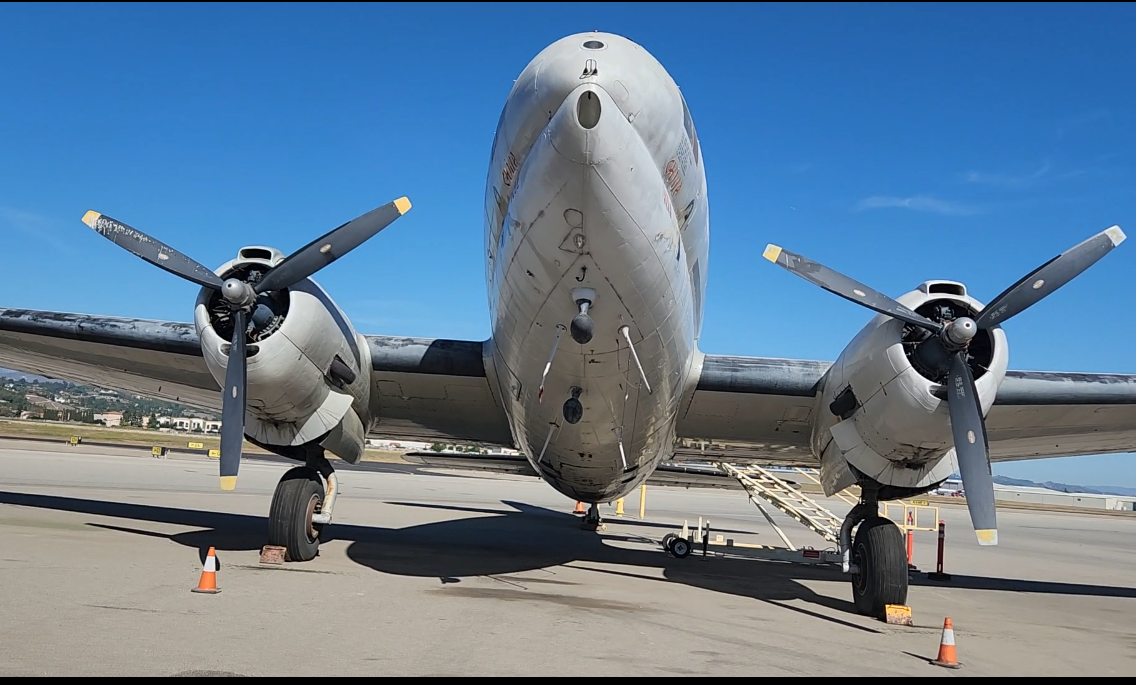
The history of the C-46F “China Doll” is typical of post-WWII surplus transport aircraft.

“China Doll” was one of 234 C-46Fs built at the Curtiss plant in Buffalo NY. She rolled off the assembly line and was accepted in July 1945, with Curtiss Construction No 22486 and AAF serial No 44-78663. Records indicate that early assignments included Sedalia Army Air Base (now Whiteman AFB, home of the B-2 bomber), Greenville SC, Brookey AL, and other bases in the southeastern United States. Used as a transport and glider tow plane, she flew with the military until the early 50’s.

Surplused and sold to Meteor Air Transport of Teteboro NJ, she was given the new number N53594, a new civilian paint scheme, and was put to work hauling clothing to Detroit and auto parts back to New Jersey. She was even used as a Christmas holiday transport, hauling toys and Santa sleighs. A radio remote was broadcast from the plane on one Christmas eve over New York City, according to Ken Johnson, chief pilot at Meteor.

Meteor went out of business in 1958, after which the plane changed hands many times … Riddle, Zantop, Universal, and several companies owned by Ortner Air Service of Wakeman OH. The last civilian owner was Plymouth Leasing of Detroit, who leased the plane to Rosenbaum Aviation, who in turn cut holes in her sides, put spray booms on her wings, and used her as a pinecone beetle sprayer.

The CAF acquired the plane from Plymouth Leasing in Feb 1978, along with the C-46 N78774. Both of the old girls were tired and needed lots of “TLC”. N78774 got lucky early and went to the Oklahoma Wing to become “The Tinker Belle”. “Ol’ 594” had to wait. She was finally assigned to the East Texas Wing, located at Conroe TX, where she was given the name “Humpty Dumpty” in honor of the C-46s that flew over the Himalaya Mountains (i.e., “the Hump”) during the war. She also received a Chinese color scheme and clever nose art , showing a Chinese egg jumping over mountain peaks.

An engine failed in 1980. This posed a bigger problem than the East Texas folks wanted to handle, and the plane sat in non-flying condition until the summer of 1981. The newly formed So Calif Wing wanted a plane, and they were offered the C-46 if they could come up with two new engines and hang them on the plane. Who could refuse an offer like that?
It took the entire summer of 1981 to replace the engines. Then, on her first test flight, she skidded off the runway into axle-deep mud. With lots of coaxing, she finally left Conroe and flew to Airsho81 at Harlingen TX, where two main oil lines let go.

During Airsho81 the C-46 was officially assigned to the So Calif Wing. On Columbus Day 1981, she was flown to Van Nuys airport, in Los Angeles, and then to her permanent home at Camarillo Airport in the spring of 1982, where work began in earnest to make her a “star airshow airplane”. This wasn’t just a line fed to an ol’ country girl. The California Colonels really meant it. Over the course of several years they cleaned up corrosion, patched up lots of sheet metal, overhauled the propellers, replaced the passenger windows, and gave the plane a new coat of shiny aluminum paint and bright USAAF markings.

Still not satisfied, the So Calif Colonels gave her a new name and glamorous new nose art. In honor of the oriental flights of her sister ships, the name “China Doll” was chosen . Tony Starcer, the famed GI artist who painted the original “Memphis Belle” nose art plus hundreds of others, applied the new name and art. It was to be Starcer’s final nose art painting. When the plane was repainted in 1994, the nose art was re-done by artist Patricia Sica.

Source: https://www.cafsocal.com/our-aircrafts/our-aircraft-and-history/c-46-china-doll/

These images were taken at the Commemorative Air Force Southern California Wing museum in Camarillo, CA.

Marvelous Air Museums is part of the John D Reinhart content family. Writer, illustrator, videographer, and accidental filmmaker — find the whole story at JohnDReinhart.com.

©2026 John D Reinhart/MarvelousAirMuseums.com – all rights reserved