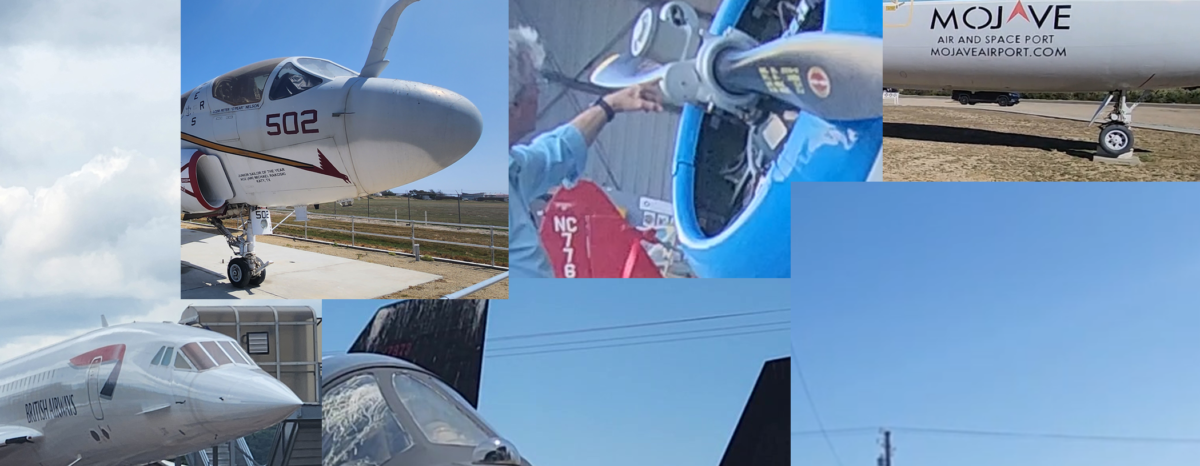
Intrepid Museum

We braved the wind and the waves to visit the Intrepid Museum, an aviation and space museum housed within the aircraft carrier USS Intrepid, a massive World War II, Korean War, and Vietnam War veteran.

Commissioned in 1943, Intrepid was the fifth of the 24 Essex class carriers built during World War Two. Her squadrons fought in several critical campaigns, including the Mariannas, Truk, and Leyte Gulf. Her Curtiss SB2C Helldivers scored a hit on the mighty Yamato, the biggest battleship in the world, and were instrumental in sinking the Musashi, Yamato’s deadly sister ship. 

As remarkable as that is, the Fighting I also survived not one, not two, but four kamikaze attacks. This US Navy photograph depicts the frightening reality of a kamikaze strike, and the heroism and bravery of the sailors fighting to overcome the damage. 

Intrepid is all about heroism and bravery. Her long hanger deck features models and movies and memorabilia from her extensive and memorable career. 

The hanger deck is where you encounter the first piece of Intrepid’s aviation history, in the form of this beautifully maintained and restored Chance Vought FG1D Corsair, an F4-U built under license by Goodyear. She bears the markings of ensign Alfred Lerch, an Intrepid pilot who earned the Navy Cross for shooting down seven Imperial Japanese airplanes in one day, making him an instant ace.

Just astern of the Corsair you’ll find the huge Grumman TBM-3 Avenger flown by president George H.W. Bush during World War II. Although the wings are folded for on-deck storage, there’s no mistaking that huge seventeen-hundred horsepower Wright 14-cylinder radial engine. With a wingspan of 54 feet, these guys were the big heroes at the battle of Leyte Gulf.

Astern of the giant Avenger you’ll find a North American FJ-2 – a variant of the Korean-war era F-86 Saber Jet specialized for carrier duty. Land or sea, there’s no escaping the beautiful design of these potent jet fighters.

And neither can you forget the McDonnell/Douglas A-4B Skyhawk, the workhorse of the Vietnam War. This early example flew from the Intrepid between 1966 and 1969.

As the shuttle Enterprise exhibit was closed during our excursion, we made our way up to the gusty flight deck. Up here is where you’ll find the bulk of the Intrepid Museum’s excellent aircraft collection. 

There’s a beautifully restored NASA Northrup T-38 Talon trainer parked right next door to a Polish-built MIG-17. There’s a nice collection of helicopters, starting with a rare Sikorsky HH-52 Sea Guard and ending with an Army Bell UH-1 Iroquois. That’s a Bell AH-1J twin-engined Sea Cobra wedged in the middle . 

The collection of jets is truly impressive and includes the first production model of the Lockheed A-12, the attack version of the fabled SR-71 Blackbird.

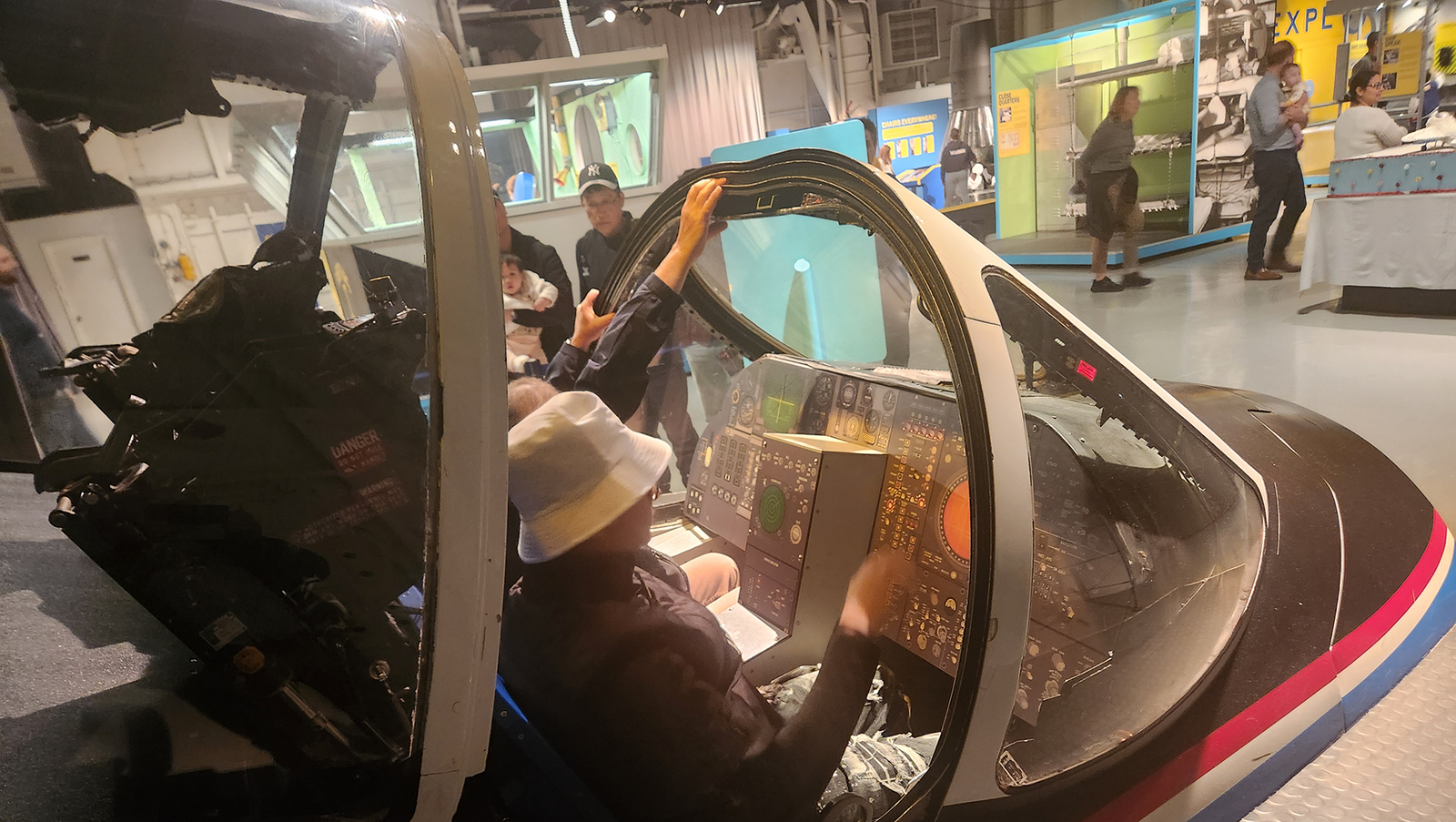
There’s a lot to see aboard Intrepid, from the spaceflight display to a ride-in A-6 cockpit mockup. 

Once you’ve seen all that, you’ll find two more surprises waiting right outside.

The first is the USS Growler, a World-War-II era diesel-electric submarine armed with Regulus cruise missiles. A nuclear deterrent vessel, the missiles were stored in those enormous tubes on the after deck.

The other big surprise is the BOAC Concorde sitting on the dock. Of the 20 built, this Concorde logged the most flight time. Compared to a 747, this lithe little ship is positively tiny!

I keep saying there’s a lot to see at the Intrepid Museum, but that’s a huge understatement. If you’re in the New York area, you owe it to yourself to check out this awesome and awe-inspiring seagoing museum.

You can watch the video of our adventure here.

Marvelous Air Museums is part of the John D Reinhart content family. Writer, illustrator, videographer, and accidental filmmaker — find the whole story at JohnDReinhart.com.

©2026 John D Reinhart/MarvelousAirMuseums.com – all rights reserved
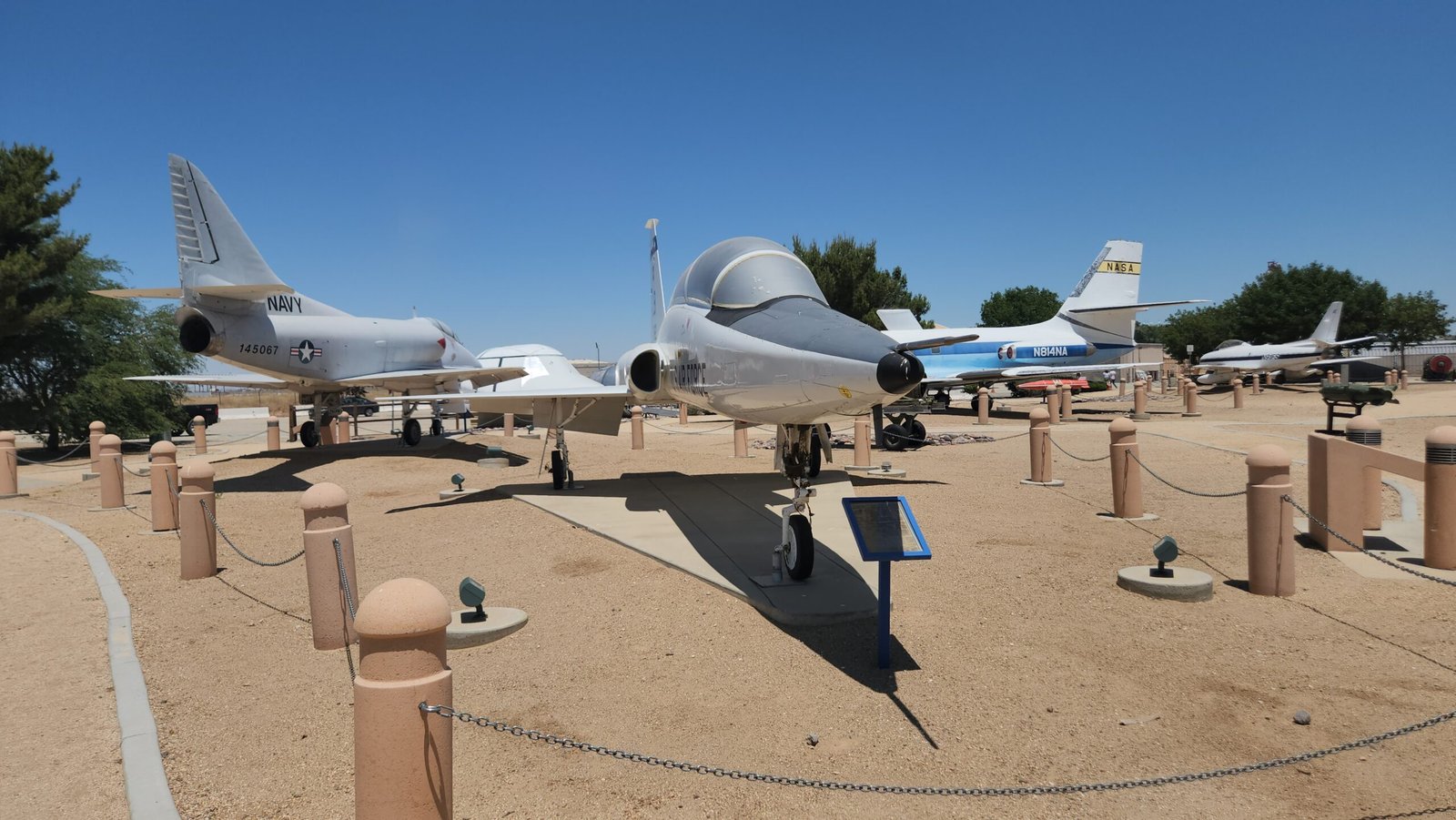
Joe Davies Heritage Airpark

Today we hit the high desert to visit the Joe Davies Heritage Airpark in Palmdale. 

Although the open-air museum is free, it’s jam-packed with a priceless collection of beautiful and important airplanes.

The park is owned by the City of Palmdale. It’s named after Joe Davies, a local who commanded Building 42 in the mid-60’s, in the heart of the Skunkworks days, and also served as a city councilman.

To get in, you have to walk right down the maw of a huge jet-engine intake. It’s cool, because it’s actually two intake fairings mounted back-to-back.

Once inside, you’ll be amazed at the sheer number, and quality, of the planes on display.

Right out of the box you’ll find a pair of NASA-owned aircraft – a Lockheed Jetstar, and a Canadair Sabre CL-15. 

There are over a dozen jets here, including this McDonnell Douglas F-101 Voodoo. In fact, the Century Series is pretty well represented, with this Republic F-100 Super Saber, the F-101, a Lockheed F-104 Starfighter, and a Republic F-105 Thunderchief. 

It was fun to compare the super-high stance of the F-105 with the crouched  approach of the F-104. 

That’s one of the best parts about the Joe Davies Memorial AIrpark – these are really spectacular pieces of aviation history.

I don’t know about you, but I’ve never stood inside the wheel well of a B-52 before. The bay itself is fenced off, but you can see right inside the lower fuselage of this huge jet bomber. She’s on stands, of course, and you can see the brakes are not quite set.

And here’s something you wouldn’t know unless you’re a fan of the BUFF: it doesn’t have a nose wheel! The massive weight of the whole ship sits on these eight, huge tires.

The BUFF’s age can be seen out here in the tail, where she still carries a quad set of 50 caliber machine guns. That’s a leftover from World War II, when air battles were fought with guns instead of missiles. 

These planes are not quite the original deal – they’re cobbled together from parts of other airframes. They look accurate, but a serial-number check won’t make it through the DMV. 

Because of that feature, Joe Davies offers another unique feature: Adopt-a-Plane. You can sponsor the restoration of these beautiful pieces of aviation history, either in part or in total. 

The star of the show for me is this positively ginormous Boeing 747 SCA, or Shuttle Carrier Aircraft. Like the B-52, I can’t quite put my finger on the last time I put my hands on a 747’s landing gear.

This SCA is one of two 747s specifically modified to ferry the space shuttle from its west-coast landing strip at Edwards to its East Coast Cape Canaveral launch facility. That it’s here is utterly amazing.

Another amazing site, and one that gave us the heebie-jeebies, was that Rockwell B-1B Lancer sitting out there on the tarmac. Although she looks ready to go, we were advised that she may very well be ready to go only into the Joe Davies collection.

There are lots of favorites to find here, from the mighty McDonnell Douglas F-4 Phantom II to the Northrop T-38, or the really nicely finished Grumman F-14 Tomcat.

Like most other open-air museums, Joe Davies doesn’t feature a gift store. It’s a tour-on-your own kind of place, and easily worth an hour or two to visit.

To find it, just take the Rancho Vista offramp from Highway 14 east until you see that huge 747.

You can take a tour of our tour by watching the YouTube video, here.

Marvelous Air Museums is part of the John D Reinhart content family. Writer, illustrator, videographer, and accidental filmmaker — find the whole story at JohnDReinhart.com.

©2026 John D Reinhart/MarvelousAirMuseums.com – all rights reserved
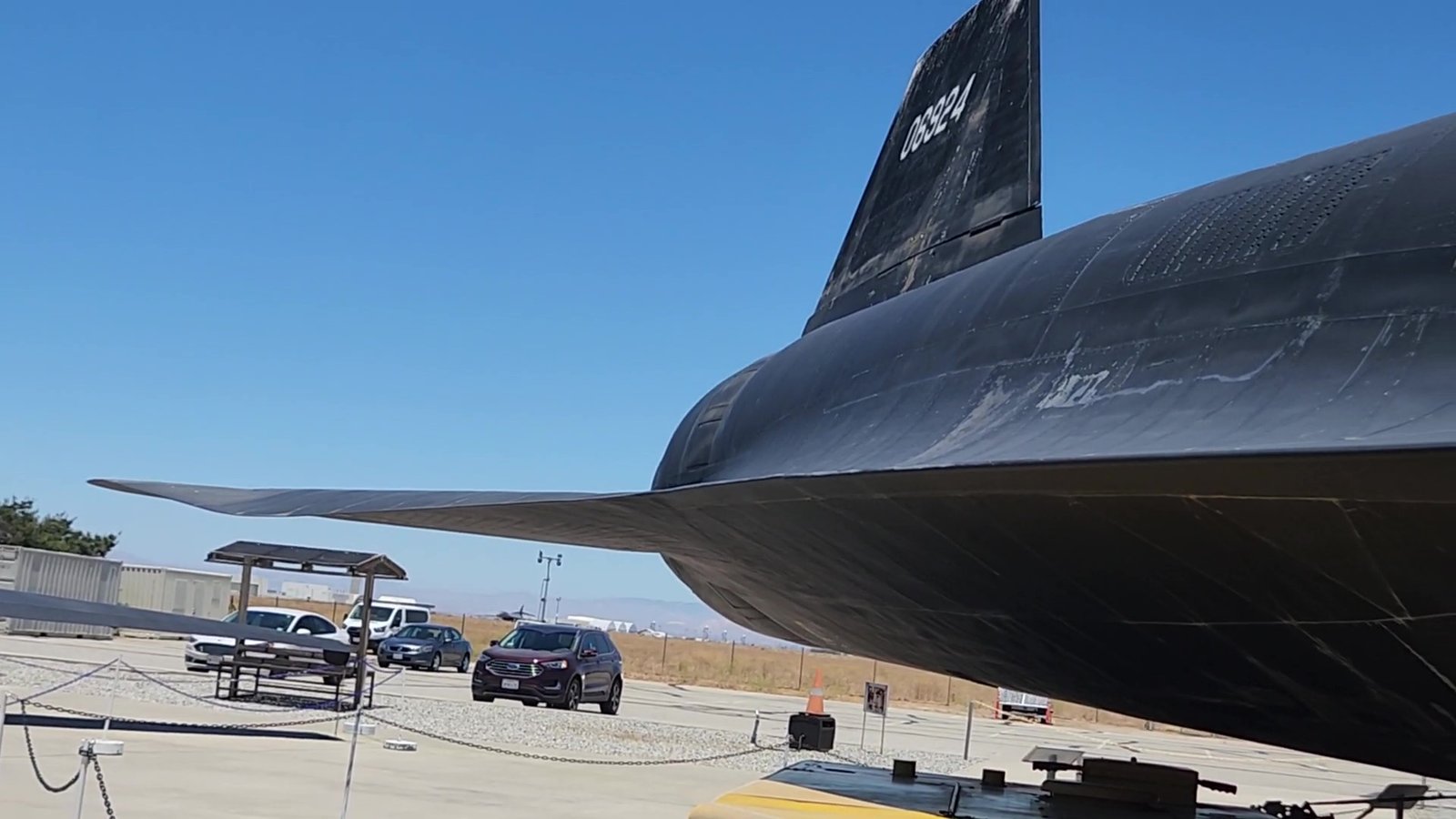
Blackbird Airpark

Here’s a fun opportunity: brave the winds and heat of the Antelope Valley to spend a few minutes at the Blackbird Airpark.

It only takes a few minutes because the museum is tiny – just four airplanes, a fire truck and a gift store.

Oh, but the airplanes there are so impressive.

You start with the U-2D, the 80-foot wingspan jet-powered glider built in 1959 but that served all the way out to 1980. This one has clearly done its time, and we were curious as to what shattered that starboard windscreen.

Looking at her, you can just picture her up there in the black, hovering on the very top of the atmosphere.

Right next door are these sinister-looking Blackbirds, an A-12 and an SR-71.

Like the U-2, these guys were assembled in the huge Building 42 – a place synonymous with top secret operations.

In fact, the A in A-12 here  doesn’t mean attack like it does for the A-6 or A-4. It stands for Archangel, the CIA codeword for the secret program for which she was developed.

The A-12 never flew a reconnaissance mission but performed as a test bed for the SR-71 program. This SR-71 in particular was pre-assembled in a secret hanger in Burbank and trucked up here at night for final assembly.

As we were looking at these astounding pieces of engineering, capable of traveling over 2,000 miles an hour at 80,000 feet, we were reminded that every inch of these incredible airframes was designed by guys with slide rules – calculators hadn’t even been invented yet.

Every square inch of the 101-foot-long fuselage has been sculpted to minimize friction and maximize lift.

The fourth airplane is a Lockheed D-21 drone. Built with little more than an SR-71 engine, these little guys zipped all the way up to 90,000 feet, where the sky is black, at 2200 miles per hour. They were built for reconnaissance, but the method of getting the film back proved to be just too difficult to manage.

The gift store has the usual tee shirts and memorabilia, but also features some really cool Blackbird-related technology, like the Goodyear tires made specifically for the Archangel program. The rubber’s mixed with powdered aluminum so they can handle the extreme heat environment of the SR-71.

The story of the Blackbird Airpark in intertwined with Edwards Flight-Test Museum. That museum is on the air force base, and only open during the week. But this Airpark is open Friday to Sunday, 11 to 4. The Flight Test Museum is seeking funding to build a new building that will someday include and protect these fine airplanes at the Airpark.

Until then, all you have to do to get here is take Exit 37, Rancho Vista Blvd, east from Highway 14.  You can’t miss it – the blackbirds are hiding just beyond the NASA 747.

Here’s the video we took during our tour: Blackbird Airpark.

Marvelous Air Museums is part of the John D Reinhart content family. Writer, illustrator, videographer, and accidental filmmaker — find the whole story at JohnDReinhart.com.

©2026 John D Reinhart/MarvelousAirMuseums.com – all rights reserved

Santa Maria Museum of Flight

The next time you find yourself on the Central Coast, make a little time to visit the Santa Maria Museum of Flight.

Sitting at the west end of the Santa Maria City Airport tarmac, the museum occupies a pair of hangers left over from the airport’s days in the US Army Air Force.

Back then, it was not uncommon to see Lockheed P-38 Lightnings roaring overhead. Inside, you find an amazing, and flyable, half-scale Lightning that was built to honor the brave guys and gals who flew the originals. Littered around the landing gear are the remains of some Lightnings that didn’t quite land as planned.

That’s actually one of the great things about the Santa Maria Museum of Flight – there’s a sense of history here, and also a sense of community, and a strong dose of folksy wisdom.

We met with docent Jerry Simas, who gave us a rainy tour of the museum ‘s wide-ranging collection. His laconic answer to my question about whether the half-scale Lightning could still fly was “Well, it was running when they shut it off.”

The museum was founded in 1984 to “preserve the past and present history of our aviation heritage, and inspiring future aviators in the Santa Maria Valley.”

There’s a memorial garden outside that is dedicated to the 99s – an international organization of woman aviators, mechanics, and innovators started in 1929 that is open to women who from over the world who love to fly. 

You’ll find that the museum is packed with surprises, from dioramas and models to some pieces of genuine Hollywood history, like the Hughes H-1 mockup built for the movie The Aviator. It doesn’t actually fly – doesn’t even have an engine, but it does have an electric motor that turns the propeller.  Some movie magic, there.

The 1991 Disney adventure film The Rocketeer was filmed right there, too. You’ll recognize the hanger, the runway outside, and of course, the Rocketeer’s iconic rocket-powered suit.

And up there is the Phoenix, a fictitious single-engine rescue plane built from the wreckage of a crashed Fairchild C-119 Flying Boxcar, made for the 2004 movie Flight of the Phoenix, with a miniature Dennis Quaid at the Controls. This is the model that was actually used in the film.

Outside, a huge F-4S Phantom II sits across from a A-4D Skyhawk, both made by McDonnell Douglas and both facing down the Czech Aero L-29 Delphin jet trainer. Inside the second hanger you’ll find a beautifully restored Folland/Hawker Siddeley Gnat – another gorgeous little trainer.

In fact, the more you look at the Santa Maria Museum of Flight, the more surprises you’ll find, like this Link Trainer. And like the flag that actually belonged to a World War II Japanese aviator. 

It’s a fun little museum, jam-packed with fascinating memorabilia that is sure to delight the entire family.

Here’s a video we made of our tour.

And it’s easy to find the museum itself, at 3015 Airpark Drive. Get to the Santa Maria Airport, and head just a block or so west on Airpark.

It’s the only building that has a Phantom jet sitting outside.

They’re open Fridays and Saturdays from 10 to 4, and Sundays from 12 to 3.

Visit their website at www.smmuseumofflight.com

Marvelous Air Museums is part of the John D Reinhart content family. Writer, illustrator, videographer, and accidental filmmaker — find the whole story at JohnDReinhart.com.

©2026 John D Reinhart/MarvelousAirMuseums.com – all rights reserved

Estrella Warbirds Museum

We journeyed out through the vineyards of Paso Robles wine country to visit The Estrella Warbirds Museum, an impressive collection of vintage aircraft adjacent to the Paso Robles Municipal Airport.

Estrella packs a huge number of surprises in a relatively small footprint. Their massive collection of mostly Vietnam-era fighter jets and helicopters is augmented by their huge cache of military transport vehicles, even a great M60A-1 Patton tank, undergoing refurbishment.

If that’s not enough, there’s the Red Ball Express, a second collection of transport vehicles from World War II. And make sure and check out the Woodland automotive museum, all on the same stretch of land.

We met with author, historian, and former combat and test pilot George J. Marrett, who guided our attention through the impressive array of airplanes that he actually helped develop.

For example, there’s a F-104 here in the museum that has George Marrett’s name on it as the test pilot.

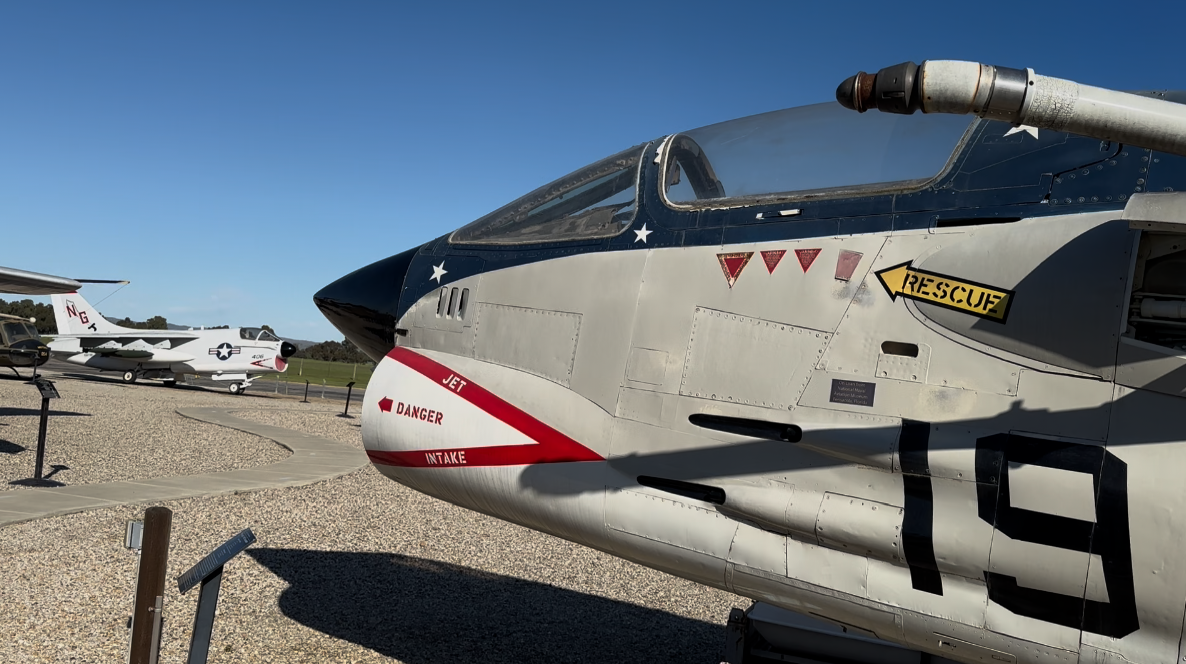
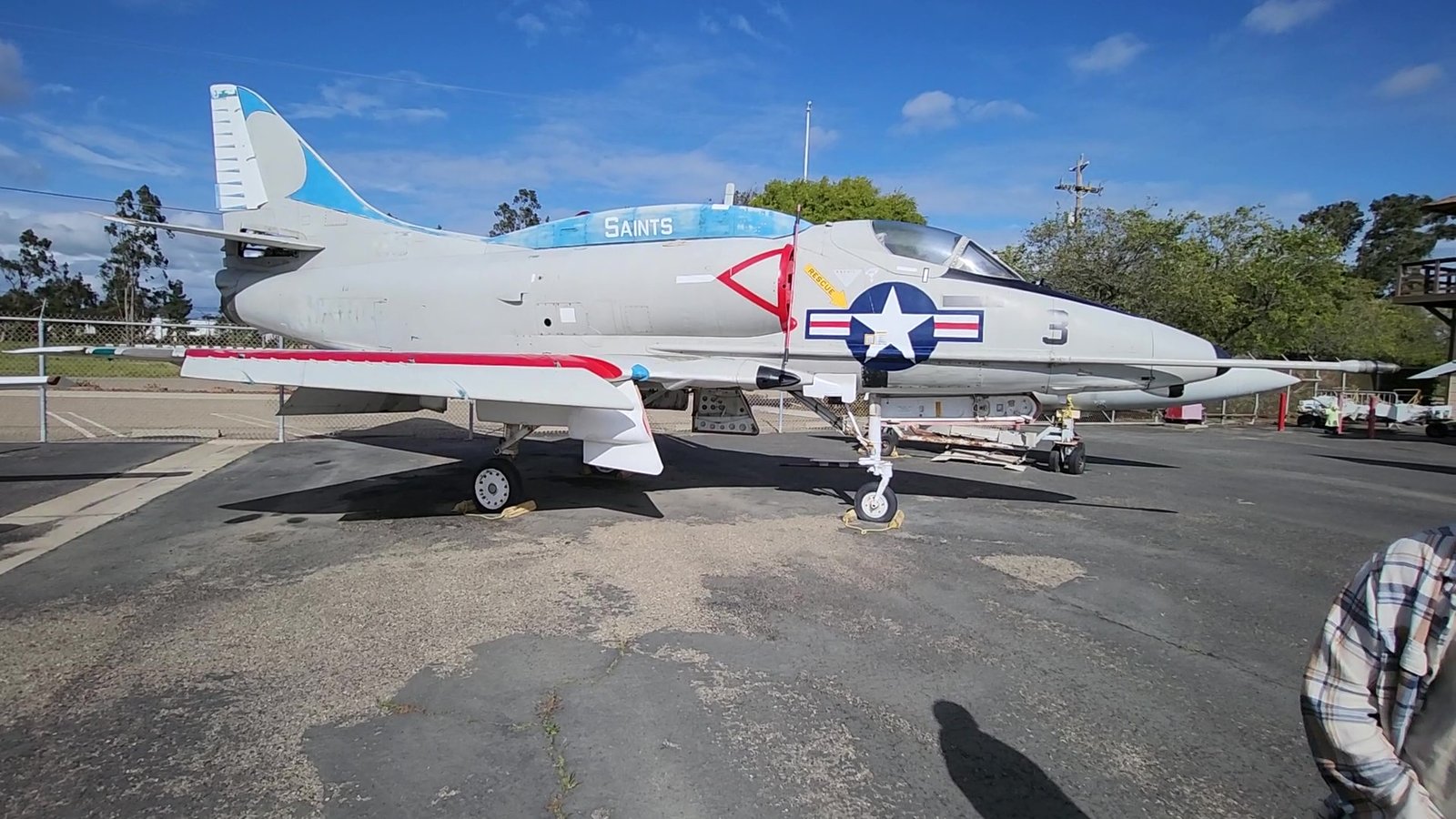
All the standards from the Vietnam War are here, from the venerable McDonnell-Douglas F-4S Phantom II to the McDonnell Douglas A4-D Skyhawk, and a Chance-Vought A7 Crusader, and a beautiful little bug-like OV-10A Bronco.

The 1980’s are represented by an F-14 Tomcat (George Marrett’s favorite), and an F-16 Falcon. There’s even an A-6 Intruder and US-2 Tracker.

You’ll also find this beautiful little Northrup F-5A Freedom Fighter.

Out on the tarmac, beyond the still-flying Douglas C-47 Gooney Bird painted in D-Day invasion stripes, sits the International Collection. Here you’ll find a Saab S-35 Draken, an Aermacchi MB326 Impala, and a sweet little Fouga CM.170 Magister.

While most of these aircraft are restored, they’re generally for ground display only. But what a grand display it is, and how wonderful to be able to touch all these iconic aircraft, side-by-side.

It’s hard to imagine it from looking at it, but the Lockheed P-2V Neptune was actually equipped to drop a nuclear bomb. These red doors covered the intakes for the jet engines. Yes, the Neptune was a JATO – jet-assisted-take-off. They closed once the plane reached a safe altitude to save gas.

Estrella is absolutely packed up with treasures, not least of all is Captain Marrett and the depth he brings to the museum.

You can read about his years as a test pilot in Contrails Over the Mojave, published by the Naval Institute Press, and in Testing Death, published by Praeger Security International, and his wild combat-rescue adventures in Cheating Death, published by Smithsonian Books.

The next time you’re in the Central Coast Wine Country, do yourself a massive favor and head over to the Paso Robles Municipal Airport, and the Estrella Warbirds Museum.  

Take Highway 46 east, get off at Airport Road, make a right on Dry Creek Road, and you’re sure to find them.

Just turn in at the A-4 Skyhawk…

Spend some time with us on our Video Tour and see just how great the Estrella Warbirds Museum is!

Marvelous Air Museums is part of the John D Reinhart content family. Writer, illustrator, videographer, and accidental filmmaker — find the whole story at JohnDReinhart.com.

©2026 John D Reinhart/MarvelousAirMuseums.com – all rights reserved
Commemorative Air Force Southern California Wing

The Southern California Wing of the Commemorative Air Force is nestled against the south side of the Camarillo Airport, just west of the Santa Monica Mountains in Camarillo. It’s a sprawling complex of hangars jam-packed with World War II aircraft.

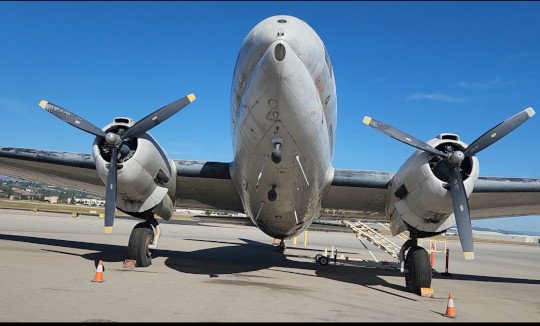
And they are beautiful examples of airplanes from both sides of the conflict. You’ll find a huge Curtiss C-46 Commando (the largest twin-engine plane ever flown by the US Army), a Grumman F-6F Hellcat, an F-8F Bearcat, and a Fairchild PT-19 trainer sitting alongside a North American SNJ-5 advanced trainer in its original, glorious yellow paint. There is a wonderful Messerschmitt BF-108 Taifun, and an in-process restoration of a Fiesler Storch. The Supermarine Spitfire MkXIV, with its menacing 5-bladed propellor is a must see, as is the Mitsubishi A6M3 Zero.

The star of the show, and the pride of the museum, is the North American PBJ Maritime Patrol Bomber. It took 23 years of loving restoration to clear the corrosion from this impressive, beautiful airplane which, at a first glance, looks like a B-25J Mitchell Bomber.

“It is the same airframe,” said Lucien Pillai, the museum’s public information officer, “except this one was built for the US Navy, not the Army. They called theirs B-25s, but the Navy called theirs P for patrol, B for bomber, and J because the plane was built by the North American Aircraft company. We traced out her tail numbers. This is the only surviving PBJ in the world.”

Like the PBJ, nearly all the other airplanes are either fully restored or in the process of getting back to their original, flying condition. The Bearcat and the Storch, for example, are currently missing their wings. The museum has the wings, but they’re being rebuilt.

Most importantly, you’ll find an oil-drip pan parked beneath each aircraft, because the CAF flies these beauties whenever they can.

Colonel Ron Fleishman, the museum’s historian, quipped that if an airplane doesn’t drip oil, there’s something wrong with it.

To prove the point, a meticulously restored T-34 Mentor in stunning Coast Guard graphics rumbled past us as we were crossing the tarmac, heading into a hangar towards a waiting drip pan.

And here’s something: you can book a ride one of these guys! Can you imagine, sitting in the front seat of the open-cockpit PT-19, rumbling through the Southern California skies? Or sitting in the all-Perspex nose of the PBJ as she thunders down the runway?  Clear your calendar for the second Saturday of each month, and visit the museum’s website for ticket information.

One of the many fun things about the Southern California Wing of the Commemorative Air Force (based in Harlingen, Texas, but with museums, called “wings,” all over the world), is that everyone you meet is an officer, as in a military officer. We met with the Public Information Officer, Lucien Pillai. He introduced us to the SoCal wing’s historian, Colonel Ron Fleishman. Ron explained that, as the title “colonel” is an honorarium, everybody’s a colonel in the CAF!

The museum also houses an impressive collection of World War II artifacts, including a semi-melted engine from a P-38 Lightning that crashed into the Camarillo hillsides back when Camarillo Airport was the Oxnard Air Force Base. You’ll also find an actual ball turret, a fiberglass replica of the lower turret that was used in B-17 and B-24 bombers. And a huge number of model airplanes, from World War I right through to the present day.

And don’t miss the Link Trainer, a flight simulator so authentic that one student pilot actually bailed out of it!

There’s a lot to see at this easy-to-find, engaging museum.

We put together a video tour of the museum that you might like. But we strongly encourage you to go visit this great collection of vintage airplanes for yourself!

Get off the 101 Freeway at Las Posas Road, go south, make a right on Pleasant Valley, and a right on Eubanks, and you’re there. You can’t miss the huge Hamilton Standard propeller!

Visit them online at CAFSoCal.com, or call them at  +1 805 482 0064. They’re open Fridays and Saturdays, 10-4, and Sundays 12-4.

Marvelous Air Museums is part of the John D Reinhart content family. Writer, illustrator, videographer, and accidental filmmaker — find the whole story at JohnDReinhart.com.

©2026 John D Reinhart/MarvelousAirMuseums.com – all rights reserved

Mojave Air Museum Legacy Park

Just off of the 14 Freeway, near where the 58 crosses it, you’ll find the Mojave Air Museum Legacy Park.

It’s not a huge museum by any means, but has an easy charm that makes it a must-see if you’re on your way up to Bishop, or heading out to Las Vegas.

Actually, there are TWO museums in the Mojave Air and Space Port. First is the trio of historic aircraft parked right at the main entrance. Beyond them, closer to the airport’s Administration Building, is another, smaller museum that features a composite scale model of Virgin Galactic’s Space Ship One and the Rotary Rocket Roton ATV, the first rocket to lift off from the Mojave Air and Space Port.

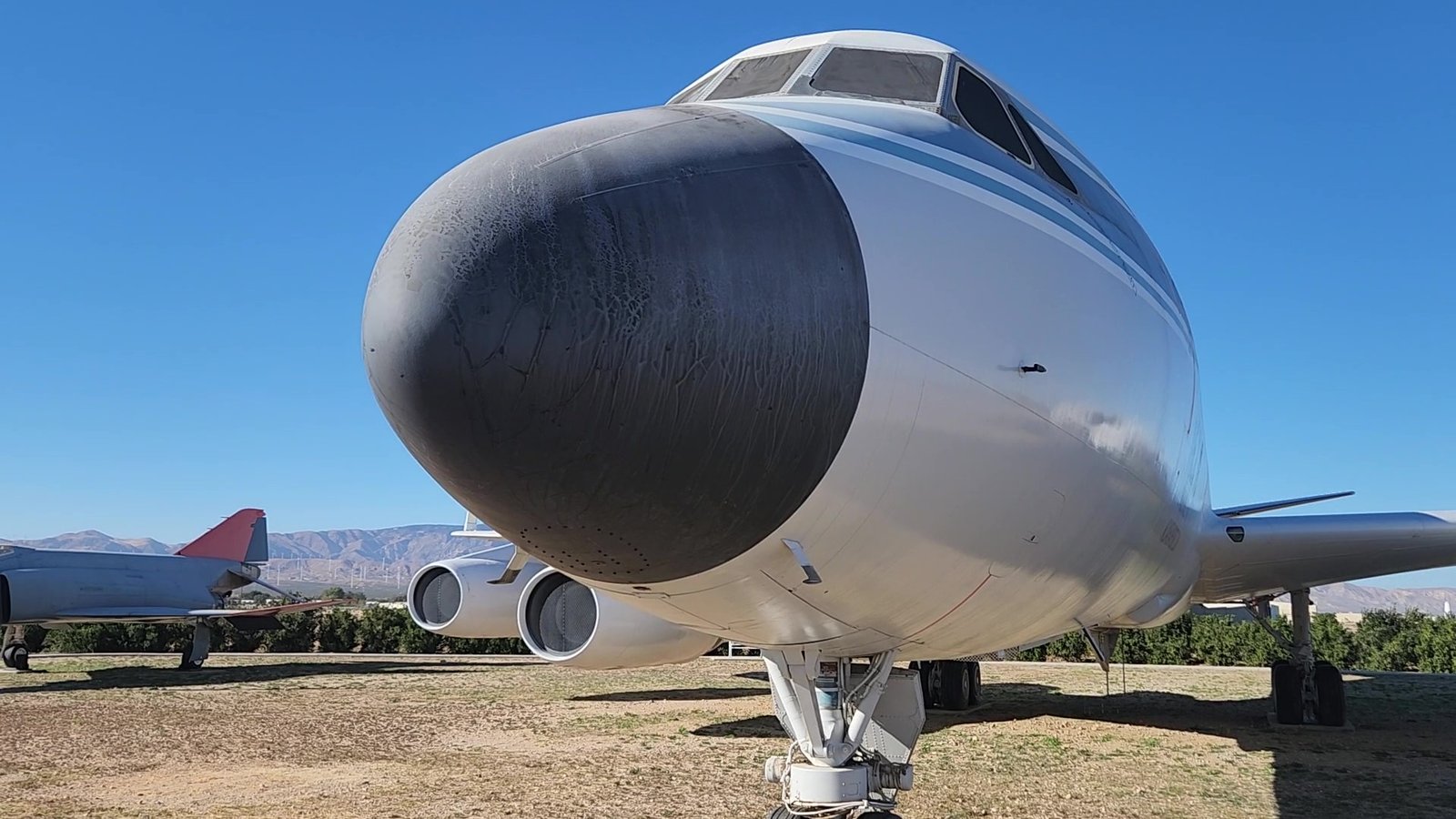
We were more interested in the first museum, which features a Convair CV990 Coronado, a McDonnell/Douglas F4 Phantom II, and a Saab T-35 Drakken.

Your tour here is entirely self-guided, and the only prohibition is to not climb on the aircraft. What makes it a great visit is that you can actually touch these pieces of aviation history.

As for history, the CV990 was used to test the main landing gear for the Enterprise space shuttle. There’s a huge seemingly iron-bound cavity in the center of the lower fuselage in which the landing gear system once sat. It is most impressive.

The F4 Phantom began her life in Missouri in 1964, and spent most of it doing hard duty in Vietnam. She was transferred out to Edwards, and retired to this museum, in the mid-1980s.

What makes her so interesting – and once you look, you’ll find all sorts of fascinating details – is that she had been converted to a drone before she was retired. The rearview mirror still sits on the canopy bow, but there are no ejection seats visible through the cockpit canopy.

The Saab T-35 was a trainer during her active days. The intakes, flared at the front and then pinched in below the cockpit, make her look menacing, and supremely aerodynamic. She has what looks like a periscope, comic in its binocular stare over the front cockpit, faired into the canopy bow.

Like the other two jets, the Drakken is available for you to touch and examine and pose for selfies with.

All three of the aircraft appear to be in very good shape – the Coronado still has its engines. They are free from graffiti, although someone was able to slip a small band sticker way up high on the Phantom’s fuselage, right below the fuel ditch port. The little park is well maintained, and even features some benches along the concrete walkways that surround the planes.

You can find this great little museum right at the entrance to the Mojave Air and Space Port, at 1434 Flight Line, in Mojave.

Marvelous Air Museums is part of the John D Reinhart content family. Writer, illustrator, videographer, and accidental filmmaker — find the whole story at JohnDReinhart.com.

©2026 John D Reinhart/MarvelousAirMuseums.com – all rights reserved

Point Mugu Missile Park

Naval Air Road, Port Hueneme, CA

This free air and space museum is easy to find, easy to get to, easy to get in and out of, and, well, genuinely easy.

The museum is quite small, containing just three aircraft and a fascinating assortment of air-to-air, air-to-surface, and surface-to-air missiles.

The three aircraft are quite impressive, not only for what they are, but also for how they are displayed.

McDonnel Douglas F4J Phantom

The F4J Phantom was the first airplane to show up at the museum and has been on display there for well over a dozen years. She’s mounted atop a ten-foot-tall pylon, looking like she’s heading out to sea on a mission over Vietnam.

Tail number 157259 was built in St. Louis in November of 1969 and joined the Navy on December 12. She appears to have served her naval days at Pensacola Naval Base until 1986, when she was transferred to Point Mugu Naval Base.  She was transferred to her current location in 1992.

Despite her blacked-out canopy and empty engine bays, she makes a striking and deep impression. The sheer size of the airframe, when balanced above you, is truly stunning.

Grumman F-14 Tomcat

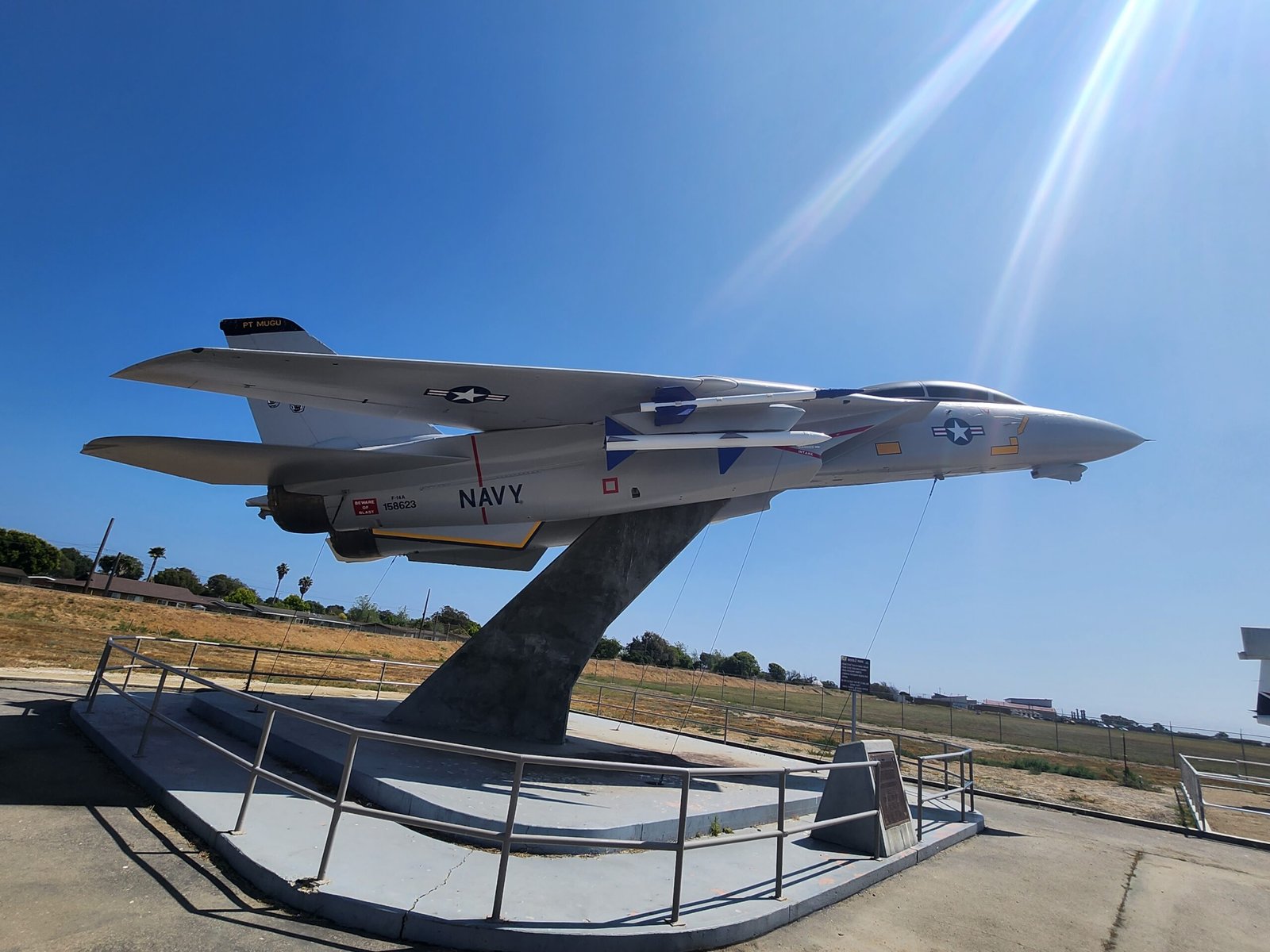
Build number 158623 joined the PMMP fleet in 2021, having served the majority of her career right here in Southern California. Built at the Grumman factory in Bethpage, NY, in 1971, she officially joined the Navy in 1973.

Here work here in California included a stint at Miramar in the combat traininng squadron. She was subsequently transferred to Point Mugu where she was reconfigured to provide evaluation data on the F-14 airframe itself.

Like the Phantom, her intakes betray empty engine bays, and her canopy is blacked out. But nothing detracts from her impression as a huge and powerful combat weapon.

Grumman EA-6B Prowler

Unlike the other birds, this four-seat ELINT aircraft sits firmly on her own landing gear.  Her canopies are still clear, allowing you to see the cockpit coaming and ejection seats inside. Like the other aircraft, here engine bay is empty. But there is no block in either the tail cone or the intakes, so you can look right down the length of the inside of the aircraft.

This particular airframe, 163890, served in Qatar in 2018, and was the very last of the EA-6Bs to be flown. The sides of the fuselage are littered with the names and callsigns of dozens of the brave crew that flew in her throughout her career.

How to Get to the Museum

The Point Mugu Missile Park is unfenced and open air, meaning that it never closes.

Take Highway 1 either South from Oxnard or North from Malibu. You’ll be able to see the park from the freeway.

Take the Wood Road offramp. The park is west of the freeway – you literally can’t miss it. The museum is actually on Naval Air Road, near the entrance to Naval Base Ventura County.

Bring your camera and prepare to be blown away by these three impressive aircraft, and the dozens of missile displays at this free air and space museum.

Marvelous Air Museums is part of the John D Reinhart content family. Writer, illustrator, videographer, and accidental filmmaker — find the whole story at JohnDReinhart.com.

©2026 John D Reinhart/MarvelousAirMuseums.com – all rights reserved