Joe Davies Heritage Airpark Gallery

Museum Visit Review

Museum Video

Home

Marvelous Air Museums is part of the John D Reinhart content family. Writer, illustrator, videographer, and accidental filmmaker — find the whole story at JohnDReinhart.com.

©2026 John D Reinhart/MarvelousAirMuseums.com – all rights reserved

Joe Davies Heritage Airpark

Today we hit the high desert to visit the Joe Davies Heritage Airpark in Palmdale. 

Although the open-air museum is free, it’s jam-packed with a priceless collection of beautiful and important airplanes.

The park is owned by the City of Palmdale. It’s named after Joe Davies, a local who commanded Building 42 in the mid-60’s, in the heart of the Skunkworks days, and also served as a city councilman.

To get in, you have to walk right down the maw of a huge jet-engine intake. It’s cool, because it’s actually two intake fairings mounted back-to-back.

Once inside, you’ll be amazed at the sheer number, and quality, of the planes on display.

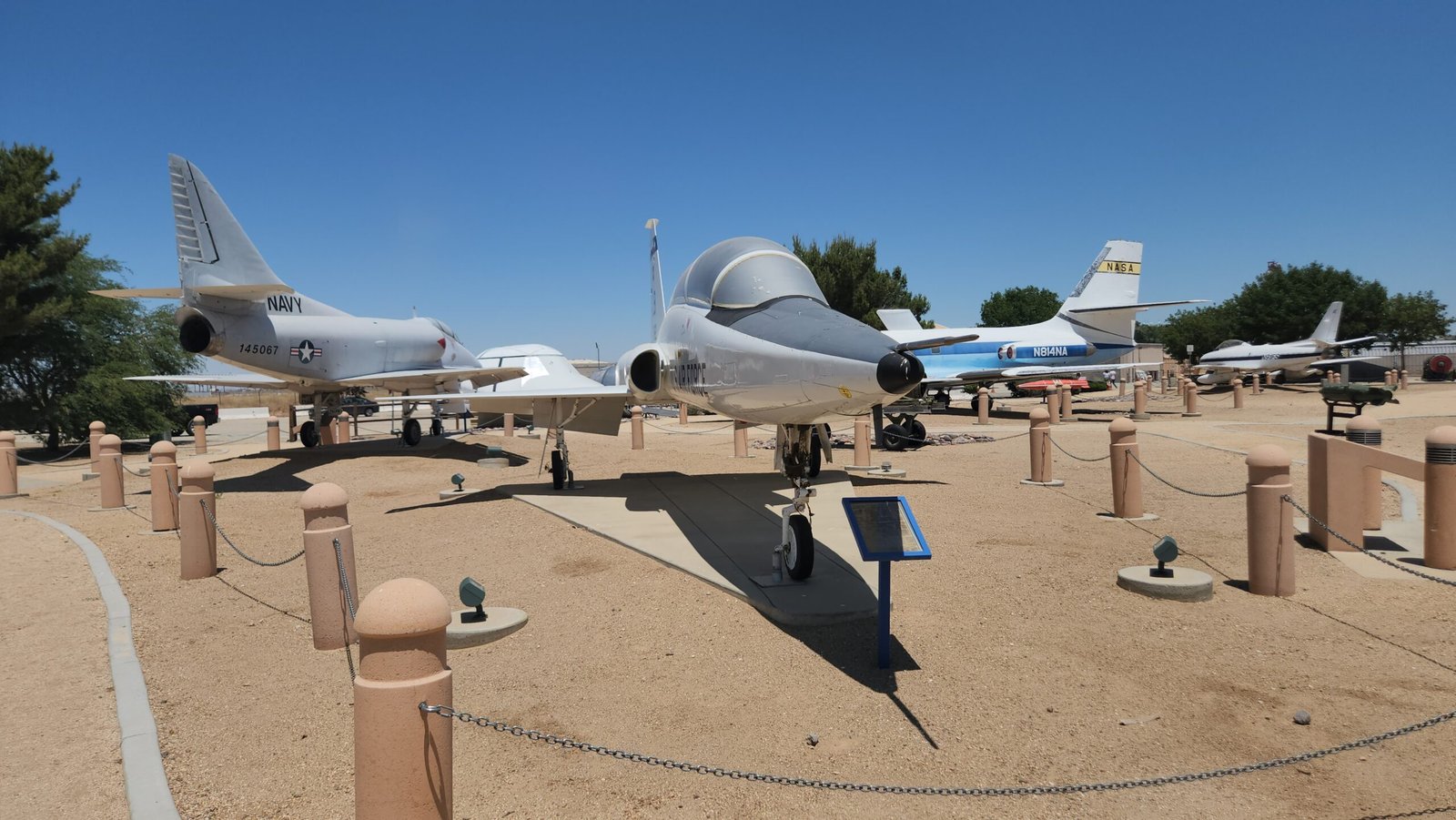
Right out of the box you’ll find a pair of NASA-owned aircraft – a Lockheed Jetstar, and a Canadair Sabre CL-15. 

There are over a dozen jets here, including this McDonnell Douglas F-101 Voodoo. In fact, the Century Series is pretty well represented, with this Republic F-100 Super Saber, the F-101, a Lockheed F-104 Starfighter, and a Republic F-105 Thunderchief. 

It was fun to compare the super-high stance of the F-105 with the crouched  approach of the F-104. 

That’s one of the best parts about the Joe Davies Memorial AIrpark – these are really spectacular pieces of aviation history.

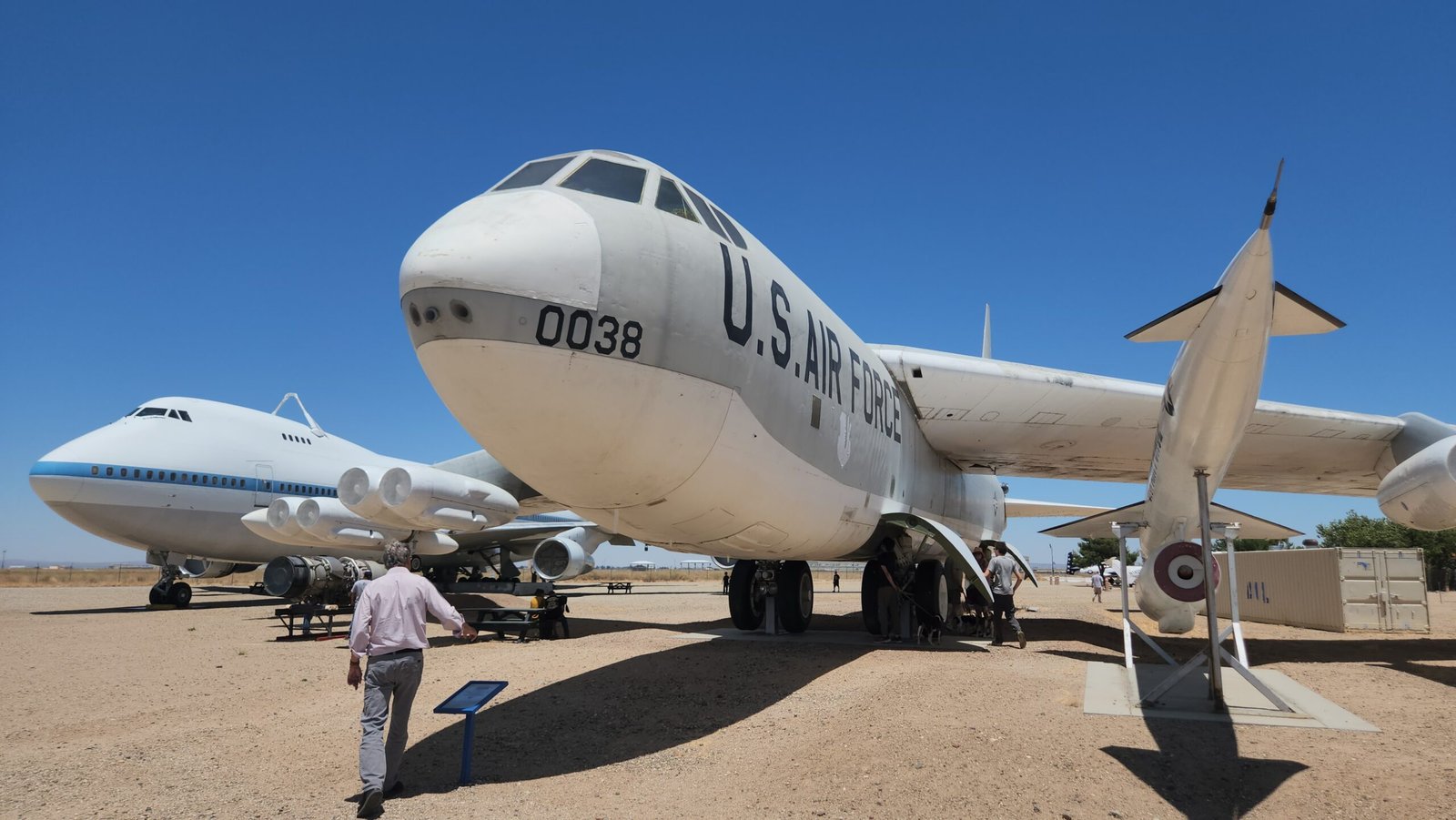
I don’t know about you, but I’ve never stood inside the wheel well of a B-52 before. The bay itself is fenced off, but you can see right inside the lower fuselage of this huge jet bomber. She’s on stands, of course, and you can see the brakes are not quite set.

And here’s something you wouldn’t know unless you’re a fan of the BUFF: it doesn’t have a nose wheel! The massive weight of the whole ship sits on these eight, huge tires.

The BUFF’s age can be seen out here in the tail, where she still carries a quad set of 50 caliber machine guns. That’s a leftover from World War II, when air battles were fought with guns instead of missiles. 

These planes are not quite the original deal – they’re cobbled together from parts of other airframes. They look accurate, but a serial-number check won’t make it through the DMV. 

Because of that feature, Joe Davies offers another unique feature: Adopt-a-Plane. You can sponsor the restoration of these beautiful pieces of aviation history, either in part or in total. 

The star of the show for me is this positively ginormous Boeing 747 SCA, or Shuttle Carrier Aircraft. Like the B-52, I can’t quite put my finger on the last time I put my hands on a 747’s landing gear.

This SCA is one of two 747s specifically modified to ferry the space shuttle from its west-coast landing strip at Edwards to its East Coast Cape Canaveral launch facility. That it’s here is utterly amazing.

Another amazing site, and one that gave us the heebie-jeebies, was that Rockwell B-1B Lancer sitting out there on the tarmac. Although she looks ready to go, we were advised that she may very well be ready to go only into the Joe Davies collection.

There are lots of favorites to find here, from the mighty McDonnell Douglas F-4 Phantom II to the Northrop T-38, or the really nicely finished Grumman F-14 Tomcat.

Like most other open-air museums, Joe Davies doesn’t feature a gift store. It’s a tour-on-your own kind of place, and easily worth an hour or two to visit.

To find it, just take the Rancho Vista offramp from Highway 14 east until you see that huge 747.

You can take a tour of our tour by watching the YouTube video, here.

Marvelous Air Museums is part of the John D Reinhart content family. Writer, illustrator, videographer, and accidental filmmaker — find the whole story at JohnDReinhart.com.

©2026 John D Reinhart/MarvelousAirMuseums.com – all rights reserved
Estrella Warbirds Museum Image Gallery

Museum Visit Review

Museum Video

Home

Marvelous Air Museums is part of the John D Reinhart content family. Writer, illustrator, videographer, and accidental filmmaker — find the whole story at JohnDReinhart.com.

©2026 John D Reinhart/MarvelousAirMuseums.com – all rights reserved

Point Mugu Missile Park Image Gallery

Museum visit review

Museum video

Home

Marvelous Air Museums is part of the John D Reinhart content family. Writer, illustrator, videographer, and accidental filmmaker — find the whole story at JohnDReinhart.com.

©2026 John D Reinhart/MarvelousAirMuseums.com – all rights reserved

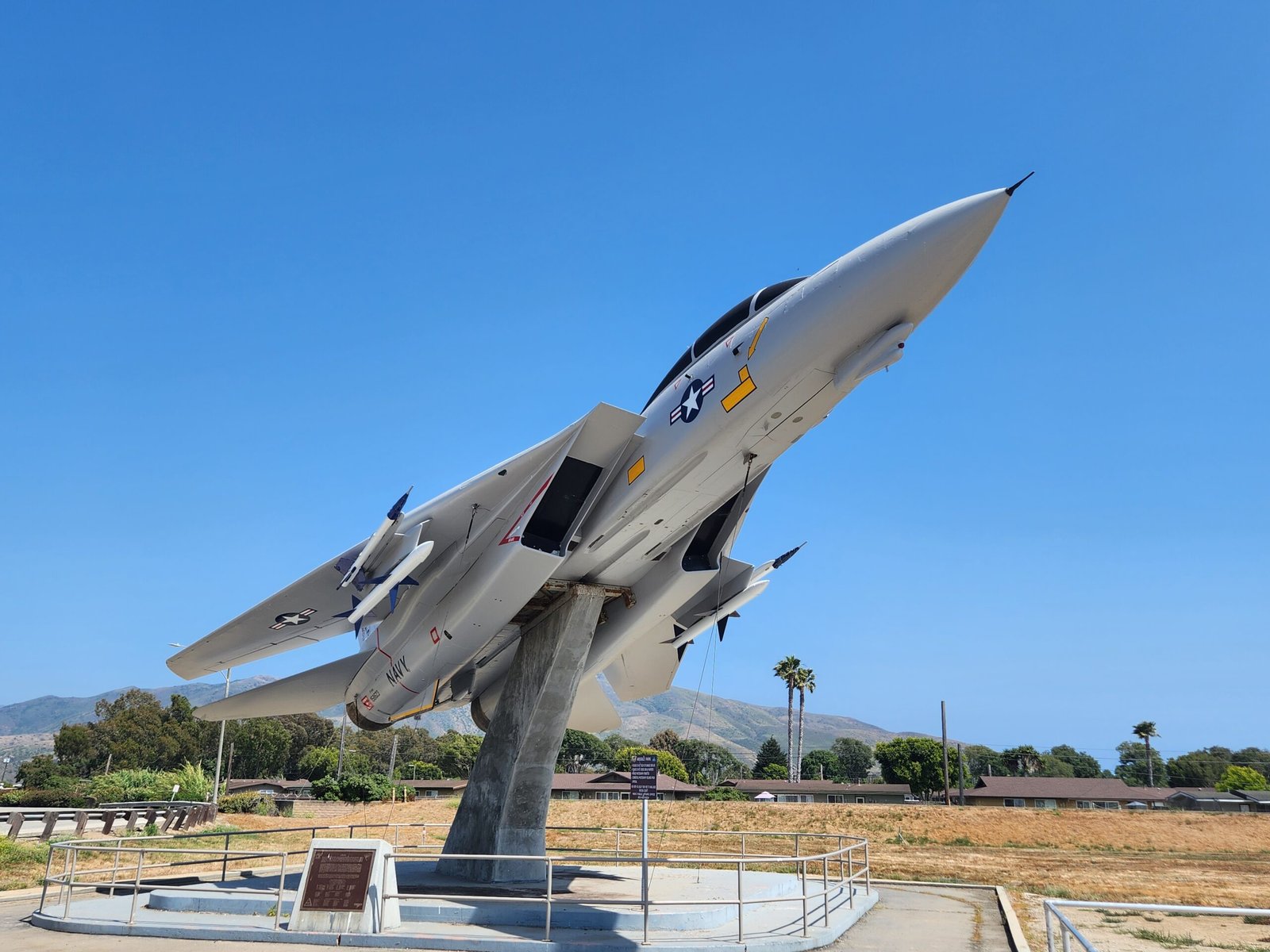
Grumman F-14 Tomcat

The variable-geometry F-14 Tomcat first left the ground in December of 1970, and served all the way through to September of 2006.

The big fighter took it’s first tour aboard the USS Enterprise in 1974, replacing the wing of aging F-4 Phantoms. The twin-engine, supersonic, two seat carrier fighter was a natural match for the Phantom’s role as air superiority, ground attack, and reconnaissance airframe.

The unique variable-geometry wing system, first developed for the General Dynamics F-111, sweeps the wings forward for more lift during take-off and landing, and then pulls them in close to the fuselage for supersonic flight.

According to test pilot George J. Marrett, the Tomcat was far and away his favorite airplane. He’s credited with the first-ever “supersonic missile kill,” having fired a missile from an F-14 while above Mach-1

The air-to-air missile sped away from the supersonic Tomcat, climbing as it went, to drop almost ballistically onto the target, a drone displaying the characteristics of the vaunted Mig-21. The drone never saw it coming. Both Marrett and the F-14 were credited for the kill. Neither aircraft were ever within visual range of one another.

The Tomcat provided the backbone for the US Navy through the Gulf, Afghanistan, and Iraq wars, to be replaced by the nimble A/F-18 in 2006.

These images were taken at the Point Mugu Missile Park in Port Hueneme, CA, and Estrella Warbirds Museum in Paso Robles.

Marvelous Air Museums is part of the John D Reinhart content family. Writer, illustrator, videographer, and accidental filmmaker — find the whole story at JohnDReinhart.com.

©2026 John D Reinhart/MarvelousAirMuseums.com – all rights reserved

Point Mugu Missile Park

Naval Air Road, Port Hueneme, CA

This free air and space museum is easy to find, easy to get to, easy to get in and out of, and, well, genuinely easy.

The museum is quite small, containing just three aircraft and a fascinating assortment of air-to-air, air-to-surface, and surface-to-air missiles.

The three aircraft are quite impressive, not only for what they are, but also for how they are displayed.

McDonnel Douglas F4J Phantom

The F4J Phantom was the first airplane to show up at the museum and has been on display there for well over a dozen years. She’s mounted atop a ten-foot-tall pylon, looking like she’s heading out to sea on a mission over Vietnam.

Tail number 157259 was built in St. Louis in November of 1969 and joined the Navy on December 12. She appears to have served her naval days at Pensacola Naval Base until 1986, when she was transferred to Point Mugu Naval Base.  She was transferred to her current location in 1992.

Despite her blacked-out canopy and empty engine bays, she makes a striking and deep impression. The sheer size of the airframe, when balanced above you, is truly stunning.

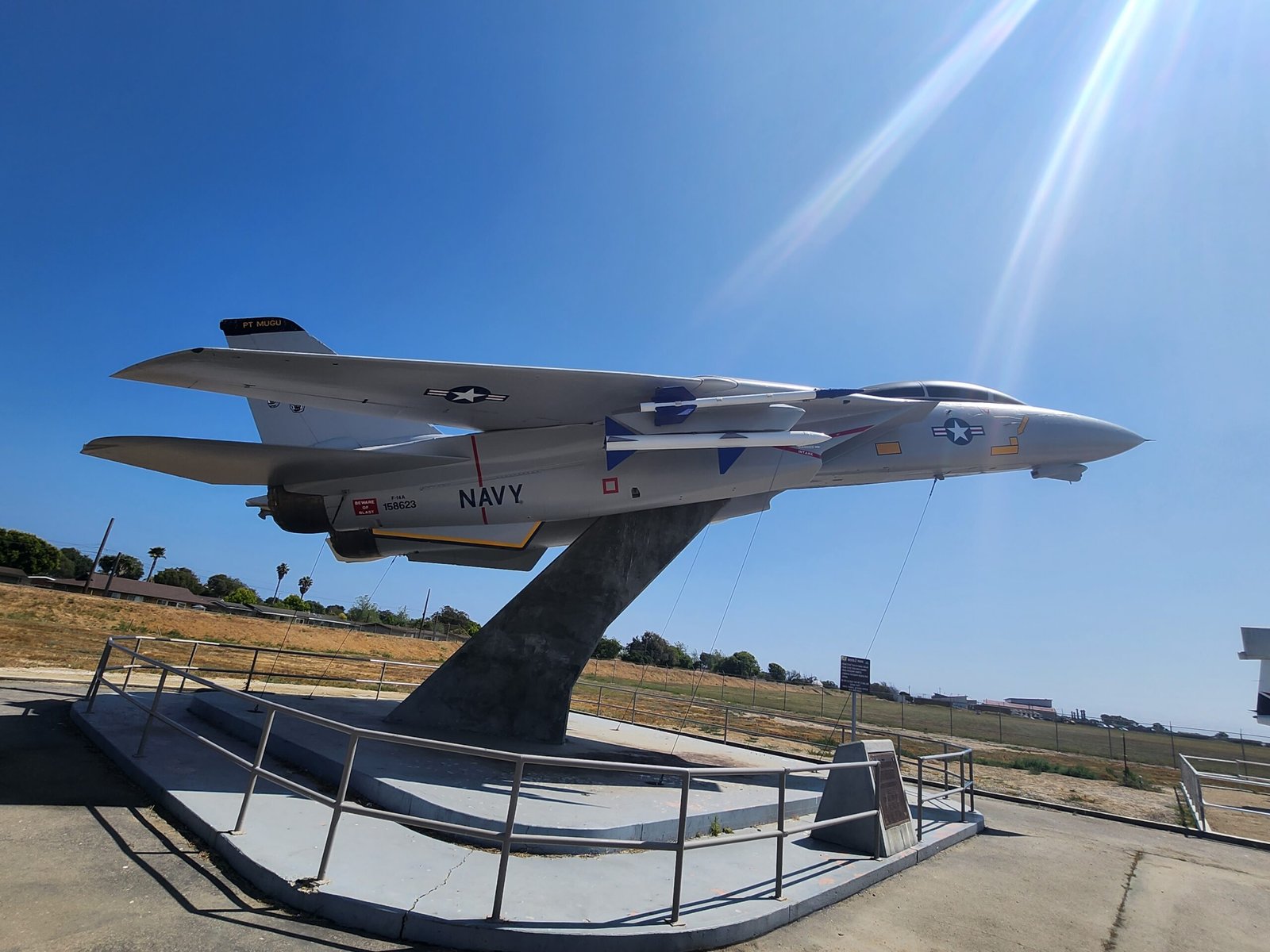
Grumman F-14 Tomcat

Build number 158623 joined the PMMP fleet in 2021, having served the majority of her career right here in Southern California. Built at the Grumman factory in Bethpage, NY, in 1971, she officially joined the Navy in 1973.

Here work here in California included a stint at Miramar in the combat traininng squadron. She was subsequently transferred to Point Mugu where she was reconfigured to provide evaluation data on the F-14 airframe itself.

Like the Phantom, her intakes betray empty engine bays, and her canopy is blacked out. But nothing detracts from her impression as a huge and powerful combat weapon.

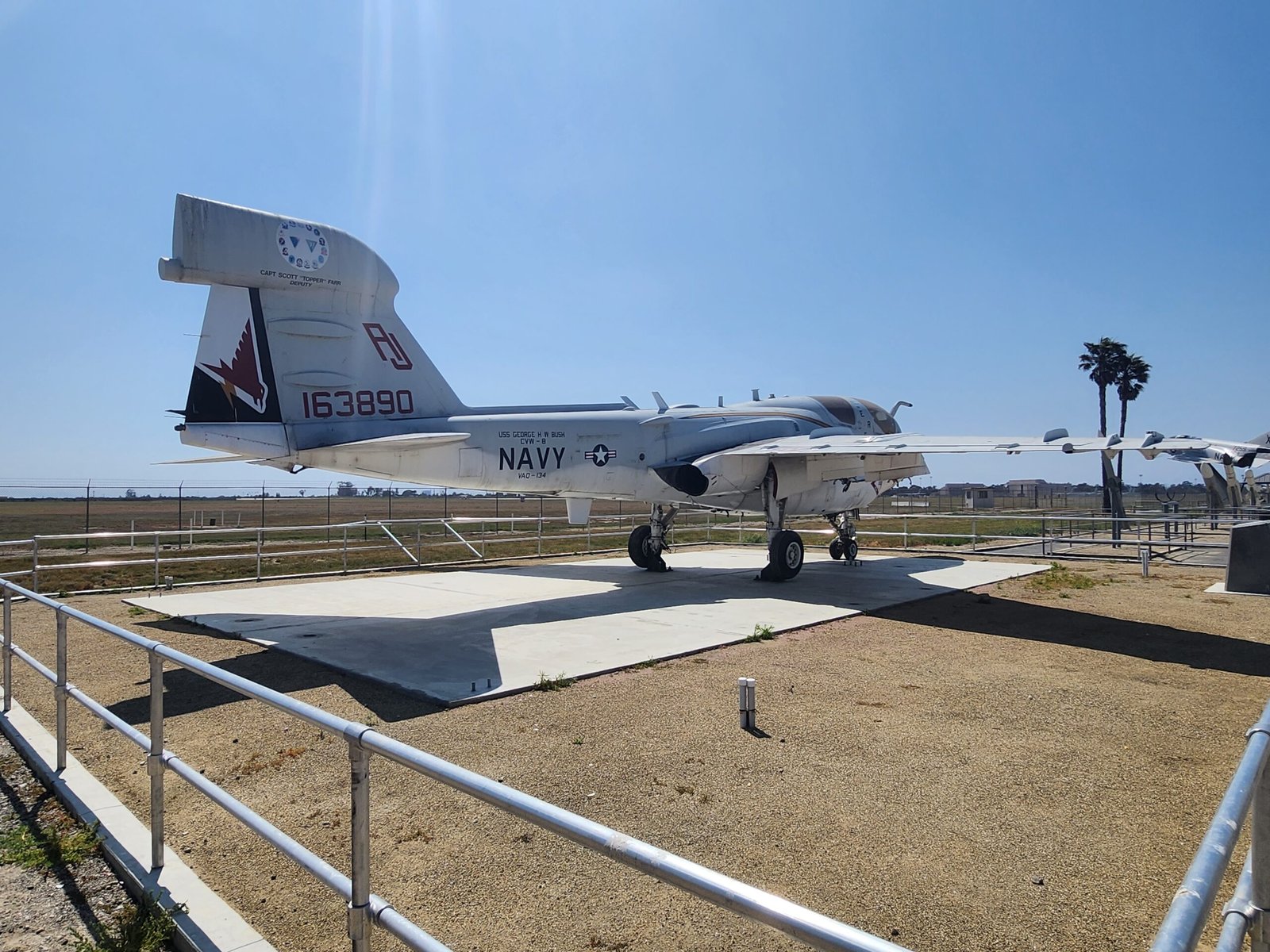
Grumman EA-6B Prowler

Unlike the other birds, this four-seat ELINT aircraft sits firmly on her own landing gear.  Her canopies are still clear, allowing you to see the cockpit coaming and ejection seats inside. Like the other aircraft, here engine bay is empty. But there is no block in either the tail cone or the intakes, so you can look right down the length of the inside of the aircraft.

This particular airframe, 163890, served in Qatar in 2018, and was the very last of the EA-6Bs to be flown. The sides of the fuselage are littered with the names and callsigns of dozens of the brave crew that flew in her throughout her career.

How to Get to the Museum

The Point Mugu Missile Park is unfenced and open air, meaning that it never closes.

Take Highway 1 either South from Oxnard or North from Malibu. You’ll be able to see the park from the freeway.

Take the Wood Road offramp. The park is west of the freeway – you literally can’t miss it. The museum is actually on Naval Air Road, near the entrance to Naval Base Ventura County.

Bring your camera and prepare to be blown away by these three impressive aircraft, and the dozens of missile displays at this free air and space museum.

Marvelous Air Museums is part of the John D Reinhart content family. Writer, illustrator, videographer, and accidental filmmaker — find the whole story at JohnDReinhart.com.

©2026 John D Reinhart/MarvelousAirMuseums.com – all rights reserved