Blackbird Airpark

Here’s a fun opportunity: brave the winds and heat of the Antelope Valley to spend a few minutes at the Blackbird Airpark.

It only takes a few minutes because the museum is tiny – just four airplanes, a fire truck and a gift store.

Oh, but the airplanes there are so impressive.

You start with the U-2D, the 80-foot wingspan jet-powered glider built in 1959 but that served all the way out to 1980. This one has clearly done its time, and we were curious as to what shattered that starboard windscreen.

Looking at her, you can just picture her up there in the black, hovering on the very top of the atmosphere.

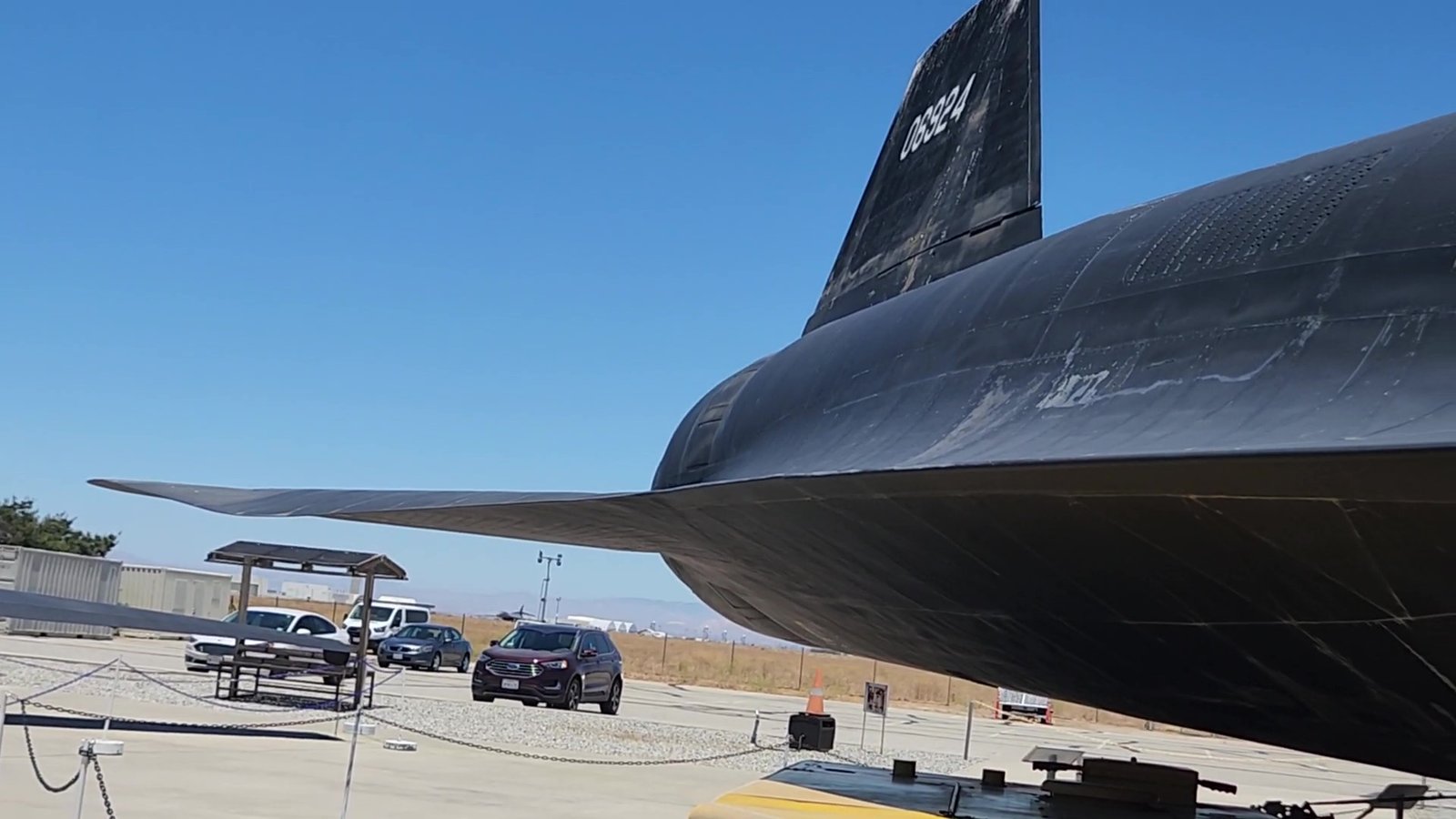
Right next door are these sinister-looking Blackbirds, an A-12 and an SR-71.

Like the U-2, these guys were assembled in the huge Building 42 – a place synonymous with top secret operations.

In fact, the A in A-12 here  doesn’t mean attack like it does for the A-6 or A-4. It stands for Archangel, the CIA codeword for the secret program for which she was developed.

The A-12 never flew a reconnaissance mission but performed as a test bed for the SR-71 program. This SR-71 in particular was pre-assembled in a secret hanger in Burbank and trucked up here at night for final assembly.

As we were looking at these astounding pieces of engineering, capable of traveling over 2,000 miles an hour at 80,000 feet, we were reminded that every inch of these incredible airframes was designed by guys with slide rules – calculators hadn’t even been invented yet.

Every square inch of the 101-foot-long fuselage has been sculpted to minimize friction and maximize lift.

The fourth airplane is a Lockheed D-21 drone. Built with little more than an SR-71 engine, these little guys zipped all the way up to 90,000 feet, where the sky is black, at 2200 miles per hour. They were built for reconnaissance, but the method of getting the film back proved to be just too difficult to manage.

The gift store has the usual tee shirts and memorabilia, but also features some really cool Blackbird-related technology, like the Goodyear tires made specifically for the Archangel program. The rubber’s mixed with powdered aluminum so they can handle the extreme heat environment of the SR-71.

The story of the Blackbird Airpark in intertwined with Edwards Flight-Test Museum. That museum is on the air force base, and only open during the week. But this Airpark is open Friday to Sunday, 11 to 4. The Flight Test Museum is seeking funding to build a new building that will someday include and protect these fine airplanes at the Airpark.

Until then, all you have to do to get here is take Exit 37, Rancho Vista Blvd, east from Highway 14.  You can’t miss it – the blackbirds are hiding just beyond the NASA 747.

Here’s the video we took during our tour: Blackbird Airpark.

Marvelous Air Museums is part of the John D Reinhart content family. Writer, illustrator, videographer, and accidental filmmaker — find the whole story at JohnDReinhart.com.

©2026 John D Reinhart/MarvelousAirMuseums.com – all rights reserved
Santa Maria Museum of Flight

The next time you find yourself on the Central Coast, make a little time to visit the Santa Maria Museum of Flight.

Sitting at the west end of the Santa Maria City Airport tarmac, the museum occupies a pair of hangers left over from the airport’s days in the US Army Air Force.

Back then, it was not uncommon to see Lockheed P-38 Lightnings roaring overhead. Inside, you find an amazing, and flyable, half-scale Lightning that was built to honor the brave guys and gals who flew the originals. Littered around the landing gear are the remains of some Lightnings that didn’t quite land as planned.

That’s actually one of the great things about the Santa Maria Museum of Flight – there’s a sense of history here, and also a sense of community, and a strong dose of folksy wisdom.

We met with docent Jerry Simas, who gave us a rainy tour of the museum ‘s wide-ranging collection. His laconic answer to my question about whether the half-scale Lightning could still fly was “Well, it was running when they shut it off.”

The museum was founded in 1984 to “preserve the past and present history of our aviation heritage, and inspiring future aviators in the Santa Maria Valley.”

There’s a memorial garden outside that is dedicated to the 99s – an international organization of woman aviators, mechanics, and innovators started in 1929 that is open to women who from over the world who love to fly. 

You’ll find that the museum is packed with surprises, from dioramas and models to some pieces of genuine Hollywood history, like the Hughes H-1 mockup built for the movie The Aviator. It doesn’t actually fly – doesn’t even have an engine, but it does have an electric motor that turns the propeller.  Some movie magic, there.

The 1991 Disney adventure film The Rocketeer was filmed right there, too. You’ll recognize the hanger, the runway outside, and of course, the Rocketeer’s iconic rocket-powered suit.

And up there is the Phoenix, a fictitious single-engine rescue plane built from the wreckage of a crashed Fairchild C-119 Flying Boxcar, made for the 2004 movie Flight of the Phoenix, with a miniature Dennis Quaid at the Controls. This is the model that was actually used in the film.

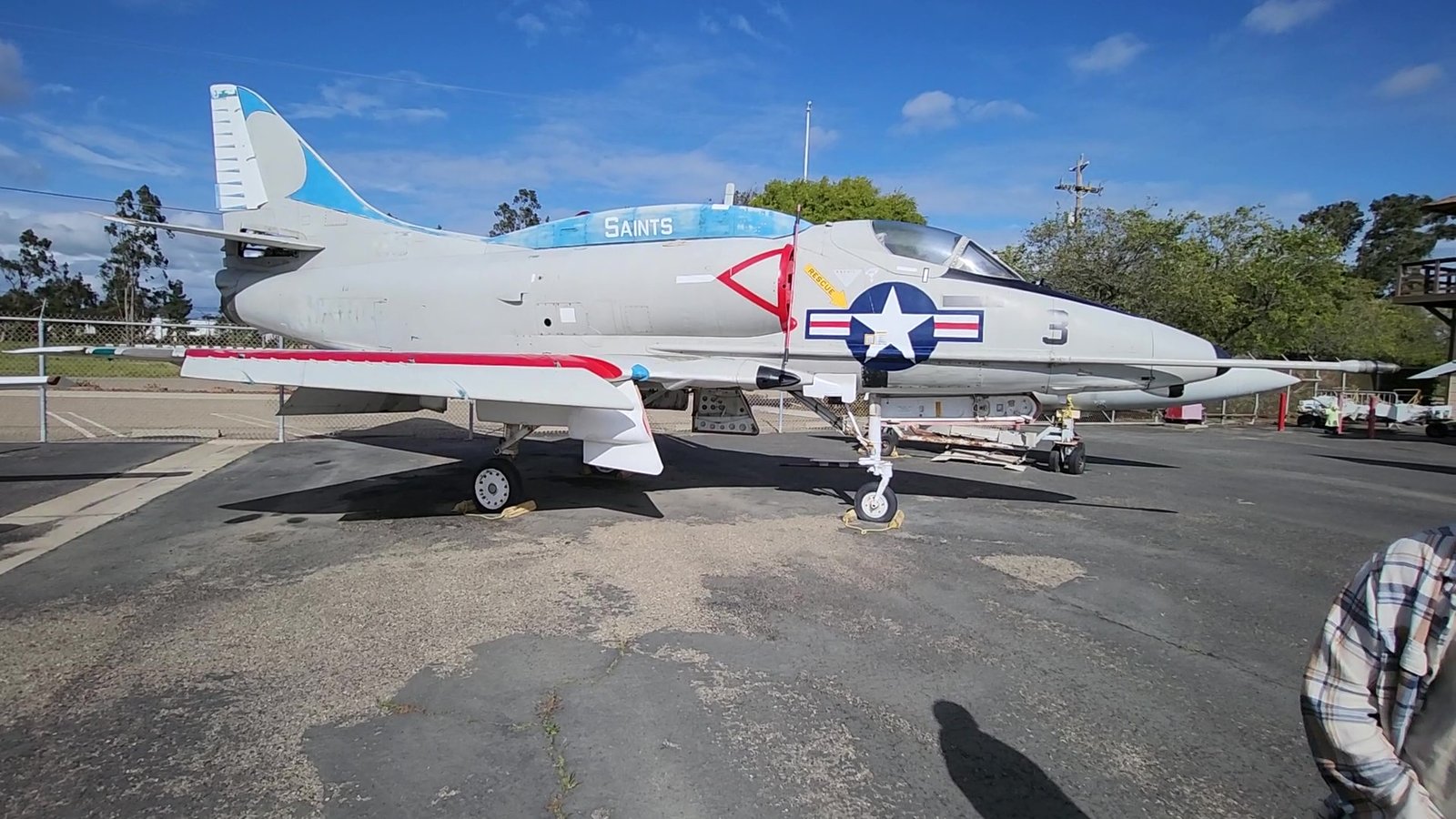
Outside, a huge F-4S Phantom II sits across from a A-4D Skyhawk, both made by McDonnell Douglas and both facing down the Czech Aero L-29 Delphin jet trainer. Inside the second hanger you’ll find a beautifully restored Folland/Hawker Siddeley Gnat – another gorgeous little trainer.

In fact, the more you look at the Santa Maria Museum of Flight, the more surprises you’ll find, like this Link Trainer. And like the flag that actually belonged to a World War II Japanese aviator. 

It’s a fun little museum, jam-packed with fascinating memorabilia that is sure to delight the entire family.

Here’s a video we made of our tour.

And it’s easy to find the museum itself, at 3015 Airpark Drive. Get to the Santa Maria Airport, and head just a block or so west on Airpark.

It’s the only building that has a Phantom jet sitting outside.

They’re open Fridays and Saturdays from 10 to 4, and Sundays from 12 to 3.

Visit their website at www.smmuseumofflight.com

Marvelous Air Museums is part of the John D Reinhart content family. Writer, illustrator, videographer, and accidental filmmaker — find the whole story at JohnDReinhart.com.

©2026 John D Reinhart/MarvelousAirMuseums.com – all rights reserved

Estrella Warbirds Museum

We journeyed out through the vineyards of Paso Robles wine country to visit The Estrella Warbirds Museum, an impressive collection of vintage aircraft adjacent to the Paso Robles Municipal Airport.

Estrella packs a huge number of surprises in a relatively small footprint. Their massive collection of mostly Vietnam-era fighter jets and helicopters is augmented by their huge cache of military transport vehicles, even a great M60A-1 Patton tank, undergoing refurbishment.

If that’s not enough, there’s the Red Ball Express, a second collection of transport vehicles from World War II. And make sure and check out the Woodland automotive museum, all on the same stretch of land.

We met with author, historian, and former combat and test pilot George J. Marrett, who guided our attention through the impressive array of airplanes that he actually helped develop.

For example, there’s a F-104 here in the museum that has George Marrett’s name on it as the test pilot.

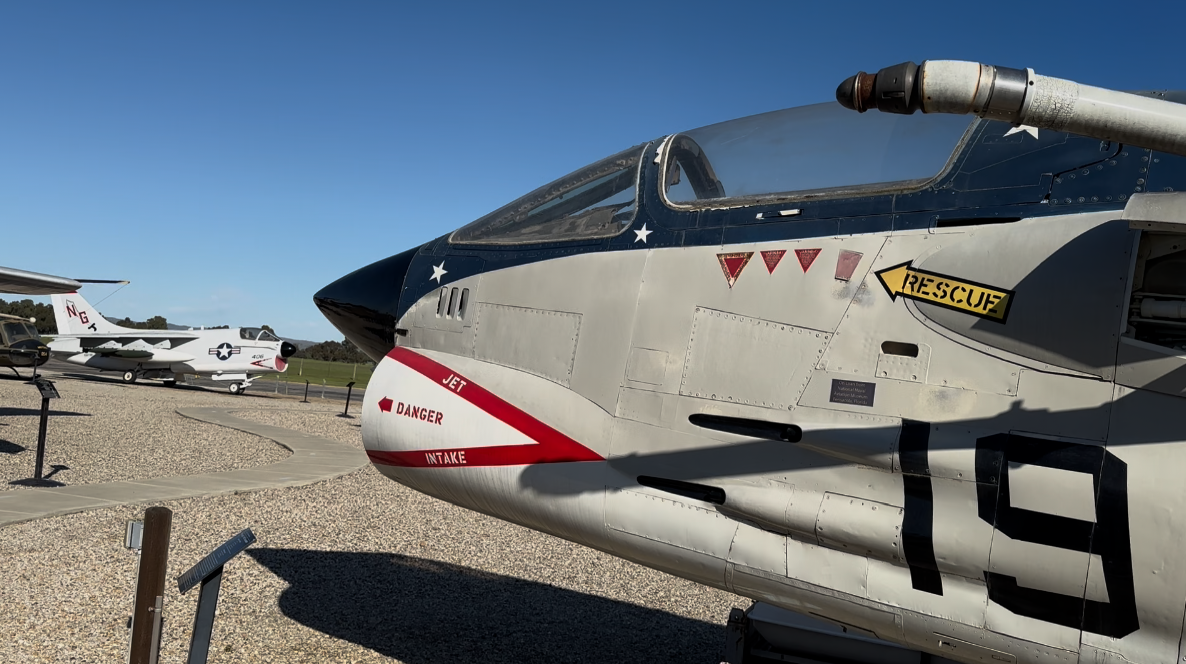
All the standards from the Vietnam War are here, from the venerable McDonnell-Douglas F-4S Phantom II to the McDonnell Douglas A4-D Skyhawk, and a Chance-Vought A7 Crusader, and a beautiful little bug-like OV-10A Bronco.

The 1980’s are represented by an F-14 Tomcat (George Marrett’s favorite), and an F-16 Falcon. There’s even an A-6 Intruder and US-2 Tracker.

You’ll also find this beautiful little Northrup F-5A Freedom Fighter.

Out on the tarmac, beyond the still-flying Douglas C-47 Gooney Bird painted in D-Day invasion stripes, sits the International Collection. Here you’ll find a Saab S-35 Draken, an Aermacchi MB326 Impala, and a sweet little Fouga CM.170 Magister.

While most of these aircraft are restored, they’re generally for ground display only. But what a grand display it is, and how wonderful to be able to touch all these iconic aircraft, side-by-side.

It’s hard to imagine it from looking at it, but the Lockheed P-2V Neptune was actually equipped to drop a nuclear bomb. These red doors covered the intakes for the jet engines. Yes, the Neptune was a JATO – jet-assisted-take-off. They closed once the plane reached a safe altitude to save gas.

Estrella is absolutely packed up with treasures, not least of all is Captain Marrett and the depth he brings to the museum.

You can read about his years as a test pilot in Contrails Over the Mojave, published by the Naval Institute Press, and in Testing Death, published by Praeger Security International, and his wild combat-rescue adventures in Cheating Death, published by Smithsonian Books.

The next time you’re in the Central Coast Wine Country, do yourself a massive favor and head over to the Paso Robles Municipal Airport, and the Estrella Warbirds Museum.  

Take Highway 46 east, get off at Airport Road, make a right on Dry Creek Road, and you’re sure to find them.

Just turn in at the A-4 Skyhawk…

Spend some time with us on our Video Tour and see just how great the Estrella Warbirds Museum is!

Marvelous Air Museums is part of the John D Reinhart content family. Writer, illustrator, videographer, and accidental filmmaker — find the whole story at JohnDReinhart.com.

©2026 John D Reinhart/MarvelousAirMuseums.com – all rights reserved

Grumman F-14 Tomcat

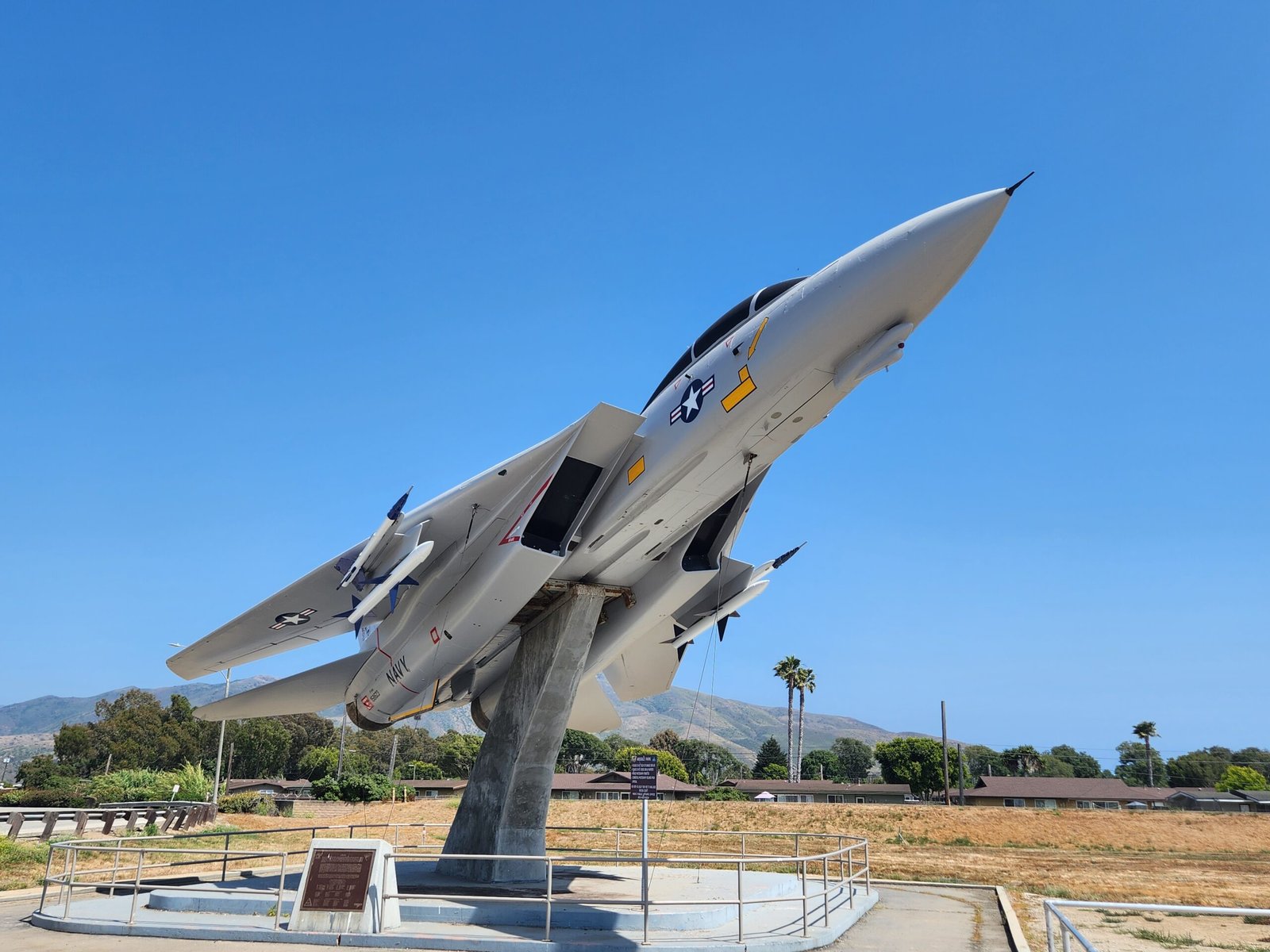
The variable-geometry F-14 Tomcat first left the ground in December of 1970, and served all the way through to September of 2006.

The big fighter took it’s first tour aboard the USS Enterprise in 1974, replacing the wing of aging F-4 Phantoms. The twin-engine, supersonic, two seat carrier fighter was a natural match for the Phantom’s role as air superiority, ground attack, and reconnaissance airframe.

The unique variable-geometry wing system, first developed for the General Dynamics F-111, sweeps the wings forward for more lift during take-off and landing, and then pulls them in close to the fuselage for supersonic flight.

According to test pilot George J. Marrett, the Tomcat was far and away his favorite airplane. He’s credited with the first-ever “supersonic missile kill,” having fired a missile from an F-14 while above Mach-1

The air-to-air missile sped away from the supersonic Tomcat, climbing as it went, to drop almost ballistically onto the target, a drone displaying the characteristics of the vaunted Mig-21. The drone never saw it coming. Both Marrett and the F-14 were credited for the kill. Neither aircraft were ever within visual range of one another.

The Tomcat provided the backbone for the US Navy through the Gulf, Afghanistan, and Iraq wars, to be replaced by the nimble A/F-18 in 2006.

These images were taken at the Point Mugu Missile Park in Port Hueneme, CA, and Estrella Warbirds Museum in Paso Robles.

Marvelous Air Museums is part of the John D Reinhart content family. Writer, illustrator, videographer, and accidental filmmaker — find the whole story at JohnDReinhart.com.

©2026 John D Reinhart/MarvelousAirMuseums.com – all rights reserved