Never Quote Me the Odds

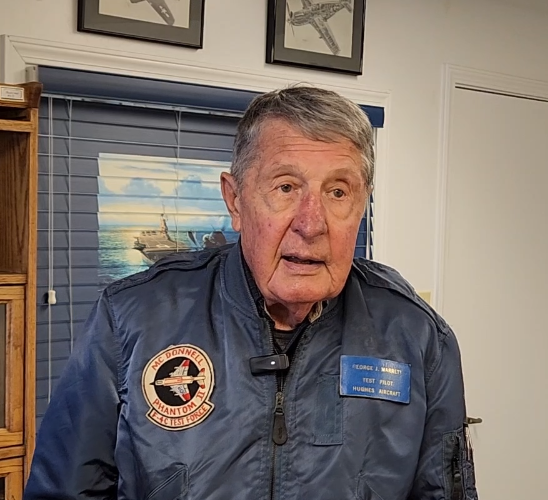
George J. Marrett is the historian at the Estrella Warbirds Museum in Paso Robles, CA. An amazing individual, he worked for Howard Hughes, has written at least half a dozen books, has test-flown nearly every jet the United States produced since World War II, flew death-defying rescue missions in Vietnam, is building homeless shelters in Paso Robles, and happens to be just about the nicest guy you’re ever going to meet.

My wife and I spent a nice trio of hours talking with him about the museum, about Howard Hughes, and about the many aircraft he’d test-flown. The man is remarkably sharp, and, at 88, still flies. He said he’d keep flying until nobody wanted to fly with him anymore.

So many of the stories he told stuck with me, but there was one in particular that I’m still pondering.

During the Vietnam war, he flew fourth position in a flight of four A-1E Skyraiders – big, propellor-driven fighter planes produced right after the end of World War II. They were slow compared to the jet fighters, but they were robust, and they carried lots of weapons.

His job, along with the other three Skyraiders, was to clear the jungle around a downed American pilot by firing at the Viet Cong soldiers intent on making a capture, so that the Huey helicopters could come in rescue him. The big fighter planes would lumber over the jungle, firing a spray of machine gun bullets at anything that moved towards the downed pilot.

The Viet Cong often fought back. In one flight, George watched the plane in front of him get hit, watched the pilot parachute away, and then actually watched the plane spiral down to crash among the trees.

“It was an amazing sight,” he grinned. He had inadvertently applied the air brakes in his own plane, called Sock It to ‘Em , and was flying too slow to be safe. But it gave him time to watch the crash.

When he returned to base, his crew chief, the guy who takes care of the plane when it’s on the ground, told him he’d been hit.

“You got a couple of bullet holes in the wheel well,” the chief said. “You wanna see ’em?”

George thought about it for a moment, and then said “No. Don’t even tell me that.”

Focus on the success, right? Let’s not recount how close we almost got to failure. His first book, the one about those rescue missions, is called Cheating Death.

That’s a profound way to look at high-risk tasks, isn’t it?

It reminds of the Star Wars line when C-3PO starts to tell Han Solo his chances of success…

“Never quote me the odds!”

Focus on where you’re going, not where you’ve been. I know George may have meant something far more profound that this, but we always apply the things we hear to ourselves, right?

So, when you’re taking a risk, and you hear that voice that starts to doubt the odds of your success, now you have an answer.

“Don’t tell me that. Never quote me the odds.”

You can learn more about the amazing George J. Marrett on Wikipedia and his many books on Amazon. And more about the impressive Estrella Warbirds Museum right here at California Air Museums.

Happy flying.

Marvelous Air Museums is part of the John D Reinhart content family. Writer, illustrator, videographer, and accidental filmmaker — find the whole story at JohnDReinhart.com.

©2026 John D Reinhart/MarvelousAirMuseums.com – all rights reserved
Santa Maria Museum of Flight

The next time you find yourself on the Central Coast, make a little time to visit the Santa Maria Museum of Flight.

Sitting at the west end of the Santa Maria City Airport tarmac, the museum occupies a pair of hangers left over from the airport’s days in the US Army Air Force.

Back then, it was not uncommon to see Lockheed P-38 Lightnings roaring overhead. Inside, you find an amazing, and flyable, half-scale Lightning that was built to honor the brave guys and gals who flew the originals. Littered around the landing gear are the remains of some Lightnings that didn’t quite land as planned.

That’s actually one of the great things about the Santa Maria Museum of Flight – there’s a sense of history here, and also a sense of community, and a strong dose of folksy wisdom.

We met with docent Jerry Simas, who gave us a rainy tour of the museum ‘s wide-ranging collection. His laconic answer to my question about whether the half-scale Lightning could still fly was “Well, it was running when they shut it off.”

The museum was founded in 1984 to “preserve the past and present history of our aviation heritage, and inspiring future aviators in the Santa Maria Valley.”

There’s a memorial garden outside that is dedicated to the 99s – an international organization of woman aviators, mechanics, and innovators started in 1929 that is open to women who from over the world who love to fly. 

You’ll find that the museum is packed with surprises, from dioramas and models to some pieces of genuine Hollywood history, like the Hughes H-1 mockup built for the movie The Aviator. It doesn’t actually fly – doesn’t even have an engine, but it does have an electric motor that turns the propeller.  Some movie magic, there.

The 1991 Disney adventure film The Rocketeer was filmed right there, too. You’ll recognize the hanger, the runway outside, and of course, the Rocketeer’s iconic rocket-powered suit.

And up there is the Phoenix, a fictitious single-engine rescue plane built from the wreckage of a crashed Fairchild C-119 Flying Boxcar, made for the 2004 movie Flight of the Phoenix, with a miniature Dennis Quaid at the Controls. This is the model that was actually used in the film.

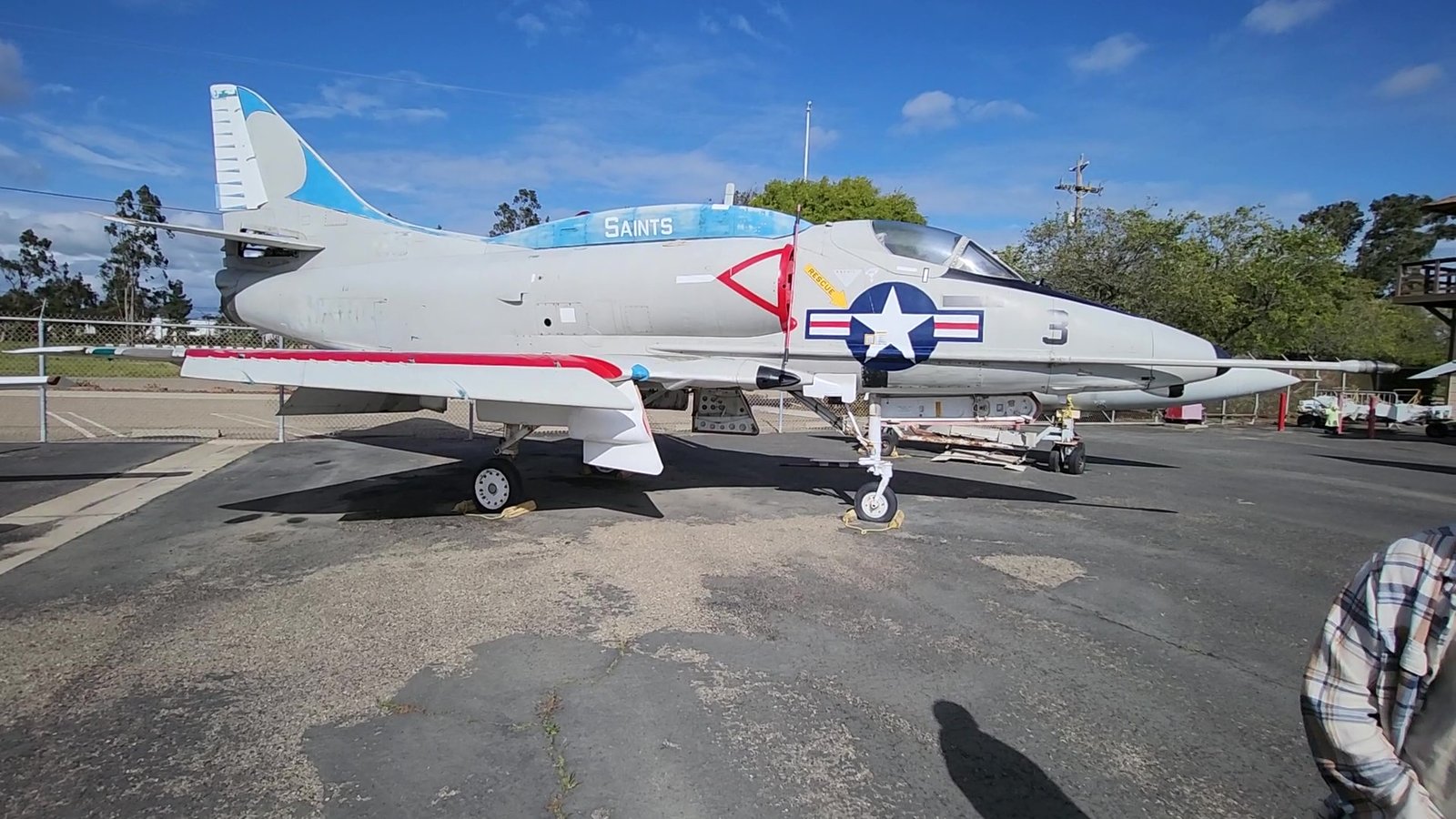
Outside, a huge F-4S Phantom II sits across from a A-4D Skyhawk, both made by McDonnell Douglas and both facing down the Czech Aero L-29 Delphin jet trainer. Inside the second hanger you’ll find a beautifully restored Folland/Hawker Siddeley Gnat – another gorgeous little trainer.

In fact, the more you look at the Santa Maria Museum of Flight, the more surprises you’ll find, like this Link Trainer. And like the flag that actually belonged to a World War II Japanese aviator. 

It’s a fun little museum, jam-packed with fascinating memorabilia that is sure to delight the entire family.

Here’s a video we made of our tour.

And it’s easy to find the museum itself, at 3015 Airpark Drive. Get to the Santa Maria Airport, and head just a block or so west on Airpark.

It’s the only building that has a Phantom jet sitting outside.

They’re open Fridays and Saturdays from 10 to 4, and Sundays from 12 to 3.

Visit their website at www.smmuseumofflight.com

Marvelous Air Museums is part of the John D Reinhart content family. Writer, illustrator, videographer, and accidental filmmaker — find the whole story at JohnDReinhart.com.

©2026 John D Reinhart/MarvelousAirMuseums.com – all rights reserved

Estrella Warbirds Museum

We journeyed out through the vineyards of Paso Robles wine country to visit The Estrella Warbirds Museum, an impressive collection of vintage aircraft adjacent to the Paso Robles Municipal Airport.

Estrella packs a huge number of surprises in a relatively small footprint. Their massive collection of mostly Vietnam-era fighter jets and helicopters is augmented by their huge cache of military transport vehicles, even a great M60A-1 Patton tank, undergoing refurbishment.

If that’s not enough, there’s the Red Ball Express, a second collection of transport vehicles from World War II. And make sure and check out the Woodland automotive museum, all on the same stretch of land.

We met with author, historian, and former combat and test pilot George J. Marrett, who guided our attention through the impressive array of airplanes that he actually helped develop.

For example, there’s a F-104 here in the museum that has George Marrett’s name on it as the test pilot.

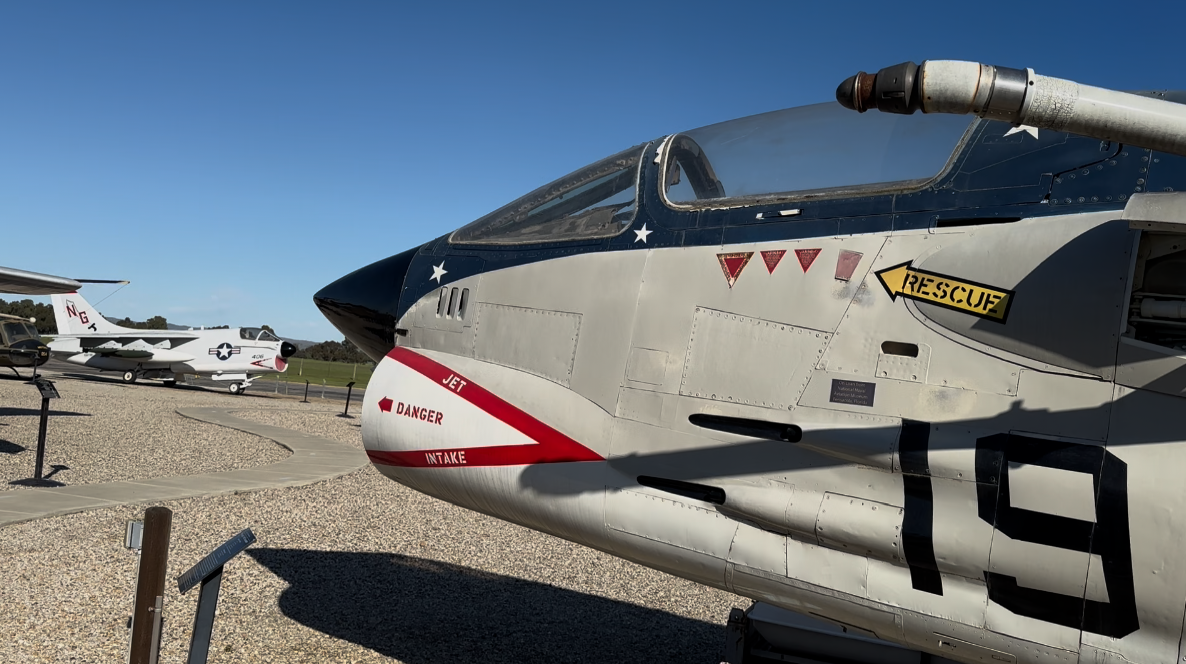
All the standards from the Vietnam War are here, from the venerable McDonnell-Douglas F-4S Phantom II to the McDonnell Douglas A4-D Skyhawk, and a Chance-Vought A7 Crusader, and a beautiful little bug-like OV-10A Bronco.

The 1980’s are represented by an F-14 Tomcat (George Marrett’s favorite), and an F-16 Falcon. There’s even an A-6 Intruder and US-2 Tracker.

You’ll also find this beautiful little Northrup F-5A Freedom Fighter.

Out on the tarmac, beyond the still-flying Douglas C-47 Gooney Bird painted in D-Day invasion stripes, sits the International Collection. Here you’ll find a Saab S-35 Draken, an Aermacchi MB326 Impala, and a sweet little Fouga CM.170 Magister.

While most of these aircraft are restored, they’re generally for ground display only. But what a grand display it is, and how wonderful to be able to touch all these iconic aircraft, side-by-side.

It’s hard to imagine it from looking at it, but the Lockheed P-2V Neptune was actually equipped to drop a nuclear bomb. These red doors covered the intakes for the jet engines. Yes, the Neptune was a JATO – jet-assisted-take-off. They closed once the plane reached a safe altitude to save gas.

Estrella is absolutely packed up with treasures, not least of all is Captain Marrett and the depth he brings to the museum.

You can read about his years as a test pilot in Contrails Over the Mojave, published by the Naval Institute Press, and in Testing Death, published by Praeger Security International, and his wild combat-rescue adventures in Cheating Death, published by Smithsonian Books.

The next time you’re in the Central Coast Wine Country, do yourself a massive favor and head over to the Paso Robles Municipal Airport, and the Estrella Warbirds Museum.  

Take Highway 46 east, get off at Airport Road, make a right on Dry Creek Road, and you’re sure to find them.

Just turn in at the A-4 Skyhawk…

Spend some time with us on our Video Tour and see just how great the Estrella Warbirds Museum is!

Marvelous Air Museums is part of the John D Reinhart content family. Writer, illustrator, videographer, and accidental filmmaker — find the whole story at JohnDReinhart.com.

©2026 John D Reinhart/MarvelousAirMuseums.com – all rights reserved

Point Mugu Missile Park Image Gallery

Museum visit review

Museum video

Home

Marvelous Air Museums is part of the John D Reinhart content family. Writer, illustrator, videographer, and accidental filmmaker — find the whole story at JohnDReinhart.com.

©2026 John D Reinhart/MarvelousAirMuseums.com – all rights reserved

Mojave Air Museum Legacy Park Image Gallery

Museum visit review

Museum Video

Home

McDonnell Douglas F-4 Phantom II

The McDonnell Douglas F-4 Phantom II first took to the skies in 1959. Right off the runway, it set 15 world records, including absolute speed and absolute altitude.

The big, twin-engine fighter’s history is inextricably linked with the Vietnam War, in which it played a critical role for the United States Air Force, Marine Corps, and the Navy. It performed air superiority, ground attack, and even reconnaissance functions for all three services.

The 41-ton Phantom soldiered on after the Vietnam War, providing air superiority throughout the Cold War. In fact, the F-4 went on to provide suppression of enemy air defenses during the Gulf War.

The Mach-2 fighter was finally retired in 1996, being replaced by the more modern F-14 Tomcat, F-16 Eagle, and F-16 Fighting Falcon.

The importance and ubiquity of the F-4 cannot be overstated, perhaps best illustrated that you’ll find one is almost every air museum in California.

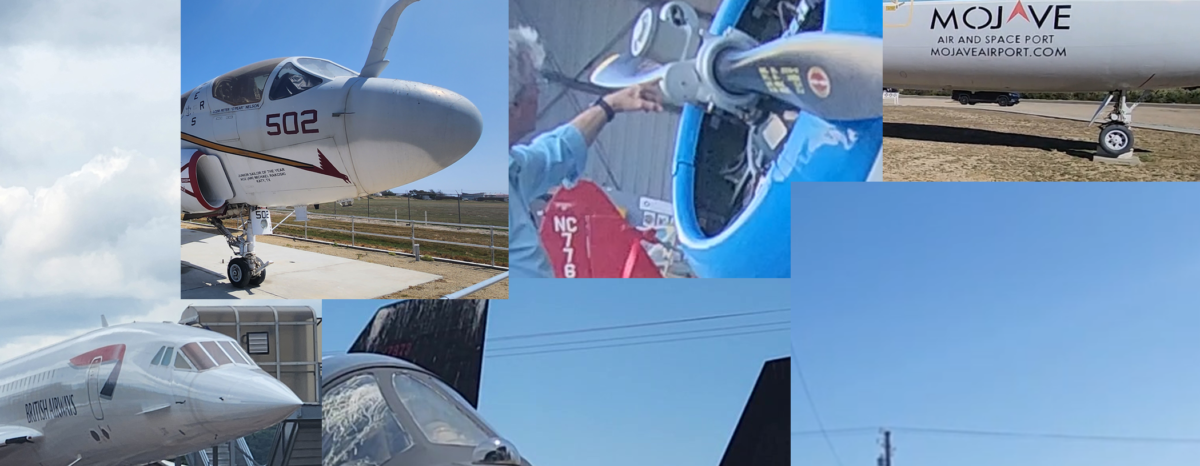
These images were taken at the Point Mugu Missile Park in Port Hueneme, CA, Estrella Warbird Museum in Paso Robles, Santa Maria Museum of Flight in Santa Maria, and at the Mojave Air Museum Legacy Park in Mojave, CA.

Marvelous Air Museums is part of the John D Reinhart content family. Writer, illustrator, videographer, and accidental filmmaker — find the whole story at JohnDReinhart.com.

©2026 John D Reinhart/MarvelousAirMuseums.com – all rights reserved

Mojave Air Museum Legacy Park

Just off of the 14 Freeway, near where the 58 crosses it, you’ll find the Mojave Air Museum Legacy Park.

It’s not a huge museum by any means, but has an easy charm that makes it a must-see if you’re on your way up to Bishop, or heading out to Las Vegas.

Actually, there are TWO museums in the Mojave Air and Space Port. First is the trio of historic aircraft parked right at the main entrance. Beyond them, closer to the airport’s Administration Building, is another, smaller museum that features a composite scale model of Virgin Galactic’s Space Ship One and the Rotary Rocket Roton ATV, the first rocket to lift off from the Mojave Air and Space Port.

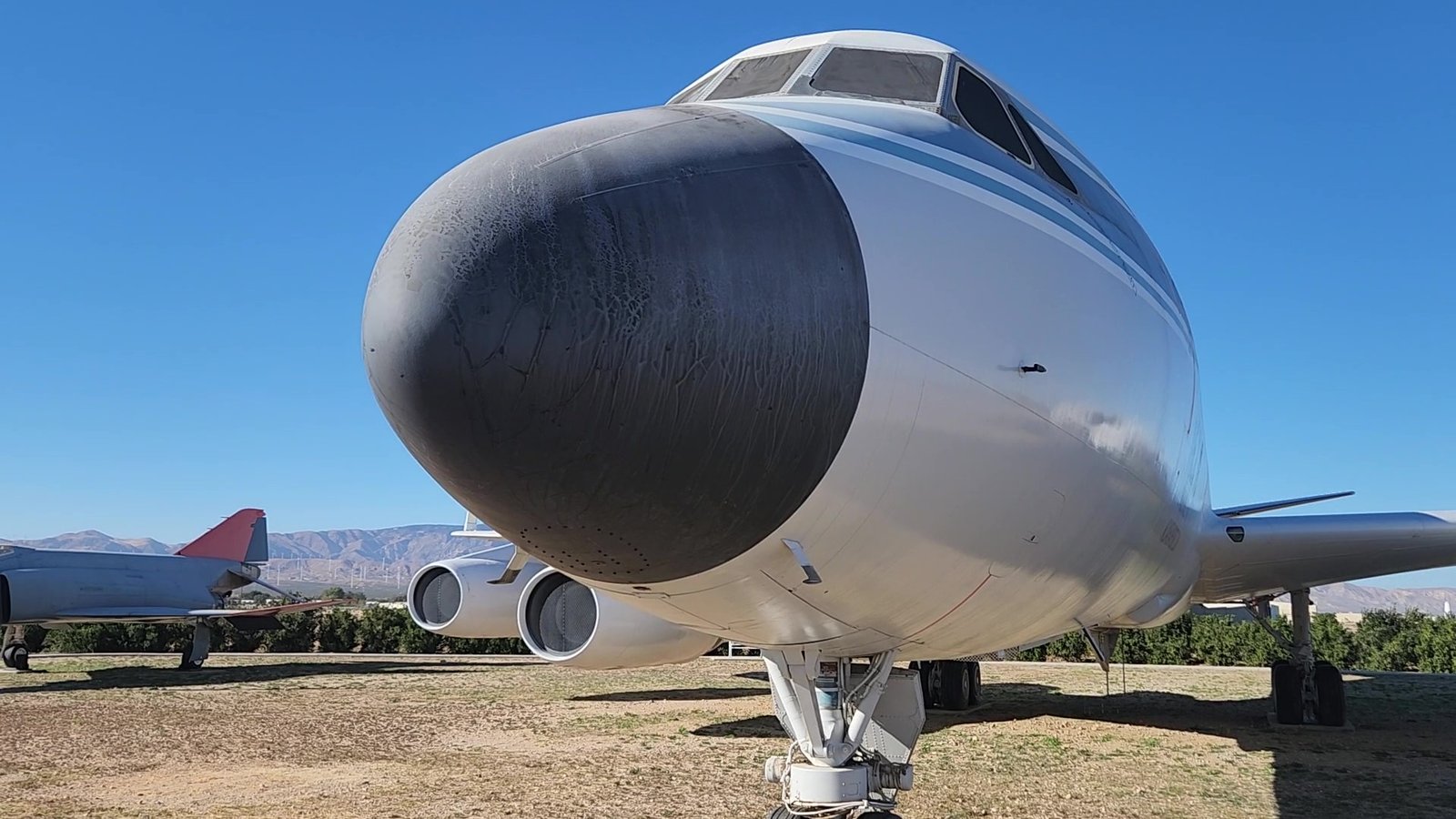
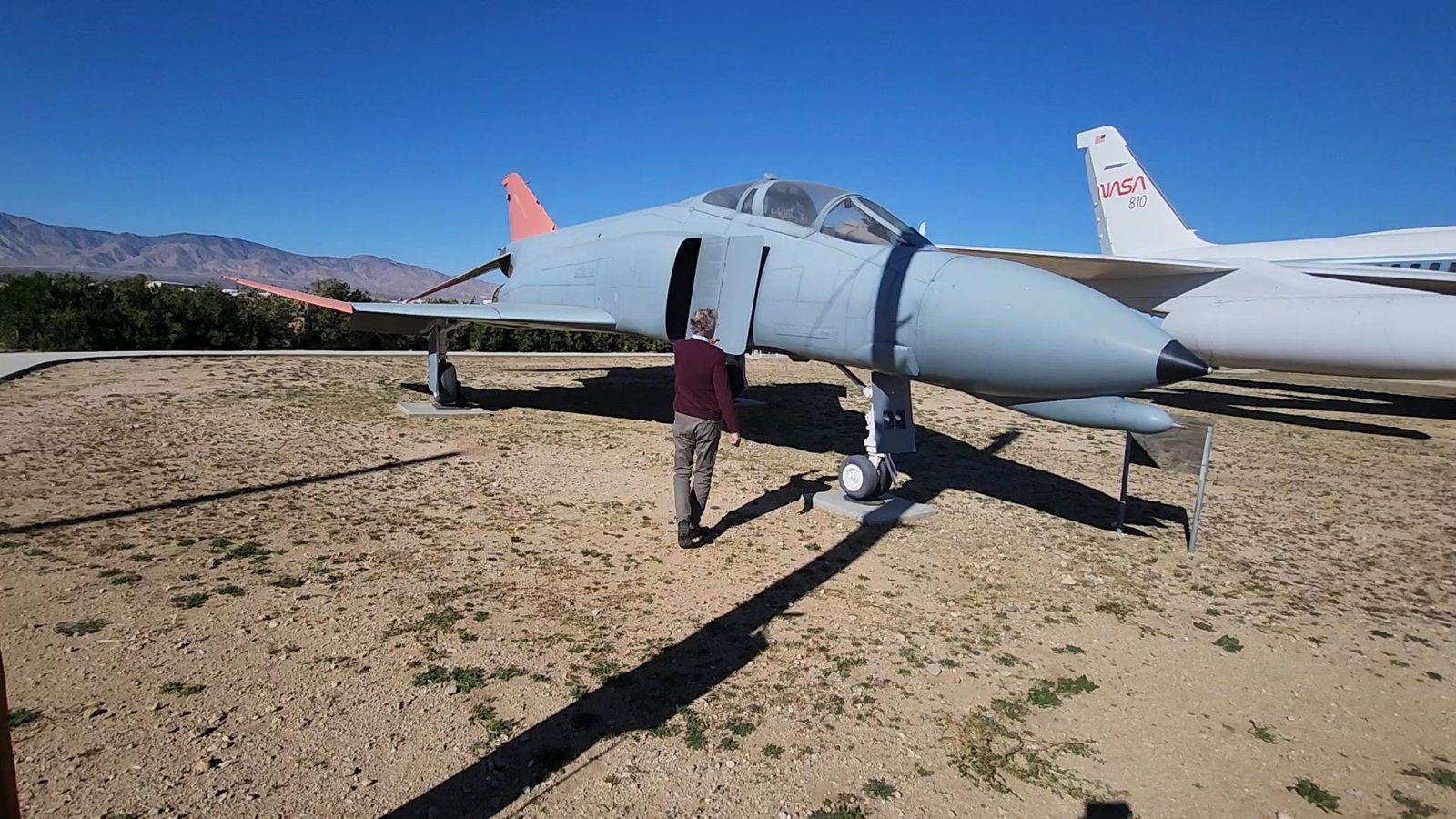
We were more interested in the first museum, which features a Convair CV990 Coronado, a McDonnell/Douglas F4 Phantom II, and a Saab T-35 Drakken.

Your tour here is entirely self-guided, and the only prohibition is to not climb on the aircraft. What makes it a great visit is that you can actually touch these pieces of aviation history.

As for history, the CV990 was used to test the main landing gear for the Enterprise space shuttle. There’s a huge seemingly iron-bound cavity in the center of the lower fuselage in which the landing gear system once sat. It is most impressive.

The F4 Phantom began her life in Missouri in 1964, and spent most of it doing hard duty in Vietnam. She was transferred out to Edwards, and retired to this museum, in the mid-1980s.

What makes her so interesting – and once you look, you’ll find all sorts of fascinating details – is that she had been converted to a drone before she was retired. The rearview mirror still sits on the canopy bow, but there are no ejection seats visible through the cockpit canopy.

The Saab T-35 was a trainer during her active days. The intakes, flared at the front and then pinched in below the cockpit, make her look menacing, and supremely aerodynamic. She has what looks like a periscope, comic in its binocular stare over the front cockpit, faired into the canopy bow.

Like the other two jets, the Drakken is available for you to touch and examine and pose for selfies with.

All three of the aircraft appear to be in very good shape – the Coronado still has its engines. They are free from graffiti, although someone was able to slip a small band sticker way up high on the Phantom’s fuselage, right below the fuel ditch port. The little park is well maintained, and even features some benches along the concrete walkways that surround the planes.

You can find this great little museum right at the entrance to the Mojave Air and Space Port, at 1434 Flight Line, in Mojave.

Marvelous Air Museums is part of the John D Reinhart content family. Writer, illustrator, videographer, and accidental filmmaker — find the whole story at JohnDReinhart.com.

©2026 John D Reinhart/MarvelousAirMuseums.com – all rights reserved

Point Mugu Missile Park

Naval Air Road, Port Hueneme, CA

This free air and space museum is easy to find, easy to get to, easy to get in and out of, and, well, genuinely easy.

The museum is quite small, containing just three aircraft and a fascinating assortment of air-to-air, air-to-surface, and surface-to-air missiles.

The three aircraft are quite impressive, not only for what they are, but also for how they are displayed.

McDonnel Douglas F4J Phantom

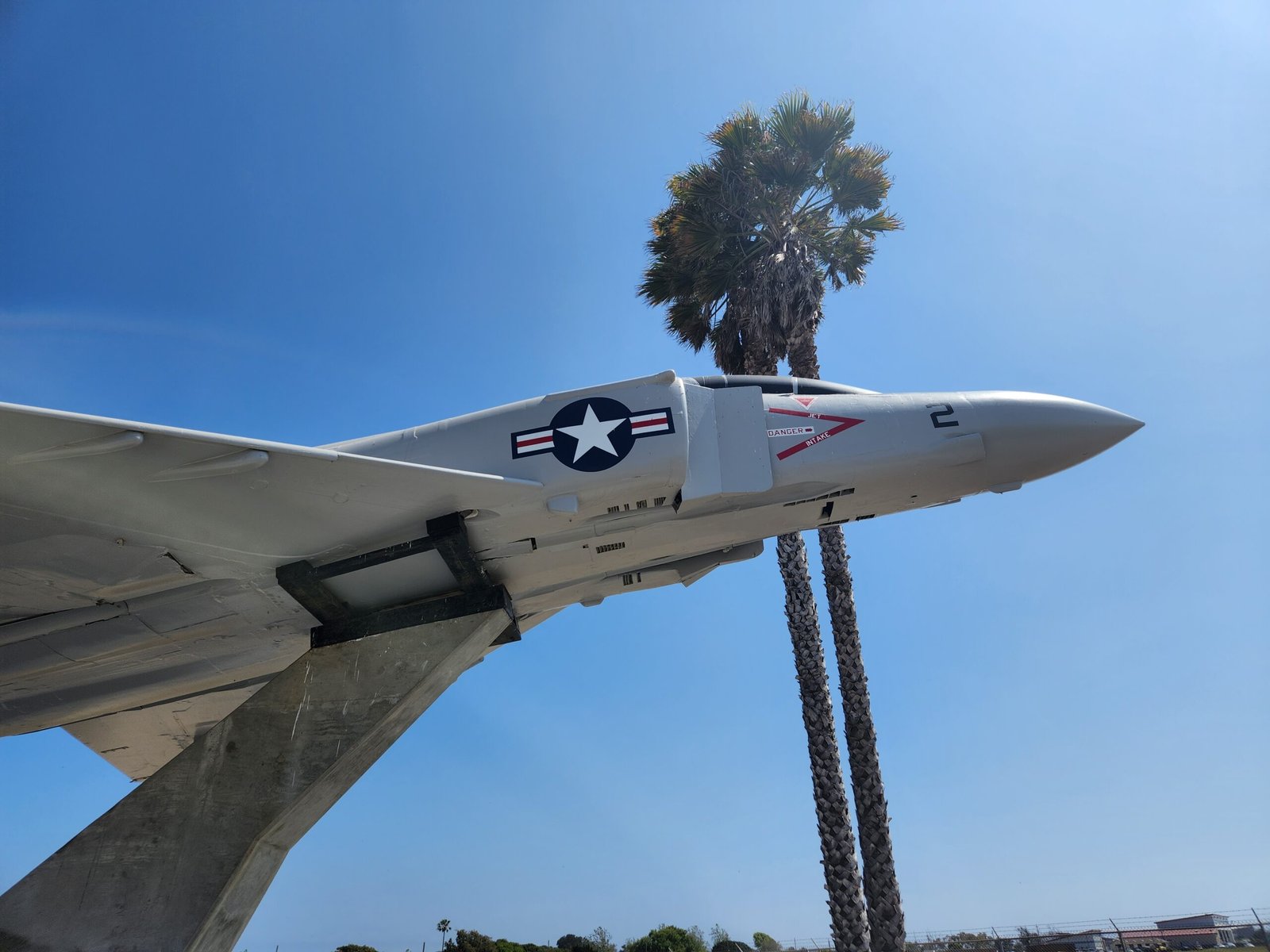
The F4J Phantom was the first airplane to show up at the museum and has been on display there for well over a dozen years. She’s mounted atop a ten-foot-tall pylon, looking like she’s heading out to sea on a mission over Vietnam.

Tail number 157259 was built in St. Louis in November of 1969 and joined the Navy on December 12. She appears to have served her naval days at Pensacola Naval Base until 1986, when she was transferred to Point Mugu Naval Base.  She was transferred to her current location in 1992.

Despite her blacked-out canopy and empty engine bays, she makes a striking and deep impression. The sheer size of the airframe, when balanced above you, is truly stunning.

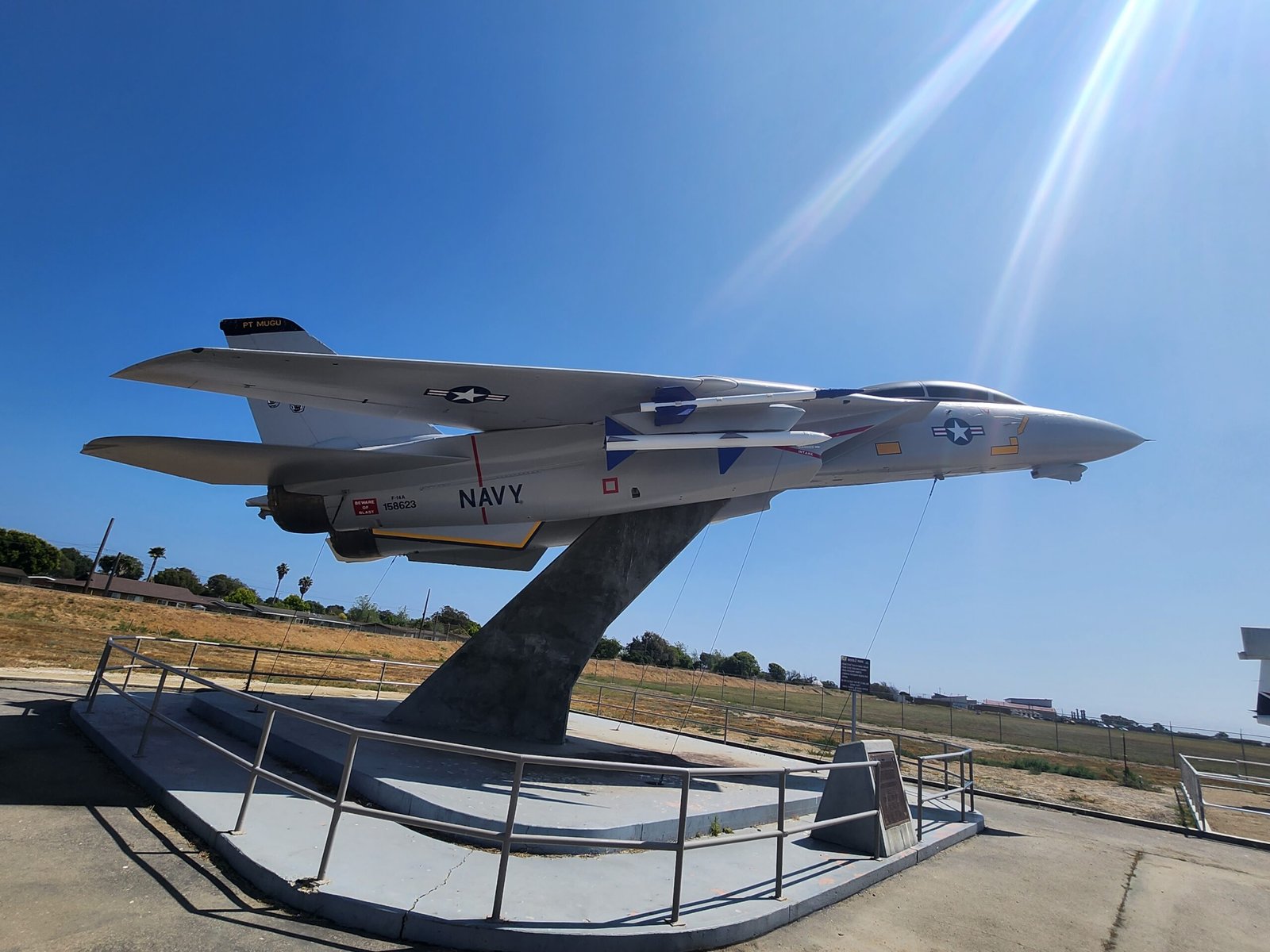
Grumman F-14 Tomcat

Build number 158623 joined the PMMP fleet in 2021, having served the majority of her career right here in Southern California. Built at the Grumman factory in Bethpage, NY, in 1971, she officially joined the Navy in 1973.

Here work here in California included a stint at Miramar in the combat traininng squadron. She was subsequently transferred to Point Mugu where she was reconfigured to provide evaluation data on the F-14 airframe itself.

Like the Phantom, her intakes betray empty engine bays, and her canopy is blacked out. But nothing detracts from her impression as a huge and powerful combat weapon.

Grumman EA-6B Prowler

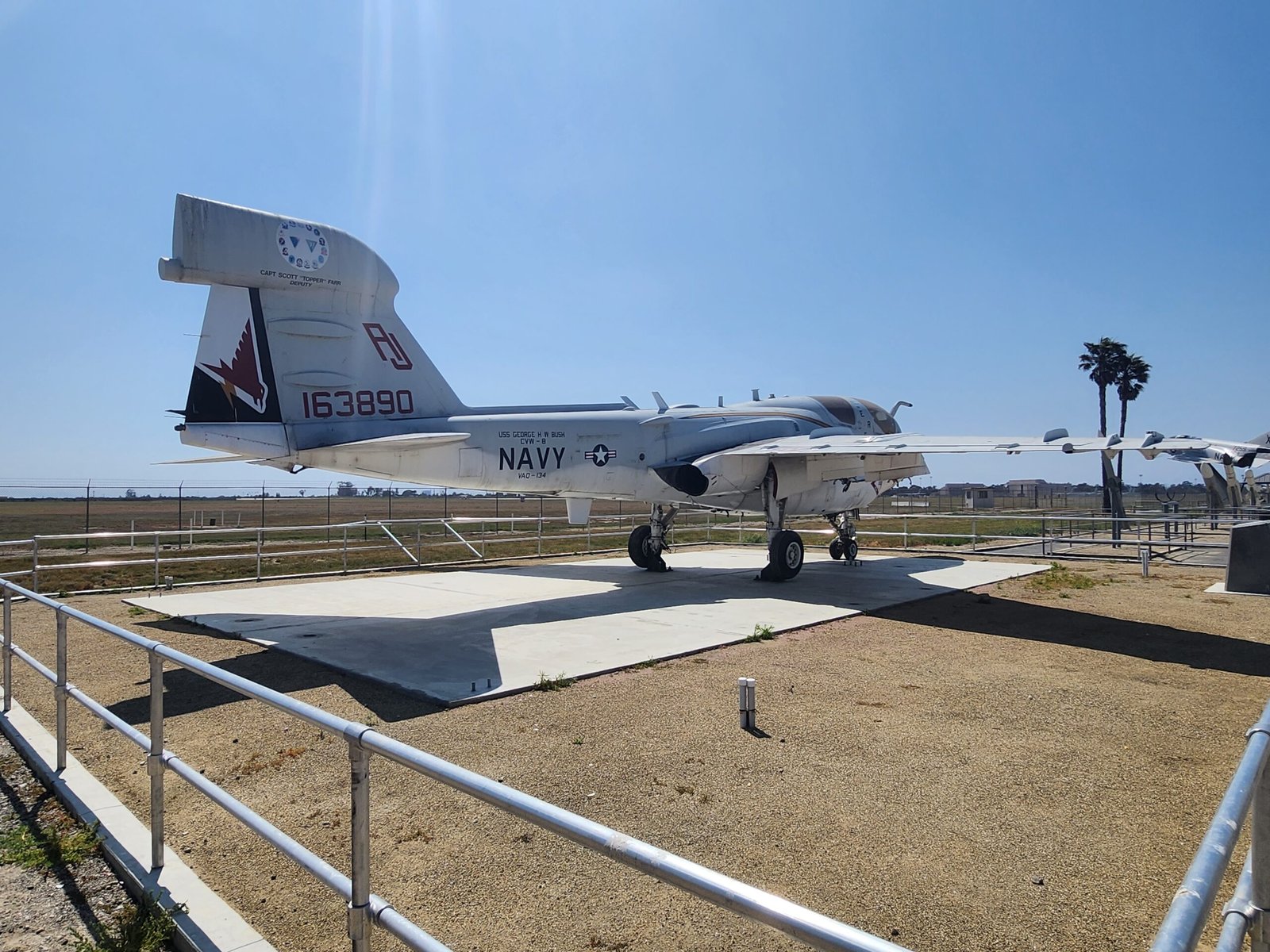
Unlike the other birds, this four-seat ELINT aircraft sits firmly on her own landing gear.  Her canopies are still clear, allowing you to see the cockpit coaming and ejection seats inside. Like the other aircraft, here engine bay is empty. But there is no block in either the tail cone or the intakes, so you can look right down the length of the inside of the aircraft.

This particular airframe, 163890, served in Qatar in 2018, and was the very last of the EA-6Bs to be flown. The sides of the fuselage are littered with the names and callsigns of dozens of the brave crew that flew in her throughout her career.
How to Get to the Museum

The Point Mugu Missile Park is unfenced and open air, meaning that it never closes.

Take Highway 1 either South from Oxnard or North from Malibu. You’ll be able to see the park from the freeway.

Take the Wood Road offramp. The park is west of the freeway – you literally can’t miss it. The museum is actually on Naval Air Road, near the entrance to Naval Base Ventura County.

Bring your camera and prepare to be blown away by these three impressive aircraft, and the dozens of missile displays at this free air and space museum.

Marvelous Air Museums is part of the John D Reinhart content family. Writer, illustrator, videographer, and accidental filmmaker — find the whole story at JohnDReinhart.com.

©2026 John D Reinhart/MarvelousAirMuseums.com – all rights reserved